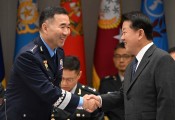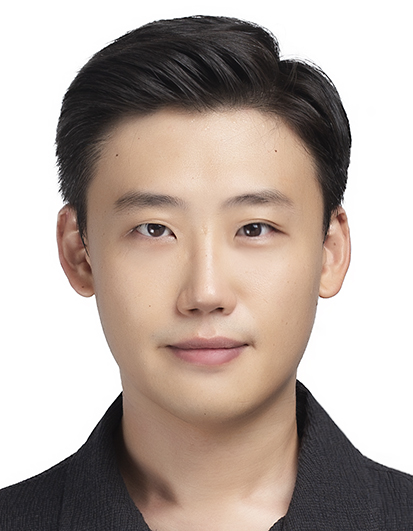


Ruling Democratic Party of Korea chair Rep. Jung Chung-rae's proposal to merge with a minor opposition party appears to be falling short of its target, drawing lukewarm responses from the Rebuilding Korea Party and backlash within his own party.
A similar move by the main opposition People Power Party to form a right-wing coalition also appears to have received a cold shoulder from the minor conservative Reform Party.
All eyes are on which political resources these major parties can leverage to join hands with like-minded fledgling parties, and whether these coalitions could mobilize more voters.
On Thursday, Democratic Party chair Jung proposed a merger with the Rebuilding Korea Party, in a plan that would increase the ruling party's parliamentary seats to 174 in the 300-member National Assembly.
Jung said there was no reason for the two parties to compete with each other in the June local election, given that both parties closed ranks to overcome ex-President Yoon Suk Yeol's martial law imposition, adding that the merger will drive the success of the liberal Lee Jae Myung administration.
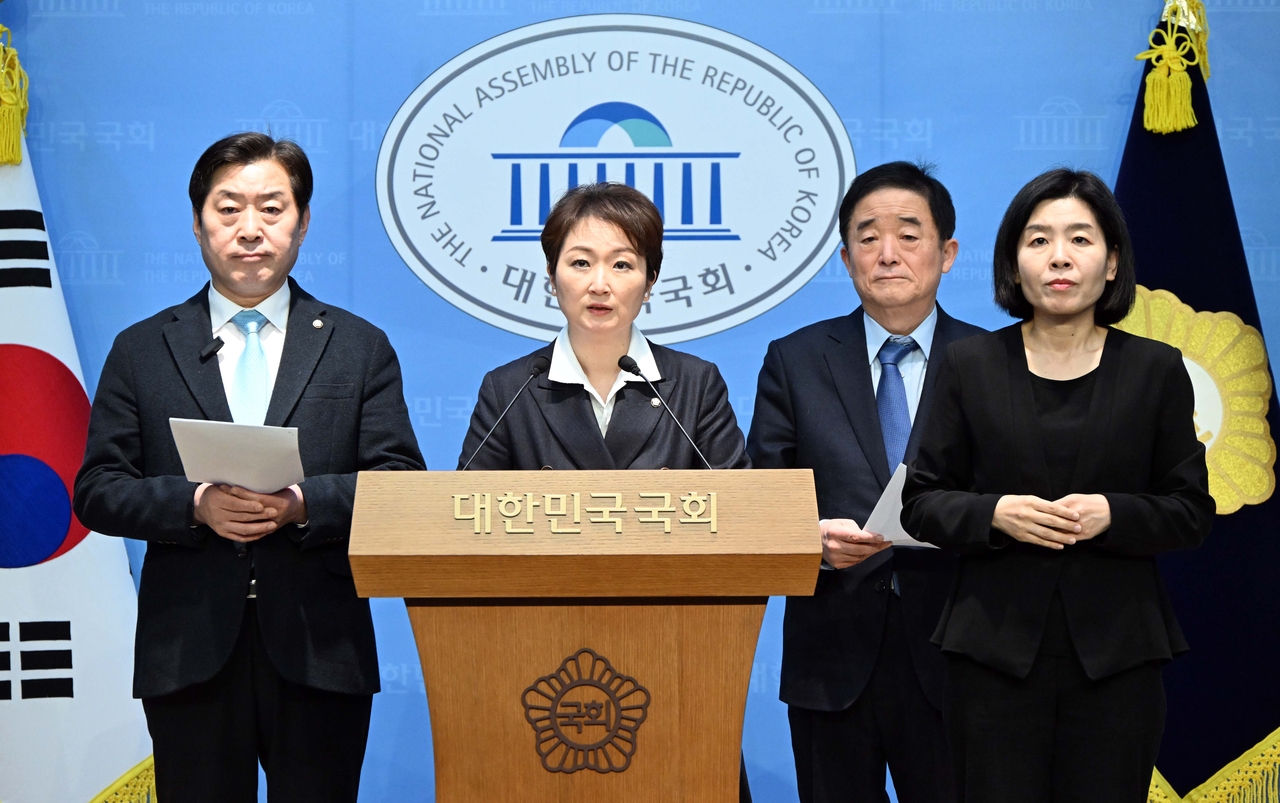
Jung's proposal was met with opposition from three members of the party's nine-seat supreme council.
The opposing supreme council members — Reps. Hwang Myeong-seon, Kang Deuk-gu and Lee Un-ju — were absent from the supreme council meeting in North Chungcheong Province on Friday, opting to hold a separate press conference in Seoul.
At the press conference, they said the proposed left-wing merger was not discussed with ruling party members and had "triggered internal confusion, mistrust and conflict" in the party, denouncing Jung's unilateral push while leaving most party members ostracized.
They demanded an apology from Jung, the disclosure of his decision-making process, and measures to prevent a party chair from making decisions unilaterally.
This echoed a joint statement by 28 first-term lawmakers of the party on Friday that said there had been no formal attempt to collect opinions on the party's merger plan, and that Jung's proposal, therefore, "lacks procedural legitimacy."
Rebuilding Korea Party chair Cho Kuk has maintained a cautious stance, even after he convened a general assembly of party lawmakers on Saturday.
"The vision, the guiding spirit and the genetic identity of the Rebuilding Korea Party should not disappear at any cost," Cho said Saturday.
Cho declined to express his personal view on the merger proposal, adding that his party's official stance should follow the Democratic Party's once it addresses its internal feud.
Rep. Jo Seoung-lae, secretary general of the Democratic Party, said the party will begin collecting internal opinions in accordance with the law and the party's internal regulations, adding that the Rebuilding Korea Party's response Saturday was a gesture of goodwill.
Jo also said the merger will take effect "within two months," and the merged party will be named the Democratic Party while preserving the fundamental identity of the Rebuilding Korea Party.
On the other hand, the right-wing minor Reform Party has continued to downplay speculation that it could form a coalition with the main opposition People Power Party.
The People Power Party and the Reform Party have coordinated on special counsel bills in an apparent bid to target liberal party lawmakers, but they have differed on the formation of a coalition.
The People Power Party chair, Rep. Jang Dong-hyeok, hinted at "a broader coalition" with other parties to win the election in a Dec. 7 speech apologizing for the crisis caused by former President Yoon's declaration of martial law.
Reform Party chair Rep. Lee Jun-seok, who was estranged from the People Power Party in 2022 while he was chairing the then-ruling party during Yoon's tenure, said in a radio interview Thursday that there was no reason for his party to join forces with the People Power Party, based on his observation that the major conservative party tilted toward the far right.
Its floor leader Rep. Chun Ha-ram echoed the party chair's stance on Friday, saying in a radio interview that his party was "unlikely to succumb to the pressure" from the People Power Party to merge with it.
consnow@heraldcorp.com