
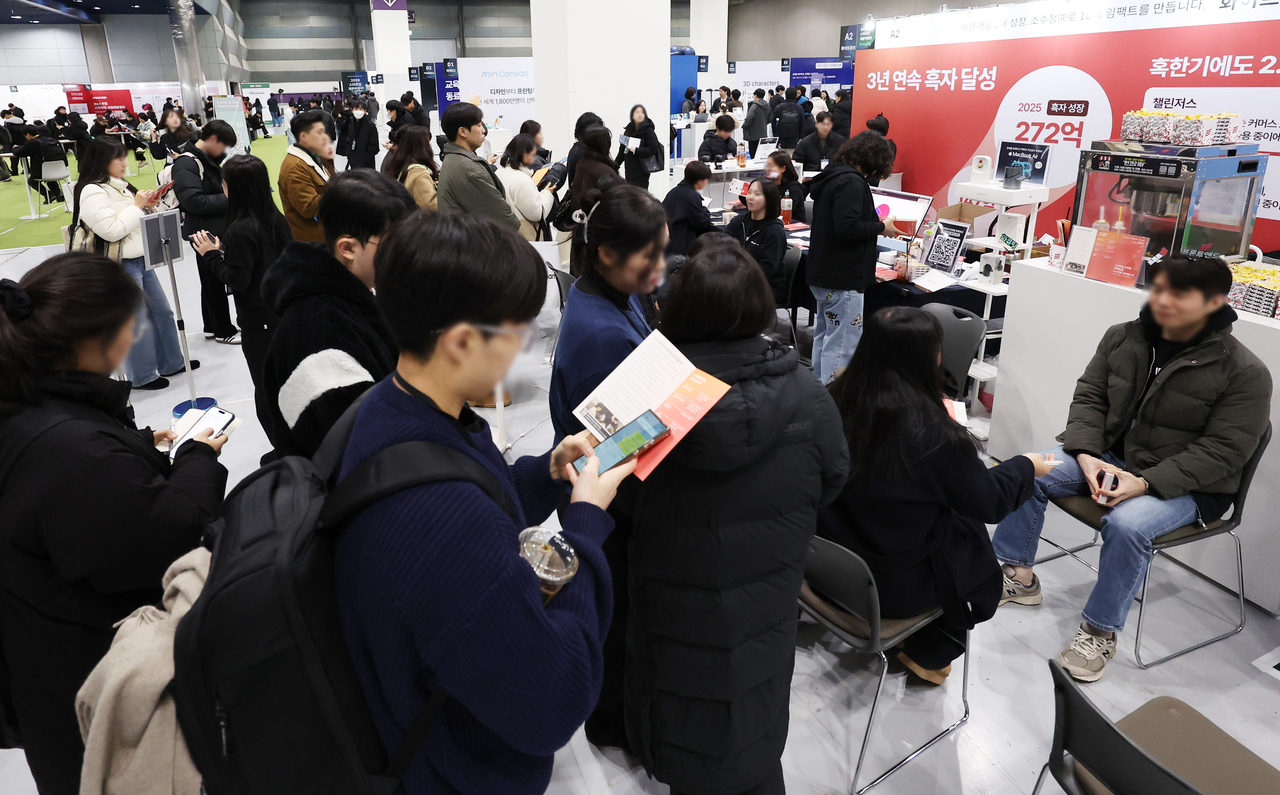
Data released Sunday showed that the employment rate gap last year between college graduates majoring in the humanities and those in natural sciences fell below 5 percentage points, marking the narrowest difference in the past decade.
According to data released by Jongno Hagwon, a major college entrance preparatory academy, the employment rate among humanities graduates stood at 59.9 percent in 2025, while natural science majors recorded an employment rate of 63.3 percent.
The gap, at 3.4 percentage points, was the smallest in 10 years, dropping by 1.7 percentage points from 5.1 percentage points in 2024. The gap has been consistently closing since peaking at 6.9 percentage points in 2019.
The narrowing trend was especially pronounced in Seoul, where most of the country’s elite higher education institutions are located. Among 43 universities located in the capital, the employment rate gap fell to 1.5 percentage points, while regional universities posted a wider gap of 5.2 percentage points.
By institution, Sogang University recorded the highest employment rate among humanities majors at 73.4 percent, followed by Seoul National University at 70.3 percent and Korea University at 69.4 percent.
Among natural science majors, Sungkyunkwan University posted the highest employment rate at 74.0 percent, followed by Sogang University at 72.5 percent and Hanyang University at 72.1 percent.
“The gap between humanities and natural science majors has narrowed as humanities students are increasingly able to pursue double majors,” said Lim Seong-ho, CEO of Jongno Hagwon.
“Moreover, the current preference for math and science majors could shift as we enter the age of AI and see growing demand for convergent talent spanning both humanities and natural sciences,” he said.
Meanwhile, the employment rate gap between universities in Seoul and regional institutions also narrowed to 5.2 percentage points, the lowest level in six years.
Regional universities recorded an employment rate of 59.9 percent, compared with 65.1 percent for universities in Seoul.
Lim attributed the narrowing gap to a relative decline in employment among graduates from universities in Seoul.
“The gap could narrow further as graduates from regional universities gain better employment opportunities at public enterprises and companies based in the regions (outside Seoul),” Lim said.
“This trend is also reflected in application patterns for regional and Seoul-based universities in the 2026 academic year.”
seungku99@heraldcorp.com