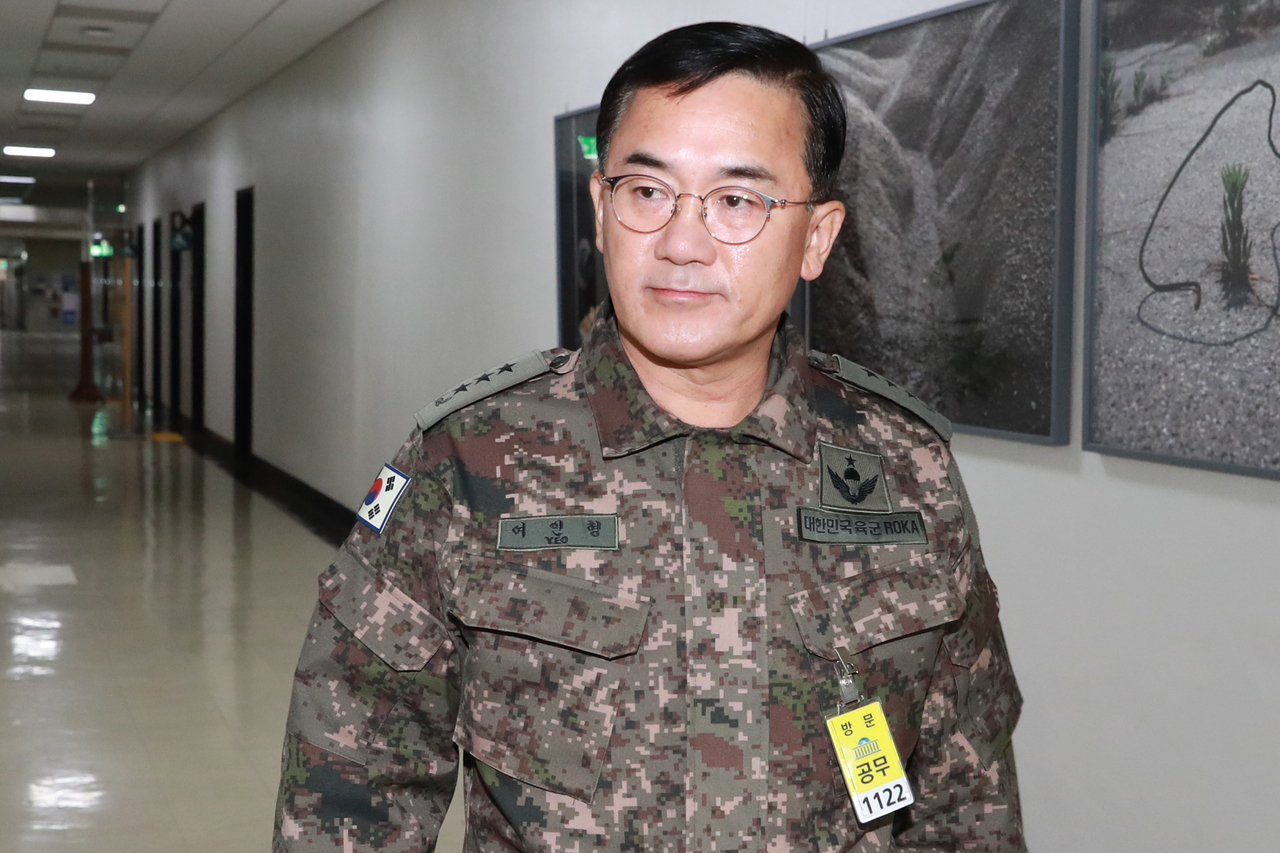
Former counterintelligence chief Yeo In-hyeong’s role in the developments leading up to the declaration of martial law in December 2024 meets the criteria for treason-related charges, according to a Defense Ministry document submitted Thursday to a ruling party lawmaker.
According to a disciplinary decision obtained by Rep. Choo Mi-ae of the Democratic Party of Korea, the Defense Ministry’s military disciplinary committee determined that Yeo — then commander of the Defense Counterintelligence Command — conspired with former President Yoon Suk Yeol and former Defense Minister Kim Yong-hyun to plan multiple drone infiltration operations into North Korea.
The committee found that between Oct. 3 and Nov. 19, 2024, a total of 18 military drones were deployed in 11 separate operations to drop leaflets over North Korean cities, including Pyongyang, Wonsan, Kaesong and Nampho. The operations began with the launch of two drones from Baengnyeongdo, a South Korean island near the maritime border, on Oct. 3.
In October 2024, North Korea also claimed that South Korea had sent unmanned aerial vehicles into its territory, releasing photographs it said showed downed drones.
The disciplinary panel said Yoon, Kim and Yeo framed the drone operations as a response to North Korea’s launches of balloons carrying waste materials. The plan was relayed through then-Joint Chiefs of Staff Chair Kim Myung-soo before being carried out by the Drone Operations Command, a joint unit of the Army, Air Force and Navy.
The operation was made known to only a small number of South Korean officials and was not disclosed to frontline units, US forces or the United Nations Command, which oversees the demilitarized zone under the 1953 Korean War armistice.
The committee also found that the operation involved producing leaflets intended to undermine North Korean leader Kim Jong-un and other senior officials to “provoke North Korea into a military or quasi-military response to justify Yoon’s declaration of martial law.” The leaflets were dispersed over key areas of the North via unmanned aerial vehicles.
The committee said that the operation carried “the risk of triggering localized North Korean artillery attacks or similar actions“ that could have resulted in significant casualties and property damage.
“Because the operation was not shared with frontline units, South Korean forces would not have been able to respond promptly had a provocation occurred,” it added.
The committee said it considered additional evidence — including Yeo’s phone memos, interrogation records, testimony from senior counterintelligence officers and indictments filed by a special counsel — in determining that treason-related misconduct had been established.
Yeo was dismissed from service in late December.
Yeo, Yoon and Kim have all been indicted on treason-related charges by the special counsel, though court rulings have yet to be issued. The committee said disciplinary proceedings are distinct from ongoing criminal trials.
Separately, Yoon has also been charged as the ringleader of an alleged insurrection, for which prosecutors have sought the death penalty, while Kim faces a possible life sentence as a key participant.
flylikekite@heraldcorp.com


![[Exclusive] Ateez to return in November](https://wimg.heraldcorp.com/news/cms/2026/09/02/news-p.v1.20260902.76162fb0ba55493aad1c076f240d0750_R.jpg?type=h&h=120)