
US Treasury remarks offer brief relief, but volatility lingers
South Korean authorities said Thursday they are weighing macroprudential measures to manage capital flows, as persistent volatility in the foreign exchange market fuels concerns that a prolonged slide in the won could threaten financial stability.
“Viewed against Korea’s macroeconomic conditions, the current level of the exchange rate is not fully appropriate,” said Choi Ji-young, vice minister for international finance at the Ministry of Economy and Finance, during a press briefing Thursday. “If the measures already prepared fail to have the intended effect, authorities would have no choice but to consider macroprudential actions to restore and maintain macroeconomic stability.”
Choi’s remarks came as the won resumed its downward trend, sliding for 10 consecutive sessions to near 1,480 per dollar on Wednesday, its weakest level this year. Although the currency briefly rebounded to around 1,430 following strong verbal intervention by authorities on Dec. 24, the recovery proved short-lived, reinforcing market perceptions that policy measures so far have had limited impact.
Authorities have pointed to surging dollar demand tied to overseas investments as a key driver of the won’s weakness, and have rolled out measures including an extension of FX swap arrangements with the National Pension Service, steps to curb the fund’s overseas investments and tax incentives aimed at drawing retail investors back into domestic markets.
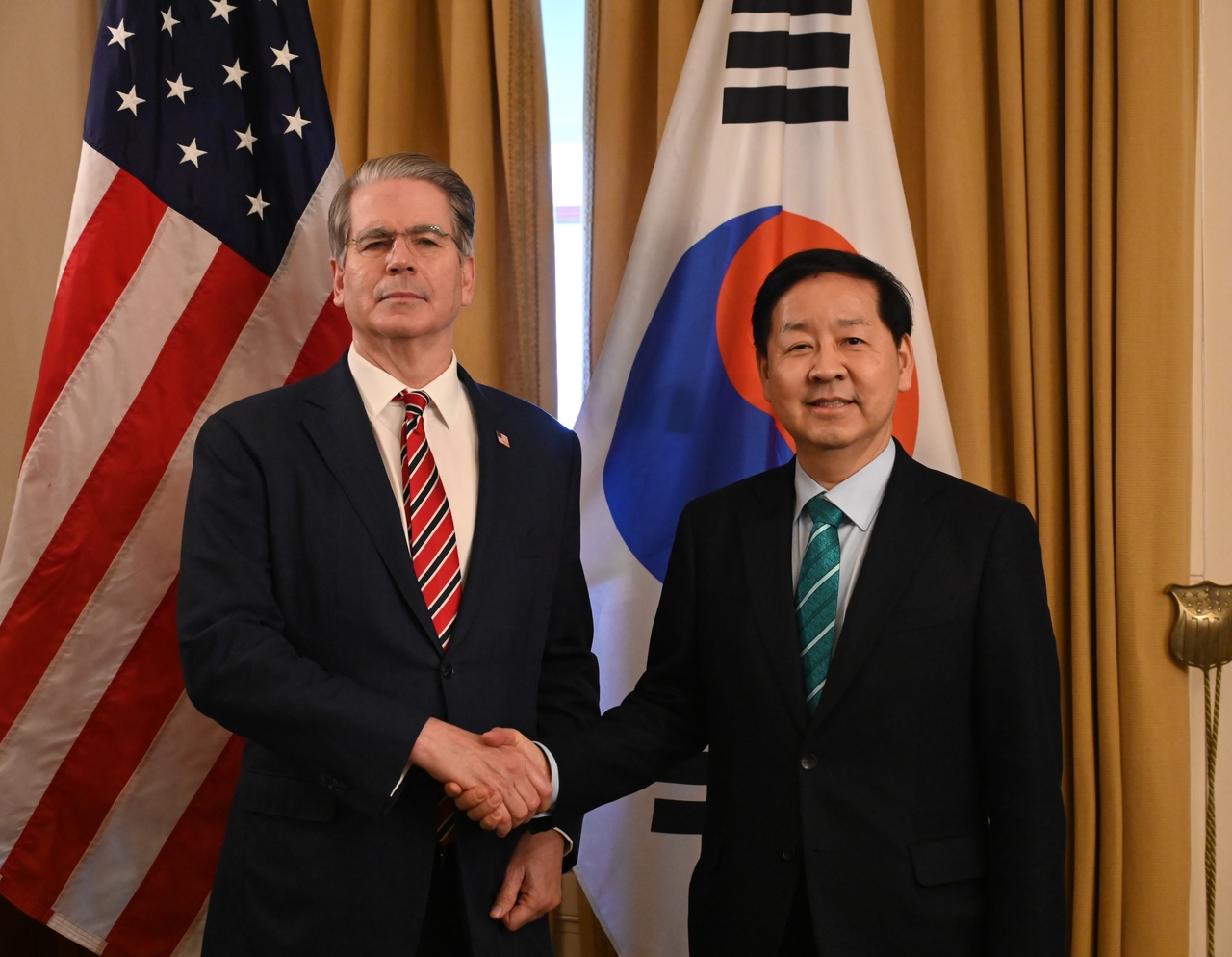
The renewed policy signaling followed remarks by US Treasury Secretary Scott Bessent late Wednesday, when he said the won’s recent depreciation “is not in line with Korea’s strong economic fundamentals” in a social media post after meeting South Korean Deputy Prime Minister Koo Yun-cheol on Monday. In a related statement, the US Treasury said the two officials discussed recent economic developments and ways to strengthen bilateral ties, adding that Bessent had emphasized “excess volatility in the foreign exchange market is undesirable.”
The rare public intervention by a US government official briefly buoyed the won in offshore trading, with the currency firming up to 1,462 per dollar overnight and opening onshore at 1,465. The gains, however, quickly faded, with the won slipping back above 1,470, as the remarks were not accompanied by tangible policy coordination.
During the briefing, Choi said there was a surge in dollar-buying demand at the start of Thursday’s session, particularly from securities firms and overseas investment-related flows. “While offshore foreign investors appeared to share Treasury Secretary Bessent’s assessment that the won’s level has diverged from Korea’s fundamentals, domestic investors seem to view the exchange rate more as a buying opportunity,” he said.
As the won weakened again, even offshore investors who had previously been selling the currency shifted back to buying dollars, with “domestic demand increasingly driving activity in offshore markets,” Choi added.
Choi said that a vicious cycle has taken hold, in which expectations of continued depreciation translate into trading behavior that pushes the exchange rate even higher. If measures rolled out so far — many of which remain in the preparatory stage — do not deliver results, authorities are reviewing the introduction of capital-flow management steps, he said.
“Financial institutions would be the primary targets, though individual trading behavior could be affected indirectly,” he said, adding that while measures aimed directly at retail investors would be avoided, they could not be entirely ruled out if conditions warrant.
Measures outlined by the local authorities so far include discussions on a new framework for the NPS' fund operations, adjustments to forward FX position limits and steps to ease foreign-currency liquidity stress-test requirements.
Choi played down the likelihood of a FX swap with the US government, saying the current bout of won weakness does not reflect a shortage of dollar liquidity. “The US government views currency swaps as a tool for situations involving an FX crisis, such as a shortage of foreign currency,” he said. “Despite elevated exchange rate levels, liquidity remains ample, so there is neither a need nor a justification for an FX swap at this stage.”
Against a backdrop of persistent won weakness and broader economic strains, including elevated housing prices and rising household debt, the Bank of Korea on Thursday held its key interest rate steady at 2.5 percent, marking its fifth consecutive hold since July.
jwc@heraldcorp.com


![[Exclusive] Ateez to return in November](https://wimg.heraldcorp.com/news/cms/2026/09/02/news-p.v1.20260902.76162fb0ba55493aad1c076f240d0750_R.jpg?type=h&h=120)