Making a film is hard, making a good film harder still. But to craft something so spectacularly awful that it ascends to legendary status takes a special kind of genius. This series digs up the gems of Korean cinema remembered for their extraordinary badness. This is the first installment.
A search for the 2004 film "Clementine" on Naver Movie, Korea's go-to platform for film ratings, reveals something peculiar: a wall of unanimous, rapturous praise rarely seen even for timeless masterpieces.
"God made man, and man made 'Clementine,'" reads one comment. Another, the most-liked of all: "This film cured my cancer." The cumulative score sits at 9.39 out of 10. For perspective: Spielberg's "Schindler's List" rates 9.45; "Saving Private Ryan" stands at 9.29.
This elaborate communal prank is a classic display of what Koreans call "nakssi" (literally "fishing"). In this case, that means flooding a terrible film's rating page with glowing reviews to lure in the unsuspecting.
Starring taekwondo world champion-turned-actor Lee Dong-jun, who also bankrolled much of the production, "Clementine" has long been Korean cinema's unrivaled monument to failure.
It holds the distinction of being the first film of the internet era to be memed into immortality — a genuine cult classic born during Korean cinema's golden age, when the industry was commanding global attention with works like Bong Joon-ho's "Memories of Murder" and Park Chan-wook's "Oldboy."
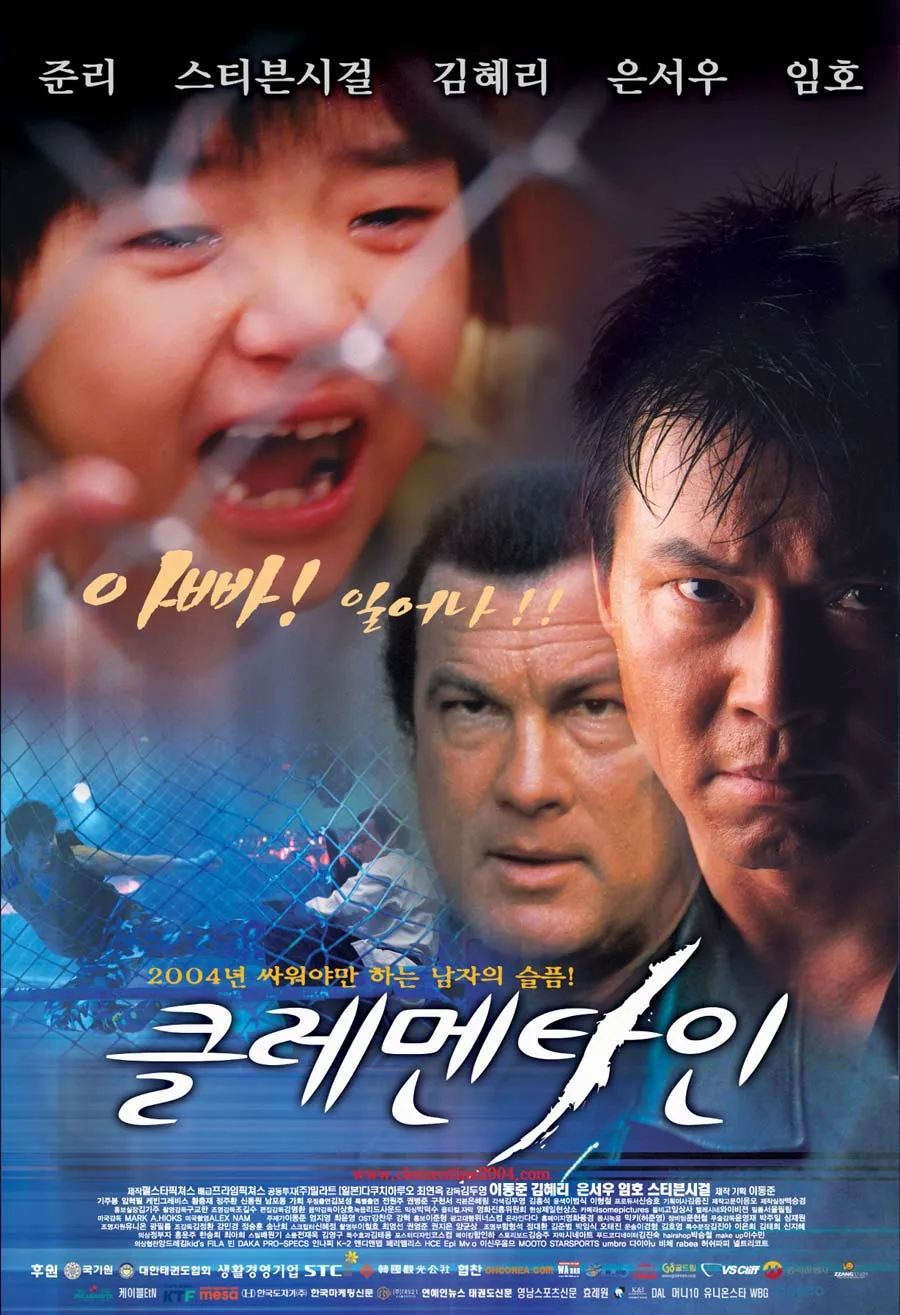
The first thing that grabs you is the poster.
There, directly at the center, looms Steven Seagal, Hollywood's ponytailed, aikido-wielding action man. Korean productions featuring Hollywood stars are no longer unheard of: Liam Neeson showed up in "Operation Chromite" (2016) and Vincent Cassel in "Default" (2018). But this was 2004, when such pairings simply did not happen.
Seagal's presence should have been the wild card that got people into seats on name recognition alone. Instead, it proves an integral part of the mess. But to appreciate just how spectacular that mess is, one must walk through the wreckage.
The plot, such as it is
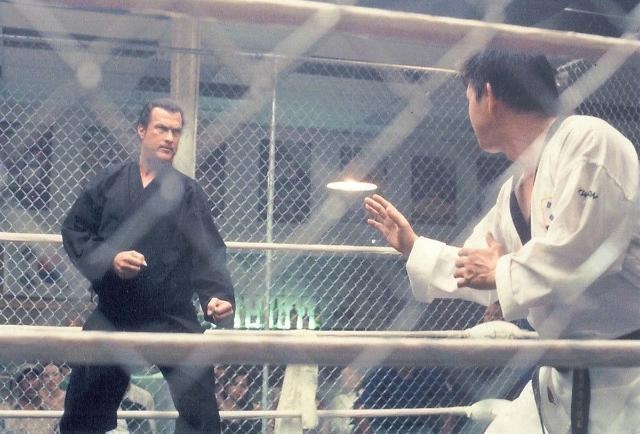
We begin with Seung-hyun (Lee Dong-jun) competing for the world taekwondo championship. His opponent, Jack Miller, is supposed to be Steven Seagal — that's the sell, right? — but curiously, the man is nowhere to be found. The role is body-doubled by two different people: an Asian stuntman during the fight and a white dude who might pass for Seagal if you squint at the medal ceremony.
That jumble of an opening gives a taste of what's ahead.
Fast-forward seven years: Seung-hyun, now a washed-up drunk, receives a lifeline when a cop friend somehow gets him a position on the force. He returns to Seoul and becomes a raging thug in a badge.
During a raid on a gambling den, he doesn't just stop at beating the gangsters to a pulp, but proceeds to smash every slot machine in the joint with a baseball bat. Fittingly, when he flashes his police ID, he holds it upside down.

His tenure proves short-lived. Fired in no time, he's thrust back into underground fighting. His daughter Sa-rang (Eun Seo-woo) is the only one who can soothe his wrath. She later befriends Min-seo (Kim Hye-ri), a prosecutor who becomes a mother figure — but don't let that kindness fool you, her interrogations invariably end with her headbutting the suspect.
The twist for the ages comes when Seung-hyun meets Min-seo face-to-face. Standing before him is his wife — the woman who supposedly died seven years earlier.
The backstory involves his mother-in-law (Jun Won-ju), a villain who would make Iago blush. Disapproving of her daughter marrying a fighter, she told Seung-hyun that his wife had died during delivery, told her daughter that he'd abandoned them, and then shipped the newborn off to an orphanage. Seung-hyun ultimately gets Sa-rang back from the orphanage, giving up his fighting career to take care of her.
Never mind the criminal implications of the mother-in-law's sick scheme; it's all fodder for the weepfest to come. Sure enough, the revelation unleashes a custody battle drenched in histrionics. Here we get the film's signature scene: Sa-rang, standing atop a hill with tears streaming down her face, belts out "Oh My Darling, Clementine."

After some more nonsense, mob boss Hwang (Ki Joo-bong) abducts Sa-rang and demands that Seung-hyun fight Jack Miller for her freedom. Off to LA he goes.
The climactic final battle proves every bit the bait-and-switch as the opening. Seagal is body-doubled for most of it, appearing in the flesh for perhaps five minutes total. As Seung-hyun takes a beating, Min-seo and Sa-rang arrive ringside; their ear-splitting chorus of wails and sobs naturally gives him strength to rise. He delivers a flying kick, and the frame freezes midair.
We never see the blow land, but no matter — next thing we know, Seagal is handing Seung-hyun the champion belt. Family reunited, credits roll, accompanied by Sa-rang's moralistic narration about family values.
Why it endures
Plenty of terrible films get released every year, only to vanish into oblivion. "Clementine" just had the right ingredients for achieving immortality.
The first is the film itself. Korean entertainment isn't exactly known for subtlety. Network soap operas trafficking in birth secrets, faked deaths and other outrageous plot reversals have been staples since the 1990s (think "Temptation of Wife" or the recent "Penthouse" series, which wrapped just a few years ago). But "Clementine" is a different beast entirely. A film can fail by doing too much or too little; this one goes all in on the former, with complete and utter sincerity, its excess saturating every frame in the most cringe-inducing ways imaginable.
The dialogue tips into pure camp — lines that sound composed by someone whose sole mission was minting quotable zingers, a bargain-bin George Lucas by way of an insane fever dream. There's no shortage of gems, ranging from the purely bizarre (Min-seo barking "God didn't issue you a round-trip ticket to heaven!" while arresting a gangster) to the genuinely disturbing ("A man should at least know how to take off his own pants," a drunk Seung-hyun slurs to his young daughter).
And of course, one can only marvel at how such an overstuffed plot keeps finding room for more tangents, each inserted with maximum jarring effect: An extended bullfighting interlude scored to a gentle ballad; an 80s-music-video-style montage of father and daughter bonding under the sunset, to name just a couple.
Rarely does a film come along where every creative decision appears to have been the wrong one. "Clementine" pulls it off with flying colors.
Still, awfulness alone wouldn't account for its cult status. That requires the second factor: the story behind it.
"Clementine" carried a budget of 5.2 billion won ($3.6 million) — considerable by 2004 standards — mostly from Lee Dong-jun's pocket. Nearly a quarter reportedly went to Seagal's fee, quite a deal for an action star who appeared for a few minutes and flaked out on his promotional duties.

The film opened May 21, 2004 — the same day as Brad Pitt's "Troy" — and flopped spectacularly, selling some 67,000 tickets. The failure left Lee buried in debt. For years, he worked nightclub gigs to dig himself out.
It was during this period that a legendary meme was born, one that would enshrine the film's legacy in Korean pop culture. Sometime in the late 2000s, someone posted a photograph from the streets of Busan showing a nightclub placard. Lee's face and name appeared prominently, next to the curious phrase "Fantastic Butthole Show." Below that: "We'll show you something!"
To this day, nobody has figured out what the butthole show thing was all about. What we do know is that Lee wasn't involved in whatever that performance entailed — if it even existed. In a 2014 TV appearance, Lee called it all an unfortunate coincidence: The nightclub had simply reused an old poster, and he had nothing to do with whatever that meant.

But none of that mattered.
The timing was too perfect, the optics too damning. Here was a man who'd staked his fortune on a passion project, watched it crash and burn and was now apparently performing god-knows-what to survive. So the myth took hold and persists even today.
Since then, "butthole show" has entered the online vernacular as shorthand for desperate, rock-bottom attempts to salvage the unsalvageable. It's the last-ditch flailing of someone with nothing left to lose, invoked whenever a project or a person hits absolute bottom, and keeps digging.
"Clementine" is available on Korean streaming platforms Watcha, Wavve and Tving, without English subtitles.
moonkihoon@heraldcorp.com