

Lee lands in Shanghai, China’s economic hub, after Bejing
BEIJING — President Lee Jae Myung on Tuesday held back-to-back meetings with China’s second- and third-highest-ranking officials: the premier who oversees the economy and the top legislator who heads the national legislature.
The meetings came a day after Lee’s second summit with President Xi Jinping and on the third day of his four-day state visit to China, the first such trip by a South Korean president since 2017.
Lee then landed in Shanghai on Tuesday afternoon for a two-day visit that was to include a dinner banquet hosted that evening by Chen Jining, Shanghai’s Communist Party secretary, as well as attendance at a Korea-China venture and startup event.
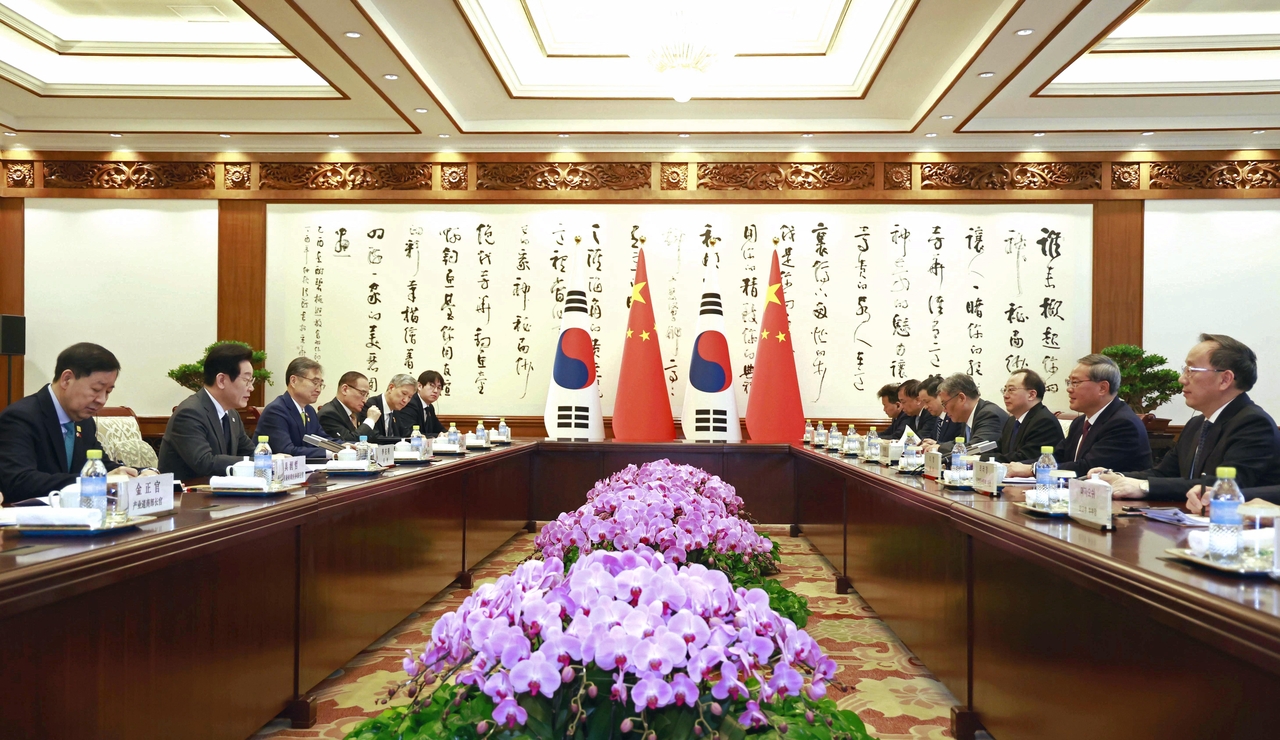
For his meetings with China's high-ranking officials, Lee first met Zhao Leji, chair of the Standing Committee of the National People’s Congress at the Great Hall of the People. He then held talks and a working luncheon with Premier Li Qiang, Beijing’s chief economic policymaker, at the Diaoyutai State Guesthouse.
Presidential spokesperson Kang Yu-jung said Lee discussed concrete ways to further develop the Korea-China strategic cooperative partnership, based on a shared emphasis on “political and friendly trust” as well as “quality of life and peace.”
Kang added Lee’s meeting with Zhao Leji set an upbeat tone for the Shanghai leg of the trip, with both sides agreeing that deeper trust — between governments and ordinary citizens alike — is the bedrock of stable Korea-China relations. Hoping to put that principle into practice, Lee invited Zhao to visit South Korea “at an early date,” and called for more energetic exchanges between the two legislatures to broaden public understanding.
Lee also pushed to expand people-to-people and cultural interaction within mutually acceptable limits, and asked Beijing to consider an additional loan of a pair of giant pandas — an enduring symbol of friendship that resonates far beyond communiques.
Zhao responded in kind, saying China hopes to maintain good neighborly ties with South Korea and deepen mutually beneficial cooperation. He added that Beijing would support wider exchanges not only between the parliaments but also across youth, culture, media, academia and local-government sectors.
Both sides shared the view that goodwill requires more than simply increasing the number of meetings — it also means taking a fresh look at how the two publics see each other. They agreed to keep improving communication through practical channels such as Track 1.5 dialogues, inter-party talks and civilian exchanges. Zhao thanked Lee for the invitation to Seoul and said he would work toward a visit at a mutually convenient time.
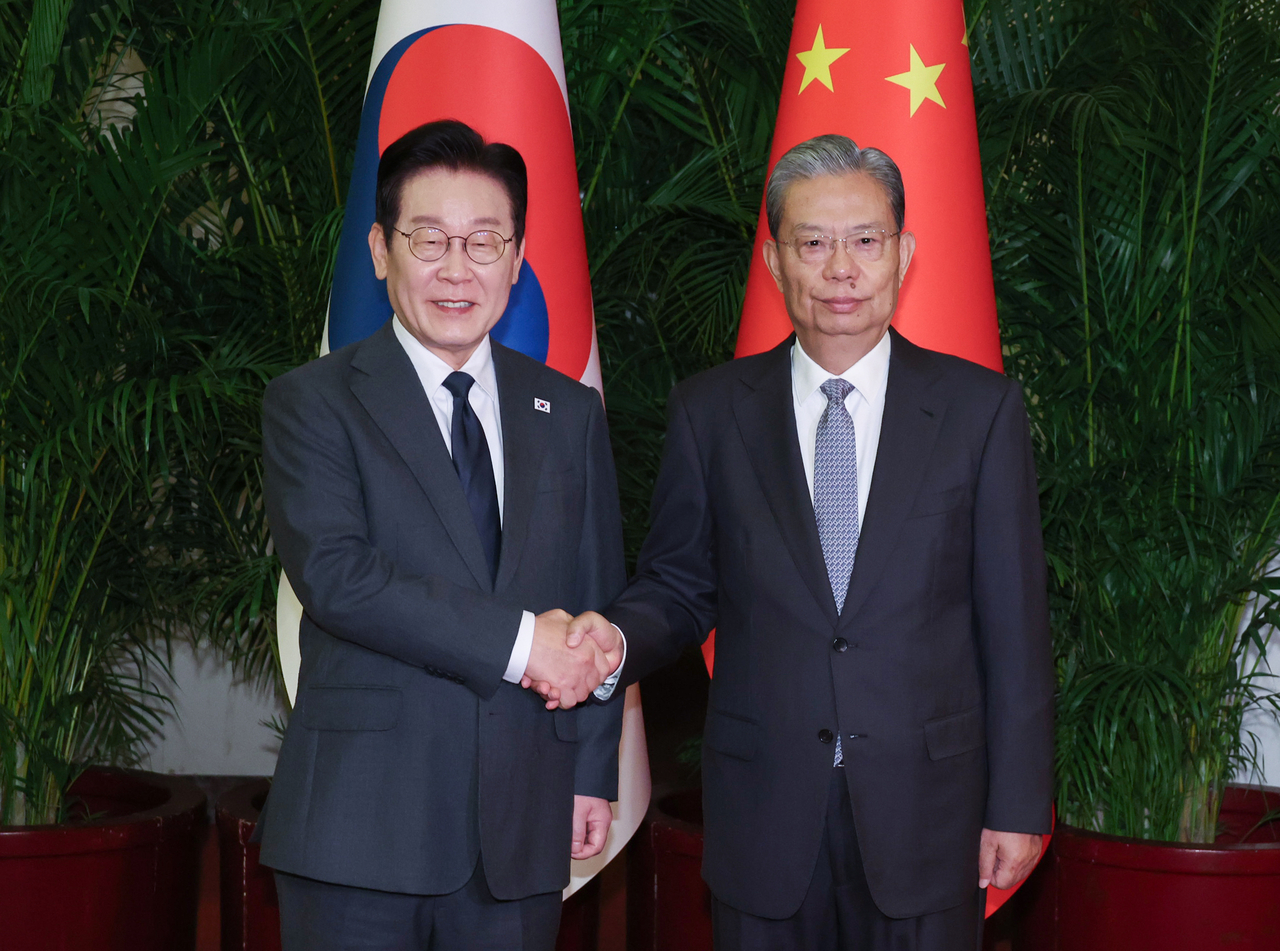
Lee exchanged views with Li on advancing South Korea–China cooperation centered on people’s livelihoods and peace, Kang said
Lee underscored the premier’s role in stepping up economic partnership, noting that Li oversees China’s economic affairs and is responsible for stability in people’s livelihoods.
Lee also highlighted Li’s role in fostering peace on the Korean Peninsula and in the region as China’s representative in the Korea-China-Japan trilateral summit.
"I believe that our two countries can expand horizontal and mutually beneficial cooperation in line with the changing times, promote peace and stability on the Korean Peninsula and in the broader region, and move forward together on a path of pragmatism and shared prosperity," Lee said.
“I hope we can discuss the future direction of our bilateral relationship frankly as old friends, and that it will serve as a turning point for substantial progress,” Lee told Li, whom he met twice previously, in October and November last year.
Li said he was “willing to exchange views candidly on issues of mutual interest.”
Li also underscored that “the relationship between the two countries is being driven forward along the right track.” China, he added, intends to “advance into the future while expanding both the scope and depth of cooperation, delivering more tangible outcomes, and bringing greater benefits to the peoples of both countries.”
Cheong Wa Dae reiterated that Seoul and Beijing agreed to broaden practical economic cooperation beyond manufacturing to include consumer goods and services — from food and fashion to tourism, entertainment and gaming — using Lee’s state visit as a catalyst.
The large business delegation of around 400 people from 161 Korean companies — the first of its kind to accompany a South Korean president to China since 2017 — traveled with Lee and attended the Korea-China business forum on Monday.
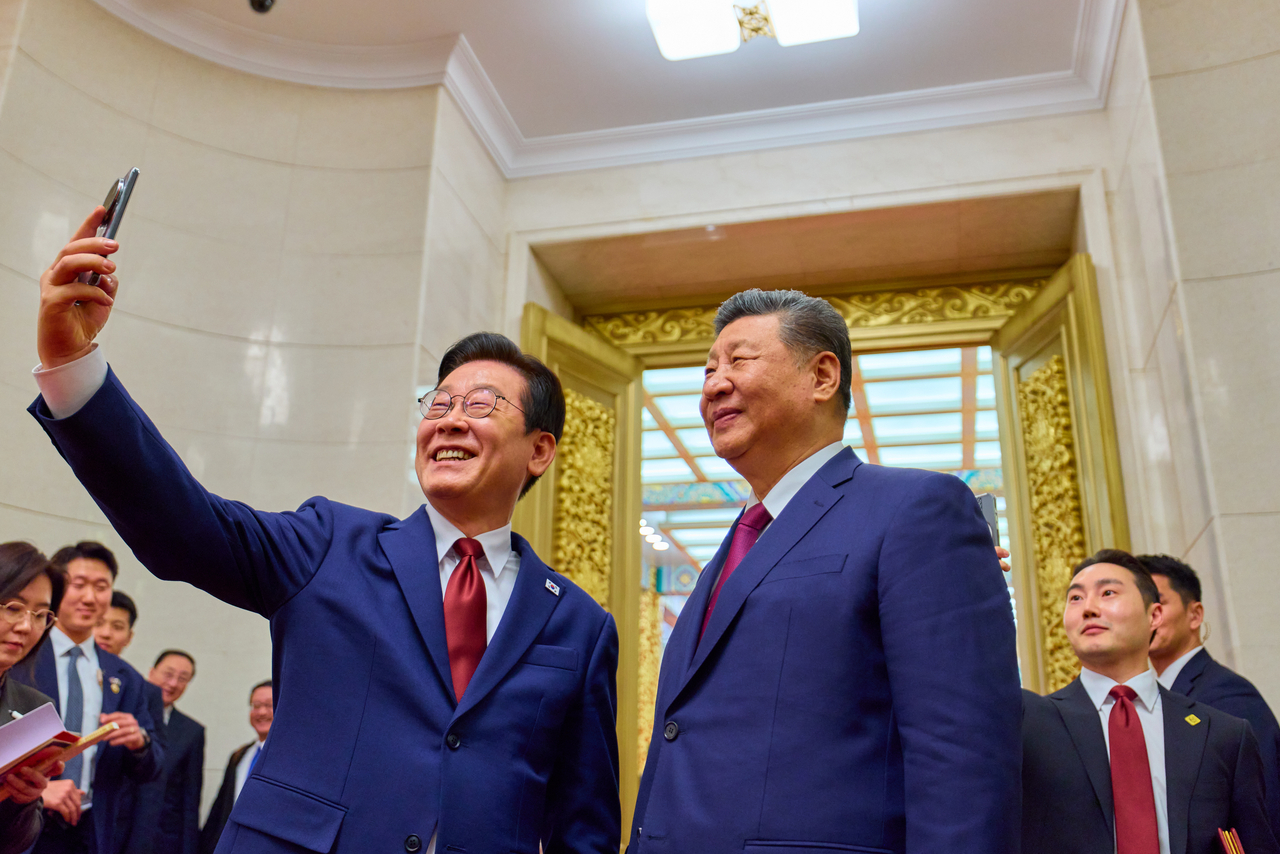
During his meeting with Zhao, Lee called for China’s National People’s Congress to lend support towards improving public understanding toward each other.
“I believe that the National People’s Congress will make a significant contribution to enhancing mutual understanding and expanding shared ground between our two countries by representing broad public awareness and diverse voices across society as an institution that reflects the will of the people,” Lee told Zhao.
Lee also underscored that “the role of the National People’s Congress is more important than ever,” especially following his summit with Xi. Lee said he and Xi shared the view that Seoul and Beijing “should work together to mature the strategic cooperative partnership, building on political trust and friendly trust at the civilian level.”
Zhao said, "The Chinese side stands ready to work with the Korean side to faithfully implement the important common understandings reached by the two leaders, strengthen communication and coordination, and deepen cooperation across all fields.”
Zhao added that through such efforts, the China-Korea strategic cooperative partnership “can move forward steadily and endure over the long term.”
The meetings came ahead of Lee’s departure to Shanghai, China’s commercial hub, on Tuesday afternoon.
The city anchors the Yangtze River Delta, home to dense clusters of South Korean manufacturers and technology firms, including key nodes in semiconductor supply chains.
dagyumji@heraldcorp.com
mkjung@heraldcorp.com