
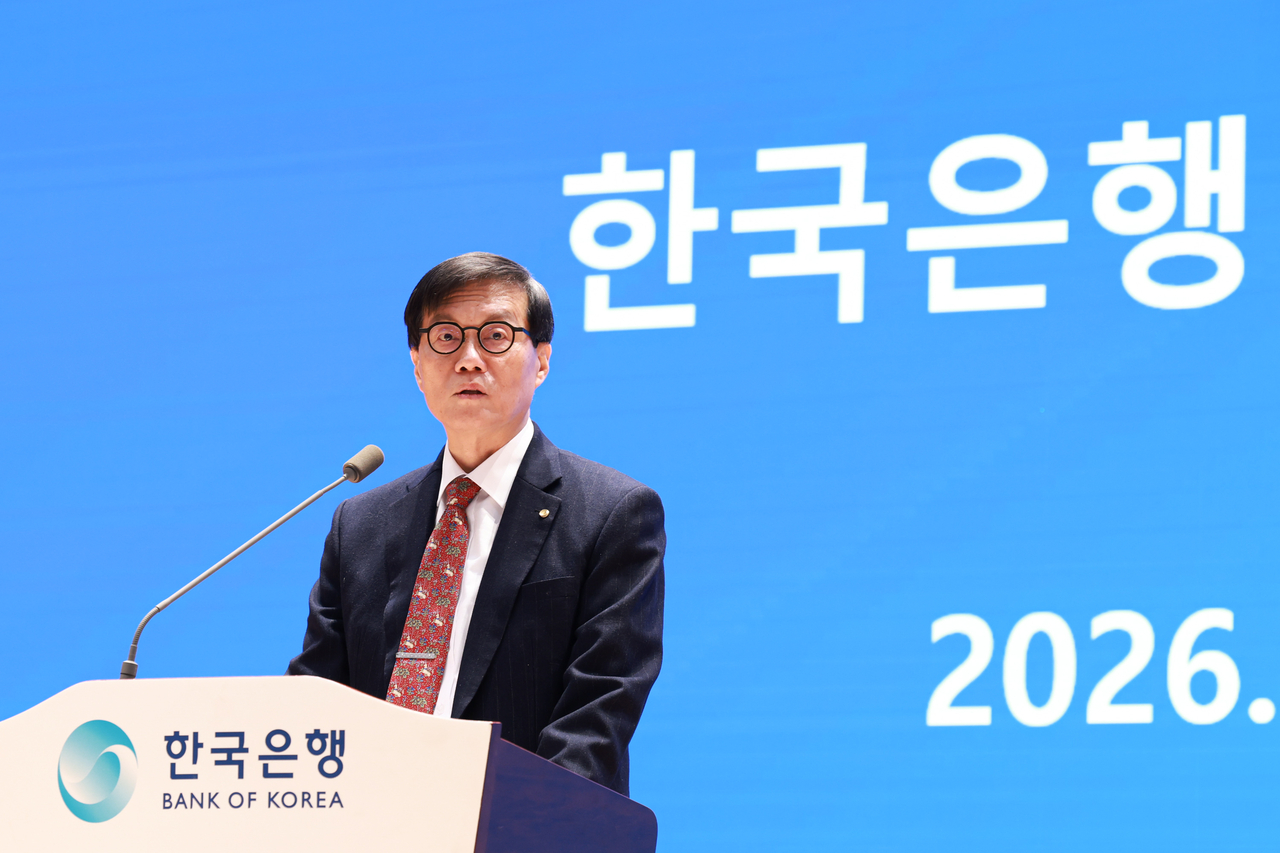
South Korea's economy is expected to grow 1.8 percent this year, rebounding from last year’s slowdown, but growth felt across much of the economy is likely to lag that pace, as sectoral disparities widen, Bank of Korea Gov. Rhee Chang-yong said.
“While the economy is expected to grow 1.8 percent, close to its potential growth rate, excluding tech-led sectors driving the expansion through the semiconductor cycle would leave growth at about 1.4 percent,” Rhee said in his New Year’s message on Friday. “Divergence between sectors will widen the gap between headline growth and what is actually perceived.”
Rhee cautioned against premature optimism. “Such a 'K-shaped' recovery cannot be considered sustainable or complete,” he said, urging efforts to diversify growth drivers and foster new industries.
On the currency, Rhee sought to reassure markets, saying the won, trading around 1,440 per US dollar, while weaker than usual, was not an urgent problem.
“The recent exchange rate in the high 1,400 won range appears far removed from our economic fundamentals,” he said. “Korea remains a net foreign creditor nation with sound external fundamentals, and it is inappropriate to judge the situation as being as severe as past crises based solely on recent exchange-rate levels.”
Citing surging overseas equity investment as a key driver of the won’s recent depreciation, Rhee reiterated warnings to investors.
“The won’s sharp decline against the dollar since October reflects increased overseas equity investment by local residents, which has distorted supply and demand in the foreign-exchange market and added short-term upward pressure on the exchange rate,” he said. “It is time to comprehensively examine the impact of the persistent expansion in foreign investment on the country’s economic growth and the development of domestic capital markets.”
Rhee also cited the widening gap in interest rates and economic growth between Korea and the US, along with the persistent undervaluation of Korean equities, as additional factors weighing on the won.
Inflation, though stable at around 2.1 percent, requires close monitoring as price pressures could again move above the government’s 2 percent target range, he said.
With risks still present as the economy seeks a stable growth path, the central bank will factor in various economic indicators, including inflation and housing prices, when mapping out its policy this year, Rhee added.
“Both upside and downside risks exist along the growth path, and inflation dynamics could also shift depending on exchange-rate movements,” he said. “With uncertainty in the policy environment rising and conflicts among policy variables intensifying, monetary policy will be run in a more calibrated manner, based on the close scrutiny of a broad range of indicators."
jwc@heraldcorp.com


![[Exclusive] Ateez to return in November](https://wimg.heraldcorp.com/news/cms/2026/09/02/news-p.v1.20260902.76162fb0ba55493aad1c076f240d0750_R.jpg?type=h&h=120)