
HD Korea Shipbuilding & Offshore Engineering on Thursday unveiled the first-year results of its global maritime research consortium, highlighting progress in autonomous navigation, cybersecurity and decarbonization technologies.
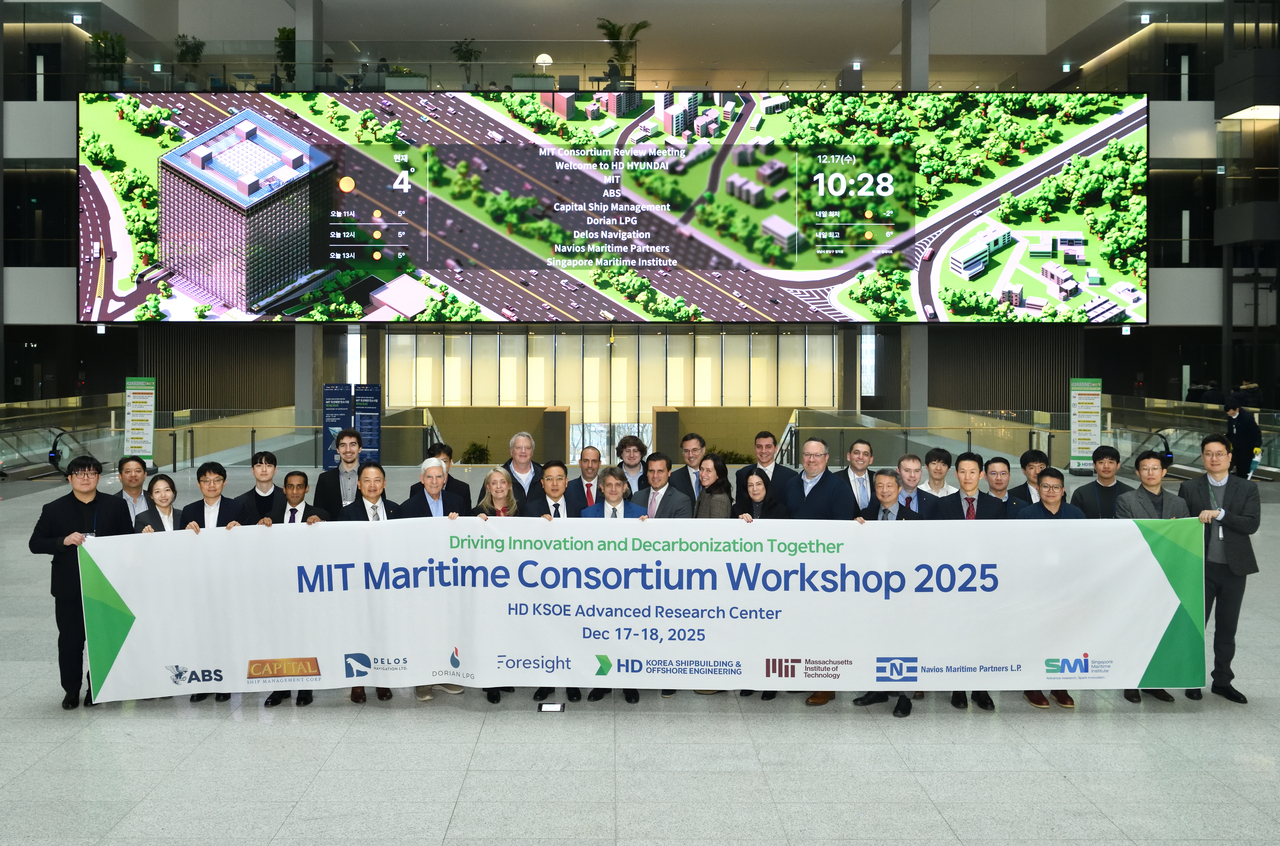
The company hosted a two-day workshop at the HD Hyundai Global R&D Center in Seongnam, Gyeonggi Province, to review outcomes from the MIT Maritime Consortium, which was launched in March in partnership with the Massachusetts Institute of Technology, Greek shipping company Capital and US-based classification society ABS.
About 180 participants attended the workshop, including experts from consortium members such as Dorian, the Singapore Marine Institute and UK renewable energy investor Foresight Group.
During its first year of research, which concluded in December, the consortium reported advances across multiple areas, including AI-based autonomous navigation, maritime cybersecurity solutions, small modular reactor propulsion technologies and additive manufacturing using 3D printing.
As part of the project, a commercial vessel was selected to be equipped with HiNAS Control, an autonomous navigation system developed by Avikus, an HD Hyundai subsidiary. The system will be tested under real operating conditions to verify fuel-efficiency gains.
The consortium also completed a prototype AI model for detecting cyber threats and contributed to the development of the SMR Nuclear Ship Safety Handbook, published by MIT in October, which aims to establish safety and regulatory standards for the commercialization of nuclear-powered ships.
The workshop further reviewed the consortium’s three-year technology roadmap and addressed industry-wide challenges such as decarbonization, tightening fuel-efficiency regulations, digital transformation and rising cyber risks.
“The structural changes underway in the maritime and shipbuilding industries — driven by stricter environmental rules and shifts in technology and fuel supply — cannot be addressed by any single company or institution,” said Themistoklis Sapsis, director of MIT’s Center for Ocean Engineering, stressing the need for cross-industry collaboration.
Chang Kwang-pil, head of HD Korea Shipbuilding’s Future Technology Research Institute, said the company plans to deepen its research engagement within the consortium, including work on standards to verify fuel savings from AI-based autonomous navigation systems.
“We aim to accelerate technological innovation and decarbonization through deeper cooperation across the global shipbuilding industry,” Chang said.
andreahaneu@heraldcorp.com