
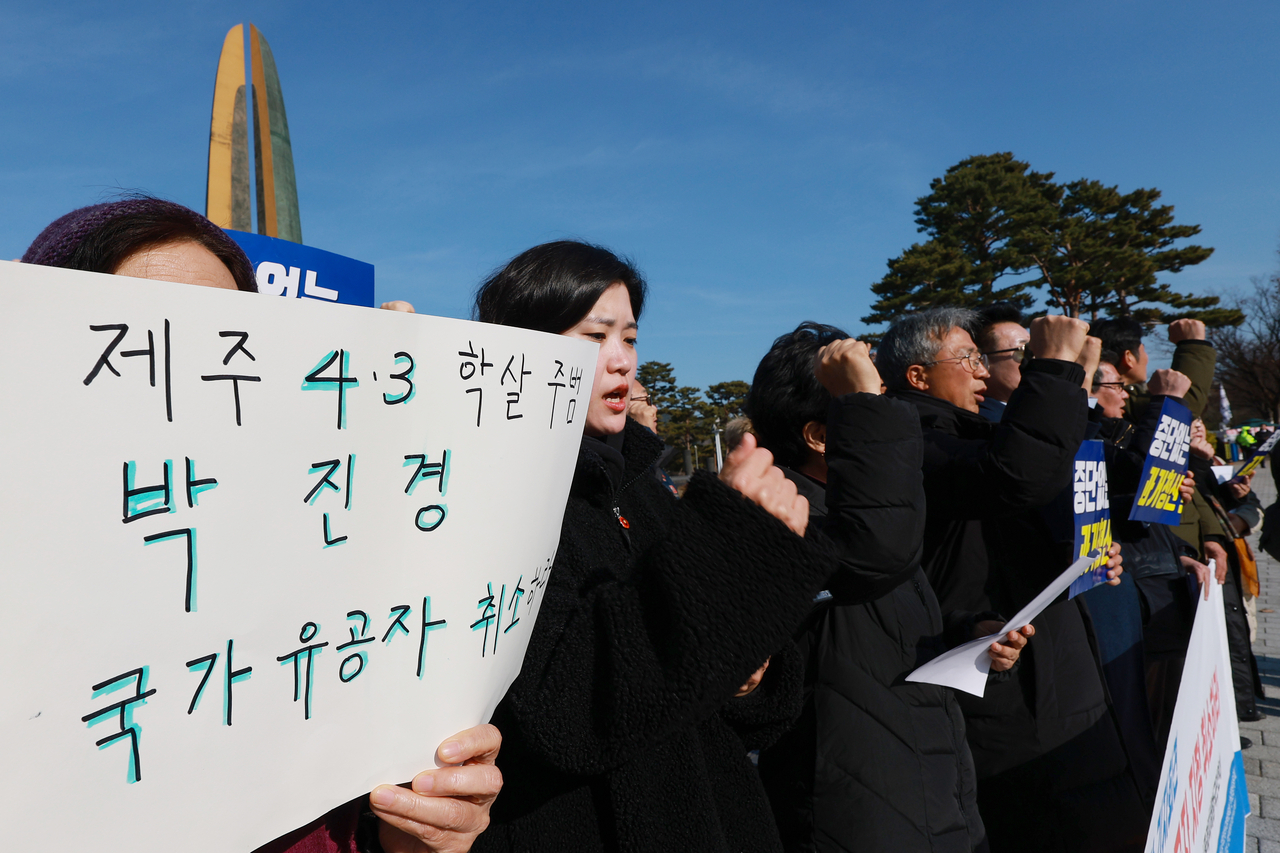
President Lee Jae Myung has ordered a review aimed at enabling the withdrawal of a national merit designation granted to a late Army colonel linked to the violent suppression of the Jeju April 3 Incident, the presidential office said Monday.
According to the presidential office, Lee instructed the Ministry of Patriots and Veterans Affairs to reexamine legal and procedural options for revoking the designation, amid mounting criticism over the decision to honor the late Col. Park Jin-kyung.
Park was designated a national merit recipient in November based on his posthumous award of the Eulji Order of Military Merit, the second-highest military decoration.
The move quickly sparked backlash, as Park is widely regarded as having played a central role in a military crackdown in Jeju in 1948 that resulted in large-scale civilian casualties. He served as commander of an Army regiment dispatched to Jeju during the early phase of the April 3, 1948, uprising and subsequent counterinsurgency operations.
During roughly 40 days following his arrival on the island, Park led hard-line suppression campaigns that involved mass arrests of residents and resulted in civilian deaths, according to historical accounts.
The Jeju Uprising began amid mounting political unrest on the Korean Peninsula in the years following liberation from Japanese occupation.
The initial uprising was led by members of the Workers’ Party of South Korea, a leftist organization aligned with North Korean communists. The group opposed separate elections planned for the South under the US military administration, arguing that they would formalize the division of the peninsula.
In April 1948, party members and sympathizers launched coordinated attacks on police stations and government offices on Jeju. The attacks triggered a military crackdown that led to sweeping arrests, village-wide targeting and widespread civilian deaths and disappearances.
According to the Jeju 4·3 Peace Foundation, a government-recognized body tasked with documenting the incident, 14,822 people have been officially recognized as victims, including more than 10,500 confirmed deaths and over 3,600 people reported missing.
Amid the controversy over Park’s designation, Patriots and Veterans Affairs Minister Kwon Oh-eul visited Jeju Island on Dec. 11 and apologized to residents.
The ministry issued a formal apology the following day, saying the designation had been processed in a “procedural” manner under existing regulations, based on an application submitted by Park’s bereaved family, without sufficient consideration of the historical context.
On Monday, the Defense Ministry separately said it would also review the possible revocation of the Eulji Order of Military Merit awarded to Park.
Park was promoted to the rank of colonel on June 1, 1948, with military authorities at the time citing his role in operations on Jeju. Later that night, however, he was assassinated by one of his subordinates.
During his subsequent trial, the assailant, Staff Sgt. Son Seon-ho, reportedly testified that Park had said it would be “acceptable to sacrifice 300,000 Jeju residents” if necessary to quell what he described as an uprising undermining Korea’s independence.
flylikekite@heraldcorp.com

![[World Class] HUFS bets on Songdo, AI to redefine what a global university can do](https://wimg.heraldcorp.com/news/cms/2026/10/18/news-p.v1.20260930.7e4dbeacfc1d4d16848c0e2a441c04e6_R.jpg?type=h&h=120)
