

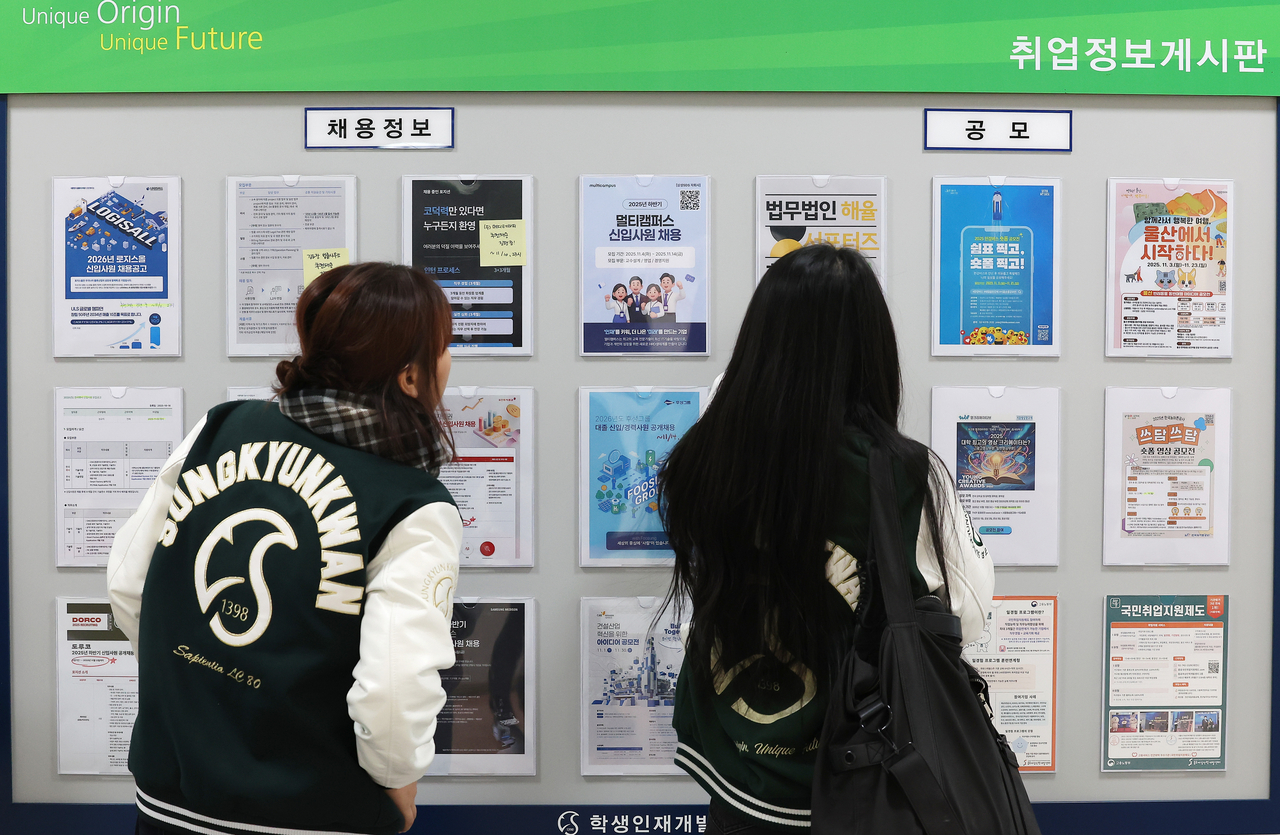
Fresh university graduates outside the Greater Seoul region, which includes Gyeonggi Province and Incheon, take an average of three months longer to secure their first job compared to their counterparts in the capital region, according to a new study published Thursday.
According to the Korea Employment Information Service, while the average job search period for youth living in metropolitan areas such as Seoul stood at 21.2 months, those in non-capital regions observed a longer period of 24.6 months, highlighting a widening regional disparity.
This disparity wasn’t observed a decade ago, when both groups reported similar gaps between their graduation and employment, averaging some 19 months.
Since then, the delay in employment has increased by just two to three months for young jobseekers in the Greater Seoul region, while non-capital regions saw a jump of over six months.
“Access to career support differs between students in universities based in the Greater Seoul region, especially Seoul, compared to those outside of the region,” sociology professor Kim Jong-young from Kyung Hee University told The Korea Herald.
“Seoul has career centers, mentoring events, networking events and corporate recruitment fairs that are far more diverse and abundant compared to regional universities and local governments. This leads to graduates outside of Seoul to face structural disadvantages from the start.”
The KEIS also found that the time young job seekers generally take to find employment, regardless of where they’re based regionally, has also lengthened to 22.7 months, up from 18.7 months 10 years ago.
Only 1 in 10 individuals succeed in finding work immediately after graduation, the study found.
The report also found notable differences based on educational attainment.
Bachelor’s degree holders found jobs in 10 to 11 months, while those with only a high school diploma or less spent nearly 34 months — almost three years — looking for a job.
While the job search period for high school graduates has shortened slightly from the previous average of 48 months, the disparity remains stark.
The share of young people taking on regular, full-time positions as their first job has declined over the past decade. In contrast, those holding temporary and irregular positions increased.
Those employed in full-time positions decreased to 61.2 percent from 73.3 percent 10 years ago, while those holding temporary positions increased significantly to 34.7 percent from 24.9 percent. The number of day laborers among fresh graduates also saw a large increase to 4.1 percent, compared to 1.9 percent a decade ago.
“The report suggests that longer job search periods may push young people to accept positions that offer less security, even if they fall short of what they consider ideal for stable employment,” the KEIS report mentioned.
lee.jungjoo@heraldcorp.com

![[World Class] HUFS bets on Songdo, AI to redefine what a global university can do](https://wimg.heraldcorp.com/news/cms/2026/10/18/news-p.v1.20260930.7e4dbeacfc1d4d16848c0e2a441c04e6_R.jpg?type=h&h=120)