
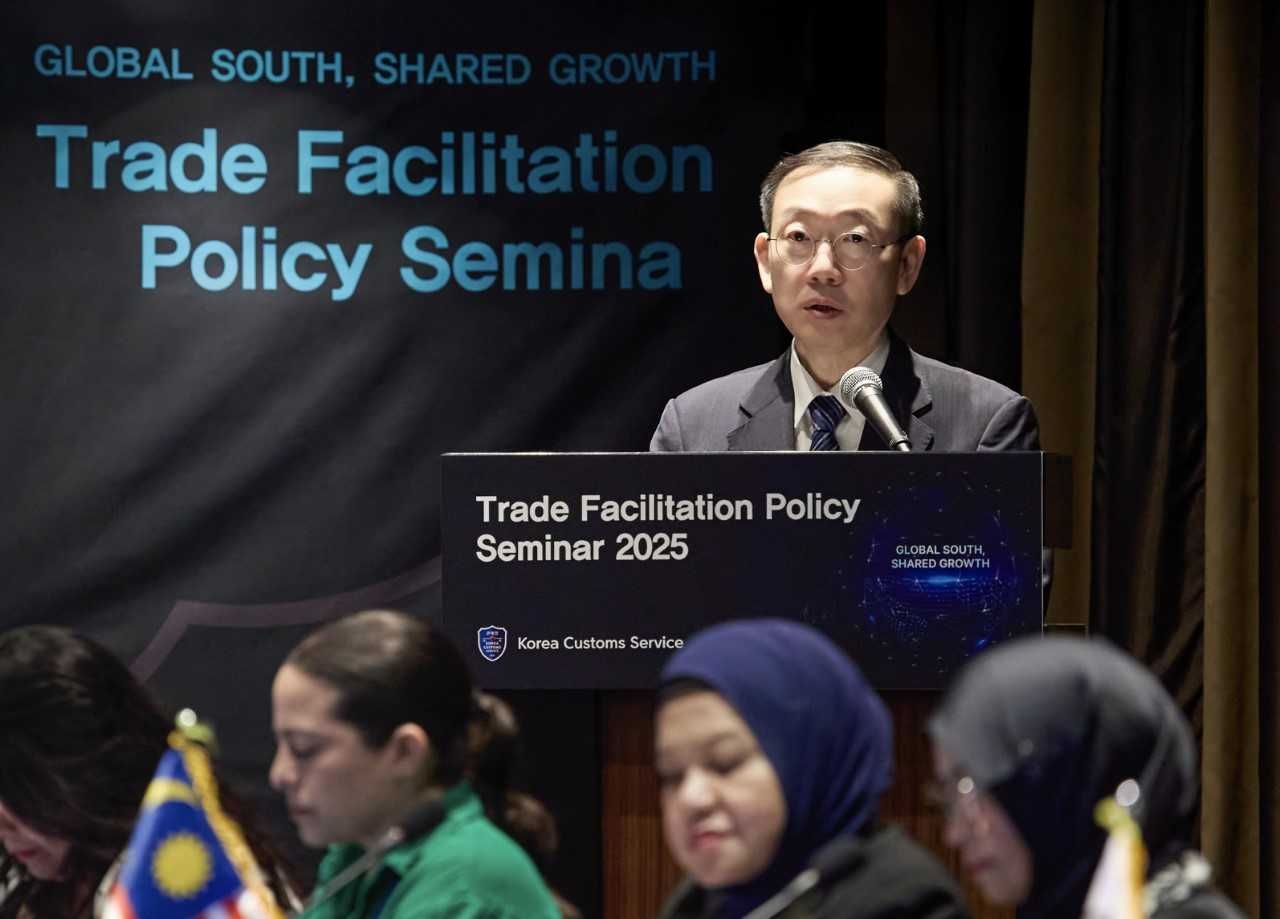
The Korea Customs Service is turning to artificial intelligence to strengthen border security, improve tax compliance and uphold fair trade order, as the nation confronts increasingly complex trade conditions, ranging from supply-chain shifts to US tariff policy changes and intensifying global tech competition.
The customs agency recently adopted a new vision of “Leading Fair Growth with AI” to respond to the rapidly changing trade landscape and reinforce safeguards for the nation’s economy and public safety.
Established in 1970 as an independent administrative agency, the KCS has grown into one of the government’s key economic gatekeepers. The agency collects about 72 trillion won ($49 billion) in customs duties and value-added taxes annually, or roughly 20 percent of national tax revenue. It also serves as a front-line enforcement body, seizing drugs, firearms and other hazardous goods and investigating violations that include illegal foreign-exchange dealings and trade fraud.
The KCS said its latest AI-driven agenda reflects its ambition to go beyond its traditional mandate. The current trade environment is shifting amid US tariff hikes, deepening ties coordination among North Korea, China and Russia and a surge in direct overseas purchases driven by non-face-to-face consumption. In response, the agency aims to leverage AI across its systems and workflows to deliver more convenient public services and to boost the competitiveness of Korean exporters.
The agency also intends to upgrade its investigative capabilities to crack down on emerging trade-related crimes, including virtual asset-based money laundering, artificially inflated import and export volumes that distort capital markets and illicit cross-border financial flows. It plans to improve tax accuracy and more proactively block border-level threats to public safety, aiming to reinforce a fair economic environment.
To prepare for future disruptions, the KCS plans to leverage its nationwide network of 34 customs offices and 16 support centers to refine its response system, adjust regulatory tools in line with government objectives and deepen communication with businesses and the public to incorporate on-the-ground policy feedback.
The agency said it will “faithfully fulfill its role as a guardian of the national economy,” prioritizing public safety, fair taxation and resilience amid global trade shifts.
kwonhl@heraldcorp.com
andreahaneu@heraldcorp.com
![[World Class] HUFS bets on Songdo, AI to redefine what a global university can do](https://wimg.heraldcorp.com/news/cms/2026/10/18/news-p.v1.20260930.7e4dbeacfc1d4d16848c0e2a441c04e6_R.jpg?type=h&h=120)