
Thailand speeds up advanced manufacturing and smart-city development to attract global investment
Thailand, ASEAN’s second-largest economy, is accelerating industrial upgrades under its Ignite Thailand strategy as it courts foreign investors, including South Korean firms.
Araya, the gateway hub for S-curve sectors
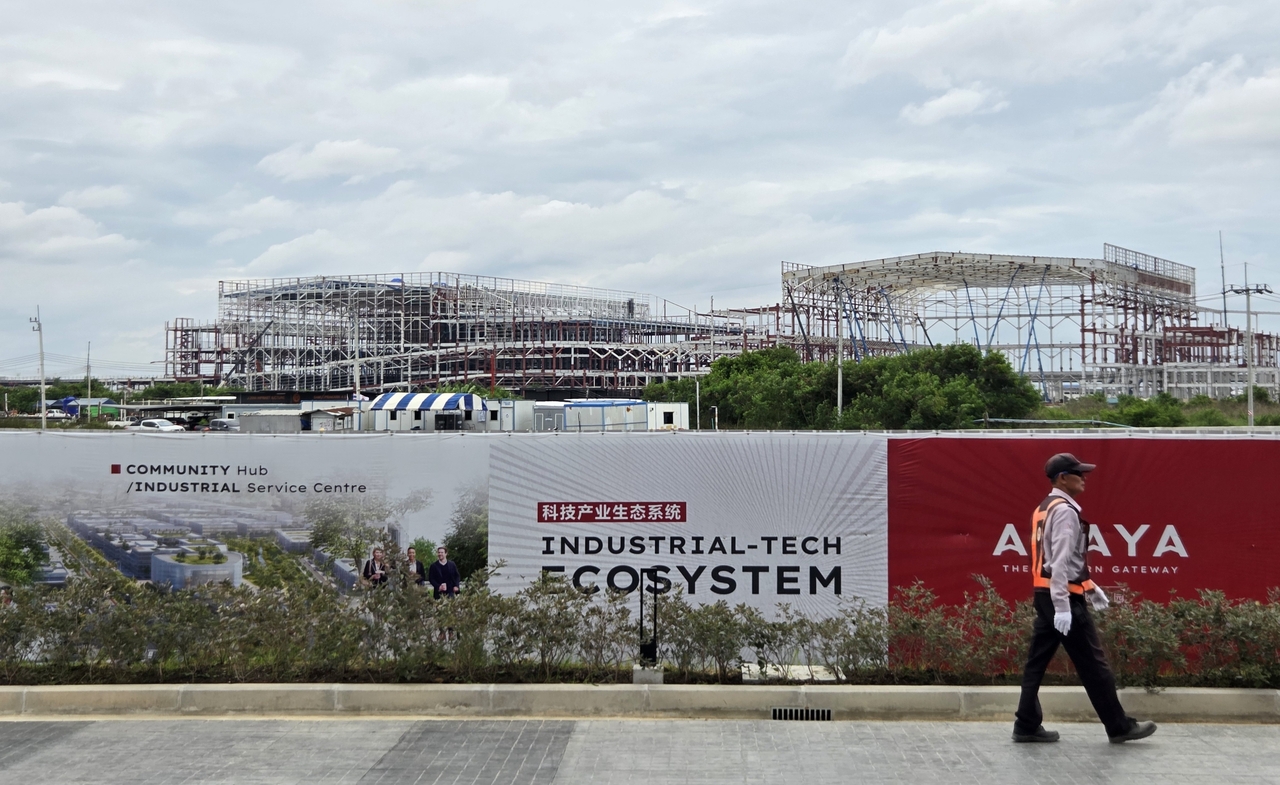
About an hour east of Bangkok on Tuesday, Araya Industrial Estate was buzzing with construction, with heavy machinery rolling across newly cleared land and a multistory building already rising. An official at Frasers Property, one of its developers, said progress has outpaced expectations since the February launch.
“Around 30 percent of the 4,600-rai (736-hectare) site has been filled already,” the official said. “It’s faster than we expected.”
Araya is positioning itself as a “gateway to Thailand,” located at kilometer 32 on Bang Na–Trat Road with quick access to central Bangkok, Suvarnabhumi Airport and the Eastern Economic Corridor. Early tenants include Infineon Technologies, a Swiss food producer, Malaysia’s Mr. D.I.Y., a Singaporean data-center operator and several Chinese and Taiwanese firms.
The estate targets Thailand’s S-curve industries — semiconductors, electronics, EV batteries and advanced manufacturing — and was designated a General Industrial Estate by the Industrial Estate Authority of Thailand in July.
“We are not developing only an industrial estate. Our aim is a township,” the official added, pointing to 43-meter roads, full utility networks and IEAT-certified smart monitoring systems planned for a mixed-use community.
EEC, the one-stop policy engine
Driving an hour south to Chonburi brought the delegation to the Eastern Economic Corridor Office, the government arm steering Thailand’s industrial transformation across the Eastern Seaboard.
The EEC operates under a special administrative law and aims to foster “modern and environmentally friendly economic activities,” an official said, stressing that investment must circulate into local communities through supply chains and skilled jobs. A one-stop licensing system and expanded digital platform allow investors to secure permits “anywhere, anytime.”
The EEC is channeling investment into five clusters — medical and health, intelligent electronics, next-generation mobility, bio-circular-green industries and high-value services such as wellness and medical tourism. To support them, Thailand is upgrading its electricity grid, deep-sea ports, U-Tapao Airport and nearby research zones.
Incentives and investment packages are negotiated on a project-by-project basis to remain competitive with neighboring countries. “Our aim is to shorten the time required to start operations — from years to just a few months,” the official said.

WHA, the plug-and-play base
Another hour east in Rayong sits WHA Industrial Estates, one of Thailand’s largest developers, operating 16 estates in Thailand and Vietnam covering more than 14,080 hectares. The sites support next-generation industries — automotive, electronics, data centers, energy and biotech — with over 829,000 square meters of ready-built factories and logistics warehouses. “Many companies want to test the Thai market first, so our ready-built factories are in high demand,” a WHA official said. “They can start operating almost immediately.”
WHA has partnered with more than 1,100 global firms, including 287 automotive manufacturers and suppliers, contributing to about $43 billion in cumulative investment. Its estates feature highway-grade internal roads, stable power and water supply, wastewater treatment, natural-gas pipelines and fiber-optic and 5G networks, with renewable-energy systems integrated across sites. “We’re trying to build a true smart eco-industrial estate,” the official said.
Amata, the ultimate industrial ecosystem
Heading back north, the delegation visited Amata Industrial Estate, another long-time anchor of the EEC. With major estates in Chonburi and Rayong, Amata attracts investors from more than 28 countries and is expanding its smart-city initiatives.
“Our goal is long-term, sustainable growth where industry and community can thrive together,” an official said, noting the estate’s location. “One hour to Bangkok and 35 minutes to Laem Chabang Port.”
More than 20,000 people work and live in Amata City Chonburi, home to over 800 factories. Japanese, Thai and Taiwanese firms dominate the site, led by the automotive and materials industries, while Rayong has seen a rapid influx of Chinese manufacturers. “Chinese and major global companies have moved quickly into Rayong,” the official said.
Amata’s push to expand digital infrastructure, commercial facilities and urban amenities reflects Thailand’s broader effort to turn the Eastern Seaboard into a modern manufacturing and innovation hub.
A representative from a Korean company inside the estate said the environment is competitive and supportive for manufacturers.
“We receive corporate tax and other fiscal incentives, and the clustering of global partners nearby is a major advantage,” he said. “It would be useful for Korean firms considering Thailand to look at how their operations align with the industries and projects taking shape here,” he noted.
jwc@heraldcorp.com