
Disruptions to lunch, after-school care services expected
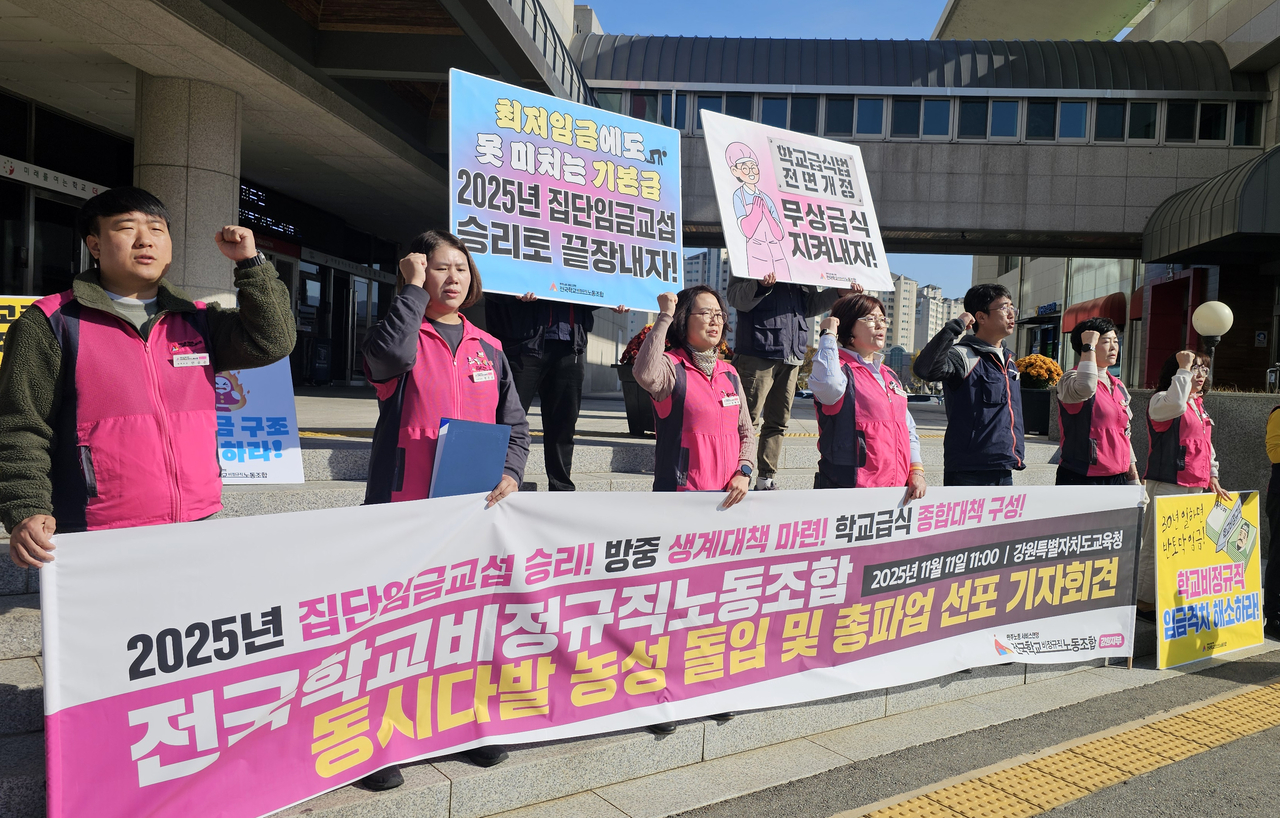
A nationwide strike by nonregular school workers, including staff responsible for school meal services, cleaning and after-school care, is set to begin Thursday, prompting the Ministry of Education and regional education offices to prepare contingency plans to minimize disruptions.
The walkout comes after months of stalled negotiations, with wage talks that began in August failing to bridge differences even during the final round of mediation last week.
The Education Ministry said Wednesday that collective bargaining involving the union representing irregular school workers, the ministry and all 17 provincial education offices has not produced an agreement despite repeated rounds of talks.
The union has called for an overhaul of the pay structure for education support staff, increases in base pay and holiday bonuses, compensation for unpaid school breaks and fairer welfare benefits.
Education authorities, citing budget constraints at local offices and limited fiscal room, have offered only modest proposals on pay raises and holiday bonuses, while rejecting most structural demands.
As a result, the union will proceed with a two-day relay strike conducted in two phases. The first walkout is scheduled for Thursday and Friday, followed by a second round on Dec. 4 and 5.
On Thursday, union members based in schools in Seoul, Incheon, Sejong, Gangwon Province and North Chungcheong Province will go on strike. The following day, workers based in Gwangju, North and South Jeolla provinces and Jeju Island will join the walkout.
Staff from Daejeon, Gyeonggi Province and South Chungcheong Province will signal the start of the second walkout on Dec. 4, and workers from Daegu, Busan, Ulsan as well as North and South Gyeongsang provinces will follow the day after.
The union, as of April, represented roughly 94,000 school staff nationwide, including cafeteria and after-school care workers,
Due to the strike, students at affected schools will be served simplified substitute meals, such as bread, milk and yogurt, instead of the standard lunches.
For after-school care, education authorities stated that substitute programs will be arranged to keep services running normally.
To quickly manage any critical issues that arise during the strike, the Education Ministry and regional education offices said they would operate emergency response rooms.
Special education schools will also implement their own contingency measures, including shortened school hours and flexible academic schedules.
During a similar strike in December last year, school lunches were halted at 3,910 schools, or 30.7 percent of all schools nationwide. At the time, schools responded by distributing prepackaged meals, allowing students to bring lunch from home or modifying class schedules.
Last year, 3.3 percent of schools canceled their after-school care services, affecting 201 schools nationwide and 37 kindergartens.
lee.jungjoo@heraldcorp.com