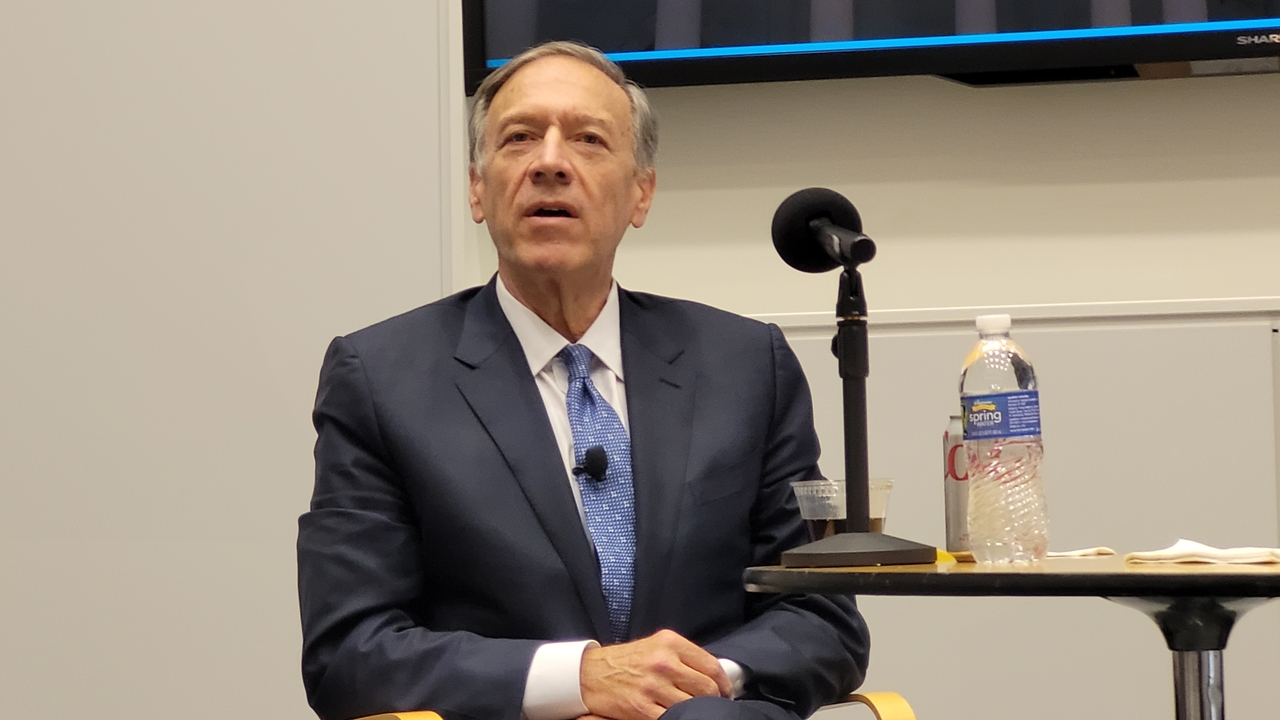
Former US Secretary of State Mike Pompeo said Monday that North Korea's denuclearization will happen only with Chinese President Xi Jinping's "permission" and "direction," underlining the need to focus on deterring Beijing from using Pyongyang as a "strategic tool."
During a forum, Pompeo, the chief diplomat during President Donald Trump's first administration, recounted his nuclear negotiations with the North in 2018 and 2019, claiming there is not much freedom for North Korean leader Kim Jong-un on the nuclear issue as Beijing and Pyongyang are "deeply intertwined."
He also pointed out that there are currently "no carrots" to convince the recalcitrant regime to renounce its nuclear program and the number of "sticks" available is low, while noting that Kim may want to get economic sanctions relief if talks with the United States resume.
"If the idea is to get the nuclear weapons moved out of North Korea, it's only going to happen with the permission and the direction of Xi Jinping. Talking to Chairman Kim is interesting but not that instructive," Pompeo said during a fireside chat hosted by D&A LLC, a South Korean law firm.
"If you said what would you do differently, it would be to focus on Beijing and deterring it from using North Korea as a strategic tool," he added.
The former top diplomat was responding to a question about what he would do to make progress should diplomacy resume with Pyongyang, while acknowledging that the nuclear negotiations during his time in office were ultimately "unsuccessful."
His remarks came as Trump has repeatedly expressed his openness to reengaging with Kim, adding to speculation that he would seek to rekindle his personal diplomacy that led to three in-person meetings with Kim during his first term -- the first in Singapore in June 2018, the second in Hanoi in February and the third at the inter-Korean border village of Panmunjom in June 2019.
Pointing to China's influence over the North, Pompeo recalled Kim's interactions with Xi before and after the top-level negotiations with the US.
"(Kim) traveled to Singapore, to Hanoi and then the third summit actually on the border. Each time, he reported back to Beijing, both before and after the meetings. This was really Xi Jinping with whom we were negotiating," he said.
"So when I think about those nuclear arsenals, I think about them not as a single enterprise ... not a great deal of freedom or agency for Chairman Kim ... This is not just a Chairman Kim problem. This is a China problem there. They are deeply intertwined."
Pompeo also raised the possibility that Xi might be behind Pyongyang's decision to send troops to Russia in its war against Ukraine.
"No one should be under any illusions that they did not go there without the direction of Xi Jinping," he said. "Now, I don't have the orders that were issued, but I am intensely confident that there was no chance that would happen."
He anticipated that Kim would want to secure sanctions relief if a summit with Trump materializes, as the impoverished country has long been struggling under the biting sanctions imposed for its nuclear and ballistic missile programs.
"What Chairman Kim would love is to get economic relief. What he would love is to be brought back into the fold of a more normal nation," he said.
But he pointed out that Kim has proffered "nothing" to convince the international community, including South Korea, Japan and the US, to allow for that relief, and that he does not have any tool to achieve it.
"It seems to me the likelihood of that being successful for him is very low," he said.
Touching on his in-person encounter with Kim, the former secretary called the dynastic ruler a "nasty" man and "evil."
"I don't mean he's rude ... He believes that the Korean Peninsula is his. They have been wronged, and he's determined to find a methodology (to) get it back," he said. "He has a buddy in Beijing that would just love to see that as well."
He expressed skepticism that the second Trump administration would formally recognize North Korea as a nuclear-armed state, amid lingering speculation that Trump could pursue a reduction of threats rather than the long-elusive objective of denuclearization.
"I would be very surprised if there would be a formal statement accepting North Korea as a nuclear nation," he said. "When we say threat reduction, what you are really saying is a recognition of them as a proper nuclear state. That would surprise me a whole lot that that would come out of the Trump administration."
Asked if he sees the possibility of Trump using the negotiations with the North as a means to secure a Nobel Peace Prize, Pompeo said, "That's not the avenue."
Noting that there is not much leverage to use against North Korea, he proposed continuing to tighten the screw on the regime through efforts including preventing its revenue generation.
"My view is we should make things as difficult as possible for the regime. Starve them of as much resources we can because those resources don't go to feed the North Korean people," he said. "Those resources go to fuel his military capability, and we ought to try and make that as small and as limited as possible."
Commenting on Trump's recent approval for South Korea's push to acquire nuclear-powered submarines, he struck a positive note, particularly regarding the prospects of the US Congress backing it.
"Yes, I think it's absolutely possible that you could get bipartisan congressional approval for further cooperation on this file from Capitol Hill. I don't think it's remote," he said. (Yonhap)