

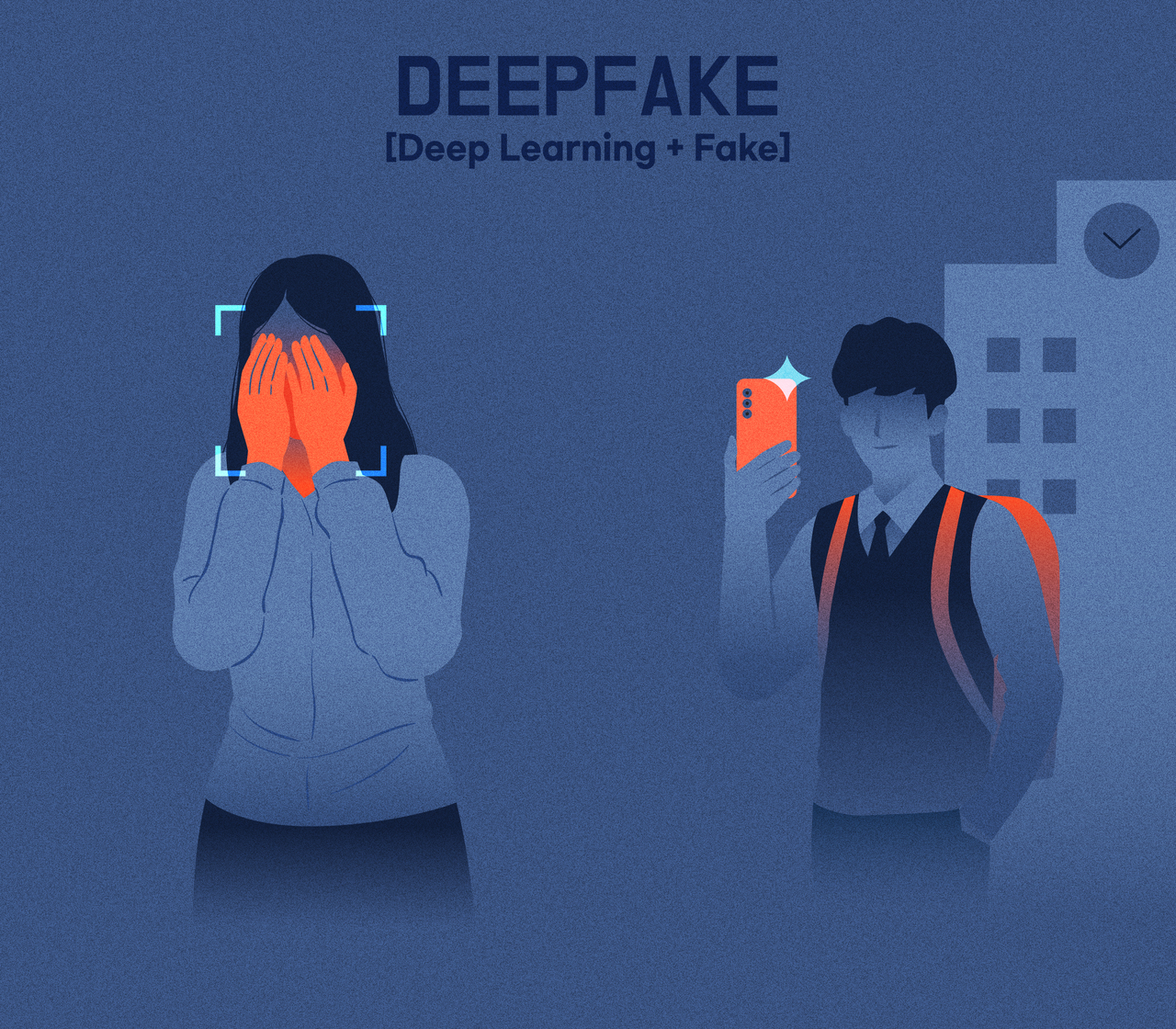
South Korean police said Monday that they arrested more than 3,500 suspects over the past year in a sweeping crackdown on cybersex crimes, with nearly half of the offenders being teenagers.
According to the Korean National Police Agency’s National Office of Investigation, the nationwide operation — conducted from November 2024 to October 2025 — uncovered 3,411 cybersex crime cases among 4,413 reported. This led to the booking of 3,557 suspects, 221 of whom were taken into custody.
Police launched the crackdown after August 2024, when Telegram chat rooms where members shared sexually explicit images of people they knew were uncovered. The images were generated using deepfake technology that employs artificial intelligence to create realistic but fake images and videos.
In its crackdown, police discovered that deepfake crimes accounted for the largest share of cybersex offenses reported, totaling 1,553 cases, or 35.2 percent of the total.
Other major offenses included possession and distribution of sexual exploitation material featuring minors (1,513 cases) and the production or circulation of illegally taken content (857 cases). When deepfake materials involved children or teenagers, the crimes were counted under both categories.
Police data showed that a majority of offenders were teenagers, making up 47.6 percent of all suspects. This was followed by individuals in their 20s at 33.2 percent and those in their 30s and 40s at 12.7 percent and 4.6 percent, respectively.
Narrowed down to deepfake-related offenses, the teen share jumped to 61.8 percent, or 895 individuals, while the number of offenders in their 20s accounted for 30.2 percent. Police attributed these numbers to young people’s digital fluency and the accessibility of editing tools.
According to the KNPA, the total number of arrests for cybersex crimes represented a 47.8 percent increase from the same period a year earlier, when 2,406 suspects were apprehended.
Officials stated the sharp rise was partly due to the rapid advancement of AI technologies that made deepfake production easier, as well as a legal revision made to the Act on the Special Cases Concerning the Punishment of Sexual Crimes, which broadened the scope of punishment for sexual crimes committed using deepfake technologies.
The KNPA said it plans to extend the crackdown to October 2026, focusing on crimes involving AI generation and emerging abuses of generative technology. The agency will continue working with platforms such as Telegram and the Korea Communications Standards Commission to remove or block explicit videos.
In response to the high proportion of teenage offenders, police will work with the Ministry of Education to expand deepfake-crime prevention materials in schools and strengthen youth awareness campaigns.
lee.jungjoo@heraldcorp.com


![[World Class] HUFS bets on Songdo, AI to redefine what a global university can do](https://wimg.heraldcorp.com/news/cms/2026/10/18/news-p.v1.20260930.7e4dbeacfc1d4d16848c0e2a441c04e6_R.jpg?type=h&h=120)
