
Kosdaq lags behind Kospi, weighed down by low profitability and capital outflow
Nearly three decades after its launch as Korea’s answer to the Nasdaq, the Kosdaq is struggling to live up to its original promise as a market for innovation and growth.
Once envisioned as a springboard for tech startups and the next generation of industry leaders, it has instead become a quiet corner of the country’s equity landscape — and an increasingly neglected one.
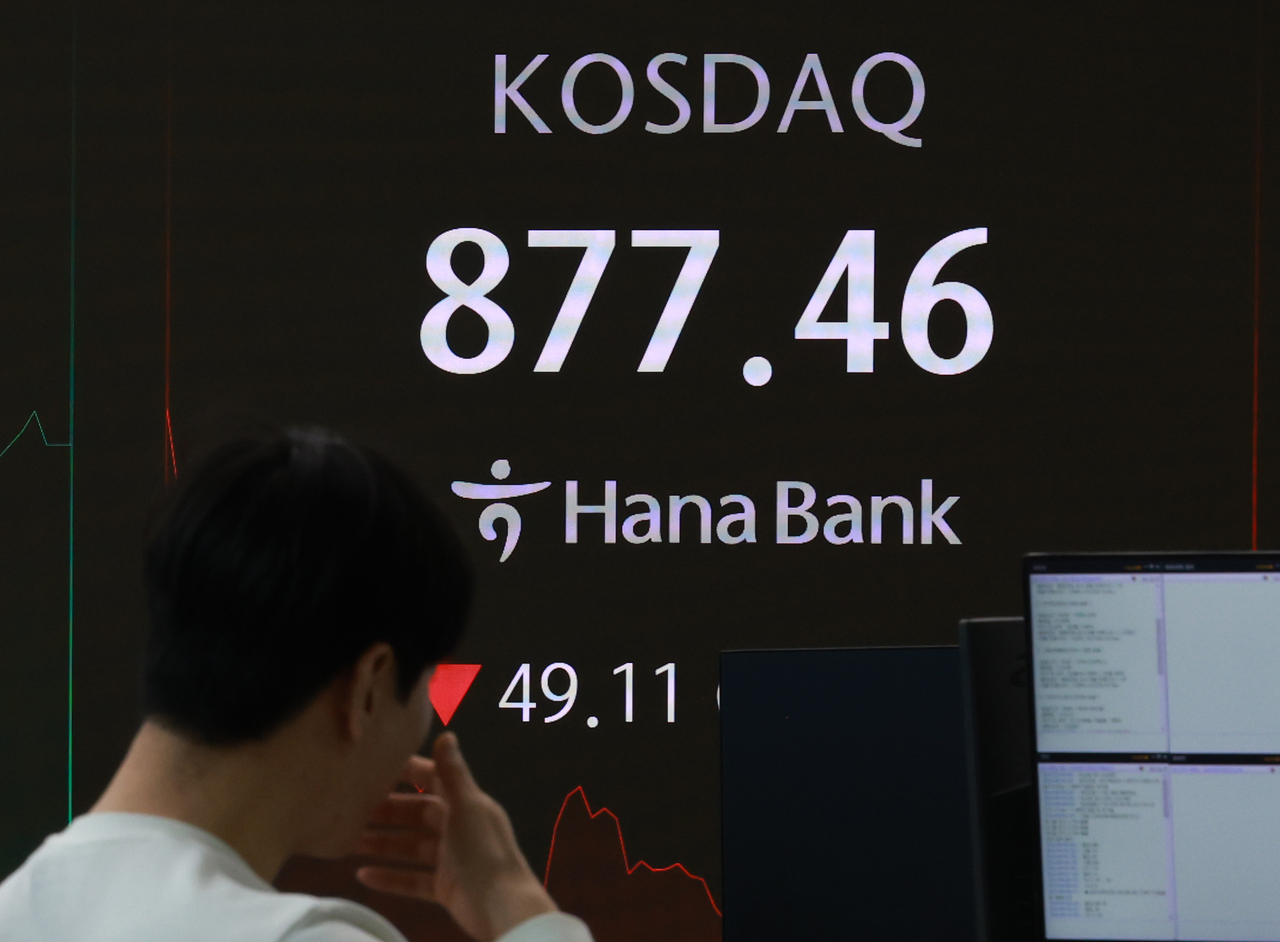
The gap between the Kosdaq and the Kospi has rarely looked wider. Since June, when the main board began its record-setting 56 percent rally, the tech-heavy Kosdaq has climbed just 26 percent. It has recently been hovering below 900, roughly where it stood five years ago and still short of the 1,000 baseline it reset to in 2004.
The Kospi’s total market capitalization topped 3,000 trillion won ($2 trillion) this year for the first time, up 1,000 trillion won in five years, while the Kosdaq still hovers near 400 trillion won, roughly where it stood half a decade ago.
Much of the recent divergence comes down to what’s driving the rally. The Kospi’s surge has been powered by heavyweight chipmakers Samsung Electronics and SK hynix, which together accounted for nearly 30 percent of daily trading volume in October and lifted the index 17 percent in a single month. The Kosdaq, dominated by smaller biopharmaceutical firms, has missed out on the global semiconductor boom and remains weighed down by weak sentiment in growth-oriented sectors.
Easy in, hard out
Analysts say the Kosdaq’s problems go far beyond short-term sector weakness. The market’s structure, designed to be accessible for smaller firms, has long prioritized entry over accountability.
“Most Kosdaq-listed companies fail to show profitability or consistent growth after listing,” said Lee Hyo-seob, senior research fellow at the Korea Capital Market Institute. “Many go public when earnings and growth potential have already peaked, so their stock performance remains sluggish afterward.”
That leniency shows up in the numbers. Listing requirements on the Kosdaq are far looser than on the Kospi, allowing even loss-making companies to list under growth or technology exemptions.
Delisting standards are softer too. Fewer than 1 percent of Kosdaq firms have been removed from the market in the past five years, compared with about 2.5 percent on the Kospi. “As a result, many financially unstable, unprofitable ‘zombie companies’ continue to trade without meaningful progress,” Lee said.
In the first half of 2025, about 47 percent of Kosdaq-listed firms posted net losses, nearly twice the ratio seen on the Kospi.
Investor flight deepens outflow
With few success stories and limited institutional participation, the market has tilted increasingly toward retail traders, reinforcing weak momentum and fragile capital inflows.
Foreign investors have largely withdrawn. Between January and October, they sold 1.8 trillion won in Kosdaq shares, while institutions offloaded another 1.4 trillion won. Retail investors were the only net buyers, purchasing 6.2 trillion won. The Kospi, meanwhile, saw foreigners switch from net sellers in the first half to net buyers in the second, helping fuel its record rally.
Foreign indifference has deepened over time. “They’re just not seemingly investable,” said an analyst at a global investment bank, who spoke on condition of anonymity. “It’s widely accepted that many unworthy firms go public on the Kosdaq just for an exit, using it as a liquidity outlet. When we talk about Korean equities, Kosdaq doesn’t even come up in the conversation.”
The result is a market expanding in size but not in substance. Over the past decade, the number of Kosdaq-listed firms has jumped from about 1,100 to 1,800, yet their average market value has grown only 37 percent. The Kospi’s listed firms, by contrast, increased just 9 percent in number but nearly doubled in market capitalization.
Regulatory reforms, capital fixes
Experts urge that policy support is essential for the Kosdaq to regain relevance. KCMI's Lee called for tightening listing and delisting rules to improve market quality. “Instead of allowing firms to go public when they’ve already peaked in profitability and growth, the system should better select promising companies with genuine potential," he said.
Government policy, however, has largely favored the Kospi. “Recent reforms, such as governance rules, can only be implemented by a few companies even on the main board,” the global banking analyst said. “That’s why financial stocks, which are less affected by controlling owners, drew investor attention early on. And they also benefited from the government’s push for higher dividends.”
Corporate governance reforms are certainly needed in the Kosdaq, but it is doubtful that many companies there have the capacity to implement them, he added.
Efforts to attract foreign investors through English disclosures or global roadshows are also seen as unrealistic for most small and mid-cap firms. “Institutions organizing such IR events usually limit participation to companies above a certain market cap,” said an official familiar with the Kosdaq market. “For many SMEs and startups, even joining those sessions is a luxury. Government-backed support is essential.”
The expert, whose work involves supporting Kosdaq-listed firms and who understands their challenges firsthand, said a more stable capital base is crucial. “If institutional investors such as the National Pension Service expand their exposure to the Kosdaq and large-scale activation funds are created, it would boost the index to gradually trend upward,” the official said.
Some market viewers expect a rebound for Kosdaq in 2026, supported by cyclical sector rotation and policy reforms aimed at reviving the market.
The government has recently simplified delisting procedures and plans to tighten listing maintenance rules, including raising the minimum market capitalization requirement from 4 billion won to 30 billion won by 2028. It also plans to strengthen the venture and startup ecosystem through a series of initiatives, including the National Growth Fund, which will invest 150 trillion won over the next five years in strategic high-tech industries.
jwc@heraldcorp.com