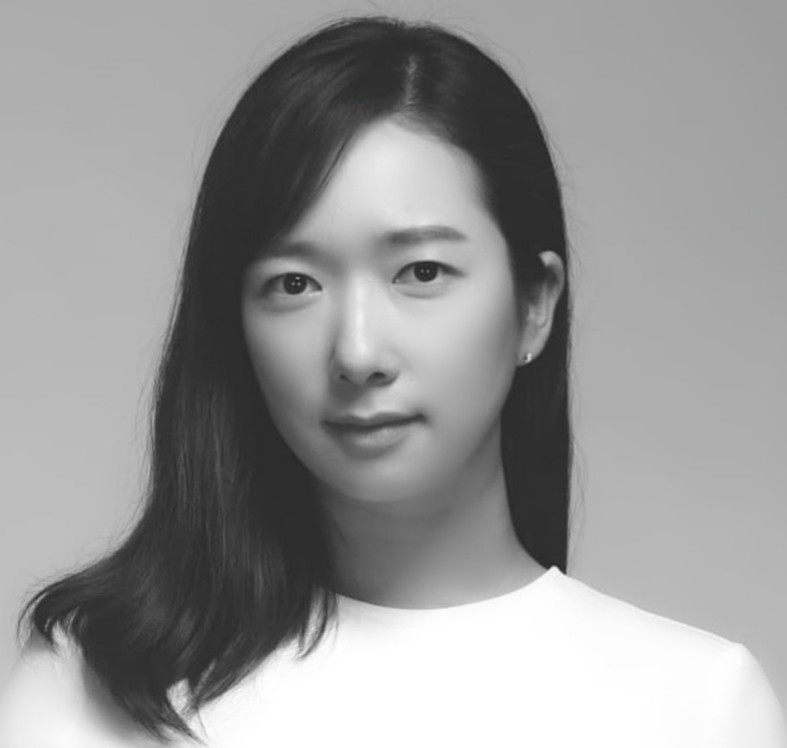
Artist reveals how past and present coexist on a single surface through the meditative process of layering and sanding lacquer.

In traditional East Asian painting, when ink is applied to hanji, Korean mulberry paper, it seeps into the fibers, becoming one with the paper itself.
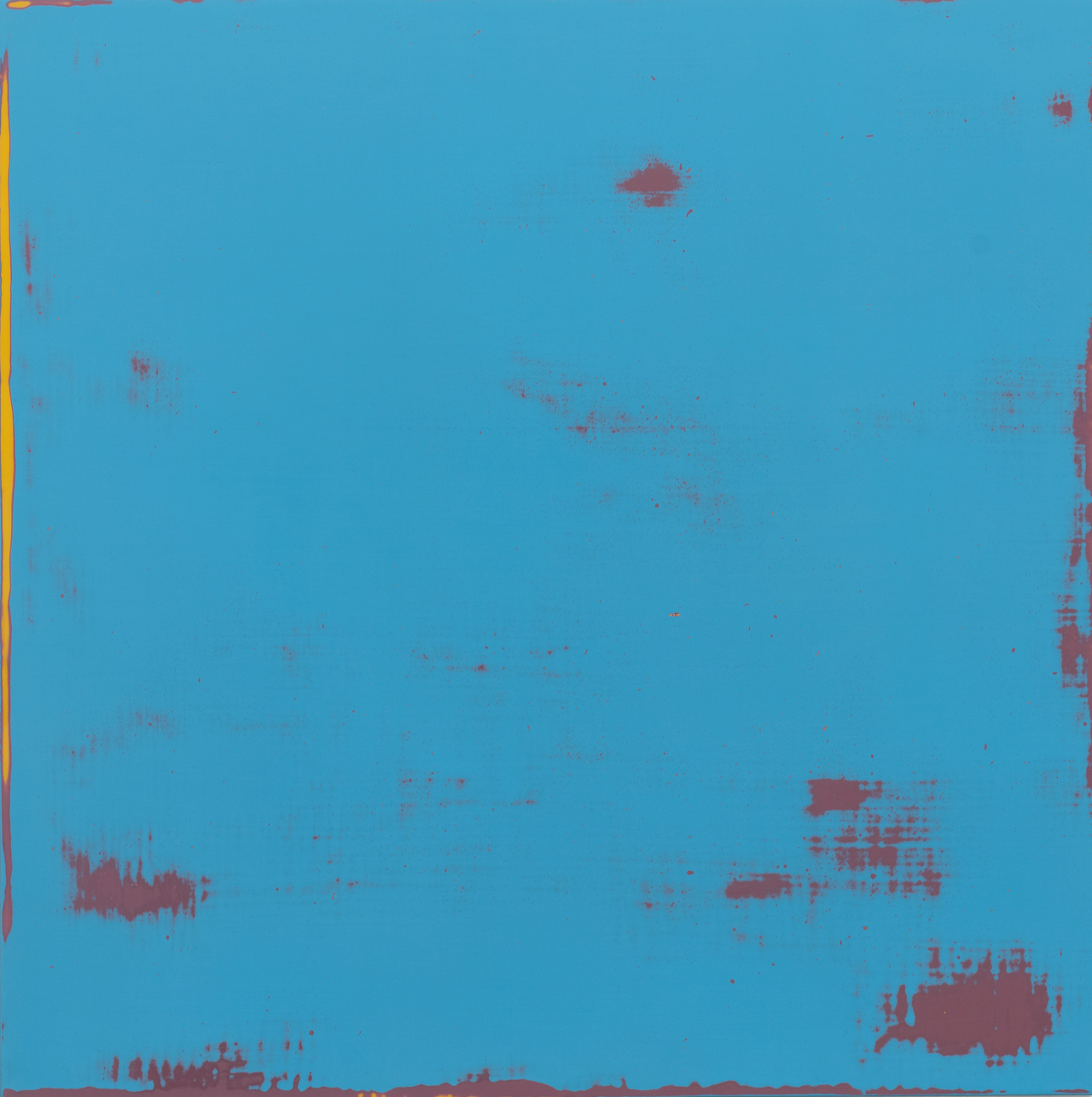
Lacquer artist Kim Deok-han’s works embody a similar principle in his own material language. Even with multiple layers of lacquer, they do not build up, but coalesce into a single, unified surface. The sense of unity is achieved through repeated sanding of the layers with sandpaper.
“You can touch it here, if you would like. I layered black, yellow, green, black again and white. But these lacquer layers exist on the same flat surface,” Kim, pointing to one of his works, told The Korea Herald on Oct. 30 at Whitestone Gallery in Seoul.
“The past isn’t beneath and the present isn’t above; past and present coexist on a single surface. Isn’t that just like who we are today? We are the accumulation of past emotions, experiences and memories that together make up our present selves,” the artist said.
Also referred to as "ottchil" in Korean, lacquer was traditionally used for decorative techniques for the finest lacquerware or mother-of-pearl inlay. Raw lacquer collected through notches cut into lacquer trees (Rhus) — which are grown only in East Asia — has a naturally dark tone.
Kim mixes color pigments into raw lacquer to create his own medium.
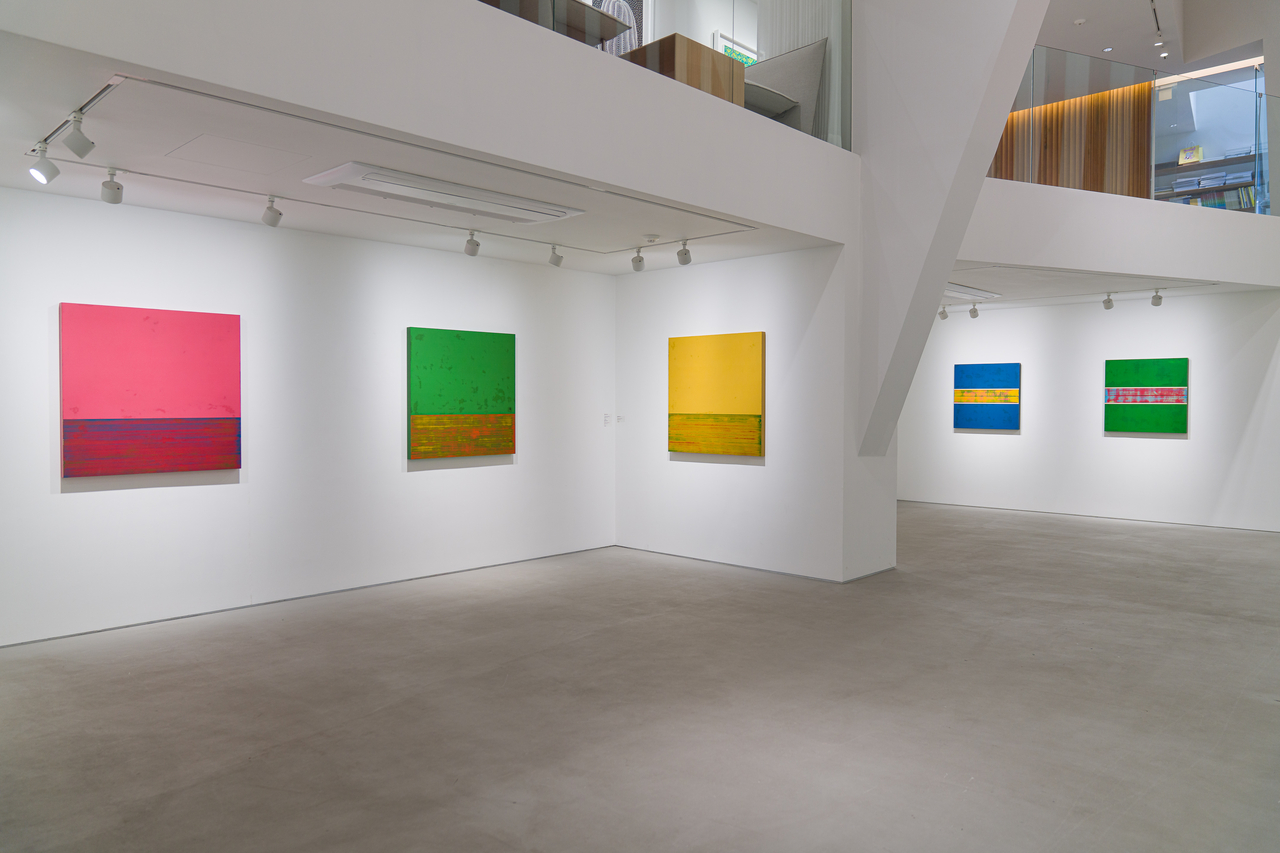
“Overlaid: Layered Time, Forms of Memory” is Han's first solo exhibition in Korea in five years, following one at the Lee Ungno Museum where he was selected as a promising artist. A total of 56 works were brought together across the three floors of the gallery.
Kim applies about nine layers of pure lacquer, followed by four to five layers of colored lacquer, over a wood or an aluminum panel covered with linen. Then his real work begins: he sands the surface repeatedly with sandpaper, the artist told The Korea Herald.
The process usually takes six to twelve months, as time and patience is required to allow each colored layer to dry completely before another is applied, according to the gallery.
“Sometimes, when I scrape the surface, it peels beautifully; other times, it doesn’t,” he said. “It depends on so many factors: the amount of lacquer, the pressure of my hand, and so on. It’s not something I can control a hundred percent. So this work is about letting chance become inevitability.”
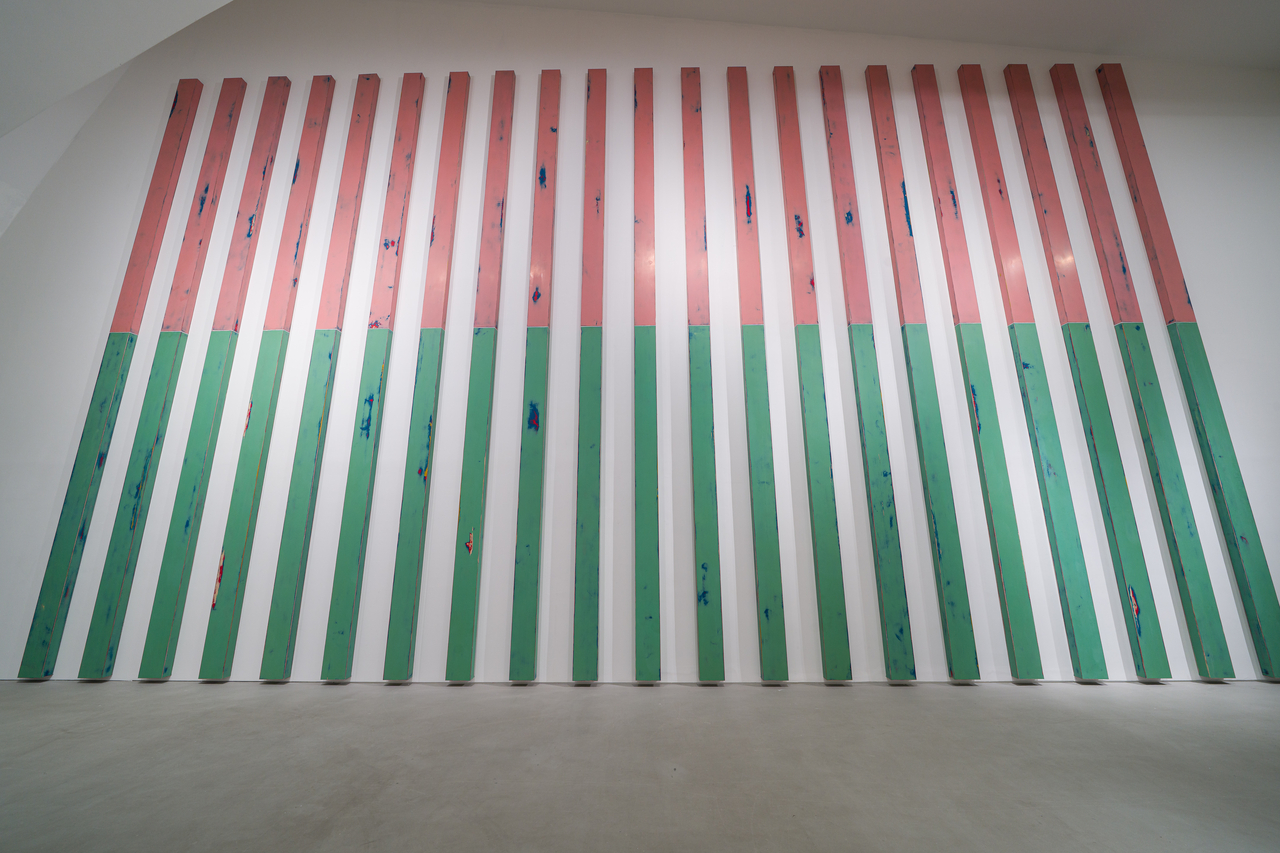
Kim presents his first monumental installation work “Division Series No.2025” at the exhibition, stretching 12 meters in length and 6 meters in height, transforming the second-floor of the gallery into an immersive spatial experience.
There are some works that he intentionally “wounded” for the exhibition. After finishing the piece — repeatedly layering lacquer — one day he pressed down hard with an “extremely rough sandpaper that I should never have used,” Kim recalled.
“As I did, the underlying layers were suddenly exposed, raw and honest, and I felt strangely relieved,” he said. “I had been carefully sanding to glimpse what lay beneath, but at that moment, I realized I could express it all through a single instant – it was like a moment of ‘chalna.’”
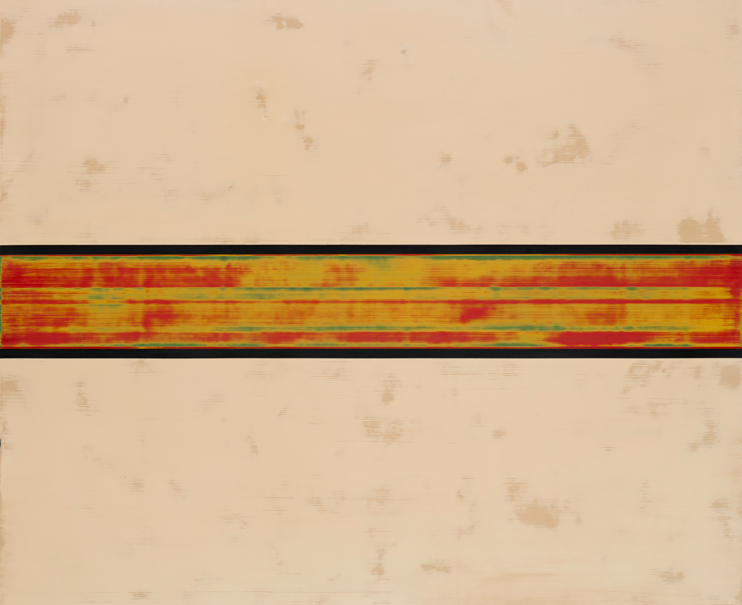
The Korean word chalna stems from a Buddhist term and represents the fleeting moment in which all phenomena arise and disappear, emphasizing the impermanence of everything that exists.
“Overlaid: Layered Time, Forms of Memory” at Whitestone Gallery in Seoul opened on Oct. 25 and runs through Dec. 7.
yunapark@heraldcorp.com



![[Exclusive] Ateez to return in November](https://wimg.heraldcorp.com/news/cms/2026/09/02/news-p.v1.20260902.76162fb0ba55493aad1c076f240d0750_R.jpg?type=h&h=120)