
Partnership aims to develop hydrogen power generation, transport networks, expanding Hyundai’s clean energy footprint across Southeast Asia
Hyundai Motor Group has forged a partnership with the Singapore government to explore opportunities for developing hydrogen-based low-carbon infrastructure, strengthening bilateral cooperation in advancing a clean energy economy.
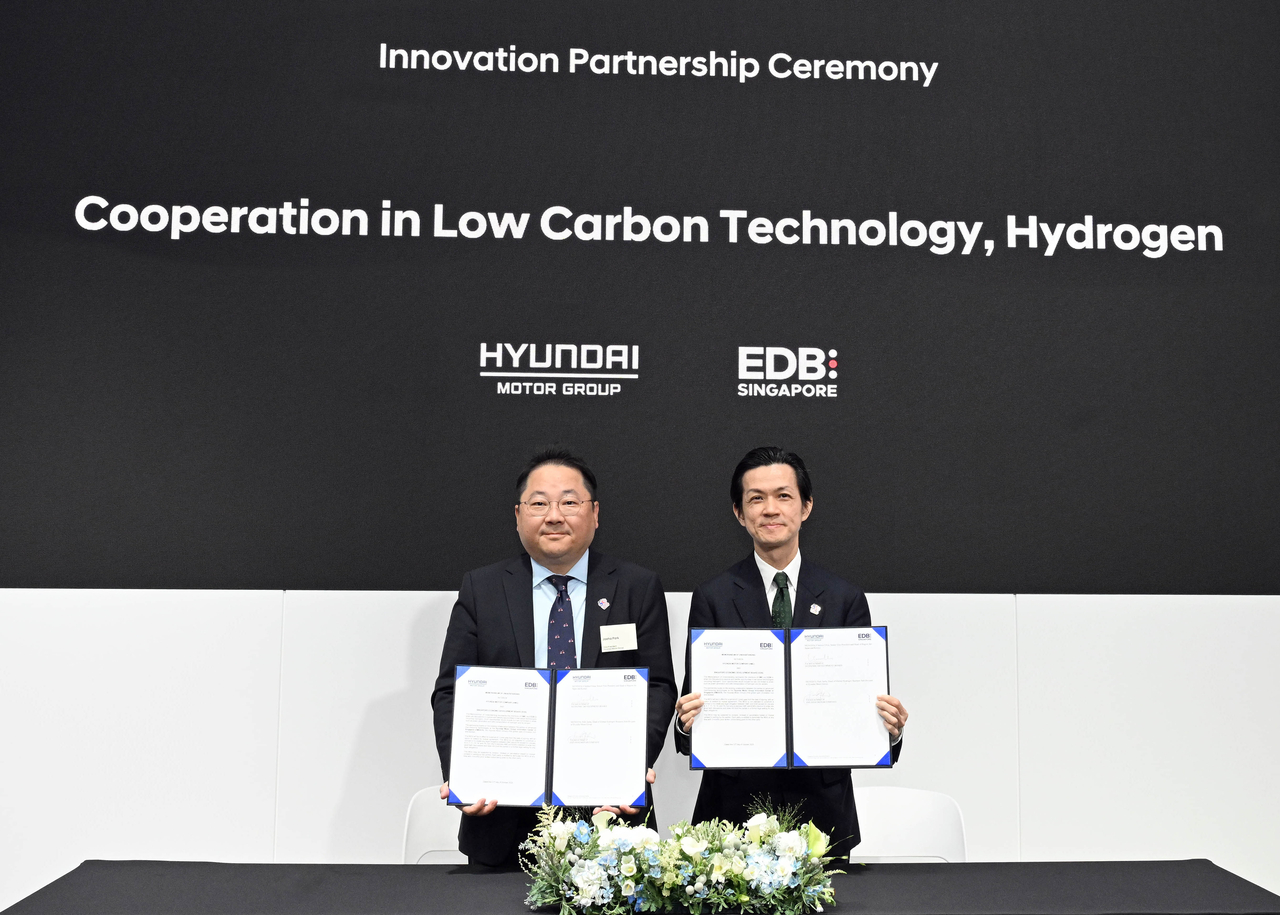
According to Hyundai on Monday, it signed a memorandum of understanding with the Singapore Economic Development Board on Friday during the K-Tech Showcase event, held on the sidelines of the Asia-Pacific Economic Cooperation summit in Gyeongju, North Gyeongsang Province. EDB, a statutory board under Singapore’s Ministry of Trade and Industry, drives the nation’s economic growth and global standing as a hub for business and innovation, with its initiatives contributing over one-third of Singapore’s annual gross domestic product.
Key executives, including Park Jae-ha, senior vice president of the global hydrogen business subdivision at Hyundai Motor Group, Clarence Chua, executive director of Korea and Japan at the Singapore Economic Development Board, and Trevor Wong, director of Korea and Japan at EDB, attended the signing ceremony.
Under the partnership, Hyundai Motor will leverage its technological expertise to support Singapore’s development of hydrogen-based low-carbon technologies, focusing on developing power generation using hydrogen energy and enabling long-distance hydrogen transport. EDB will assist in advancing Hyundai’s hydrogen ecosystem initiatives in the country.
The company stated, “Following the recent establishment of a cross-border free trade zone between Singapore and Johor, Malaysia, Hyundai expects the partnership to expand into a wider hydrogen infrastructure network across Southeast Asia.”
Hyundai also plans to collaborate with local mobility partners in Singapore to raise public awareness of sustainable hydrogen ecosystems by deploying hydrogen-powered vehicles in local operations.
“Government and institutional support are vital to building a solid foundation for the hydrogen industry. Through our partnership with EDB, we aim to shape policy direction and implementation frameworks that will accelerate the development of the hydrogen ecosystem,” said Park.
Hyundai has been expanding its global hydrogen footprint, particularly in California, where it is advancing its fuel cell truck business through clean port logistics projects such as the NorCAL Zero initiative. Under the program, Hyundai deploys its Xcient Fuel Cell heavy-duty trucks for commercial freight operations, showcasing the viability of hydrogen-powered transport while promoting refueling infrastructure and scalable clean logistics across North America.
The Xcient Fuel Cell truck is the world’s first mass-produced hydrogen fuel cell heavy-duty truck, equipped with a high-efficiency 350-kilowatt motor, dual 90-kilowatt fuel cell stacks and a 72-kilowatt-hour high-voltage battery. Since its launch in 2020, the vehicle has been deployed in key markets including Korea, the US, Switzerland and Germany, achieving a cumulative driving distance of over 15 million kilometers.
Meanwhile, the carmaker has been deepening ties with Singapore. While the country's vehicle sales volumes are relatively small compared to major markets, it serves as a strategic hub for technological innovation. In 2023, the company established the Hyundai Motor Group Innovation Center in Singapore in Jurong Innovation District — a smart factory test bed for advanced manufacturing platforms and future mobility technologies.
hyejin2@heraldcorp.com