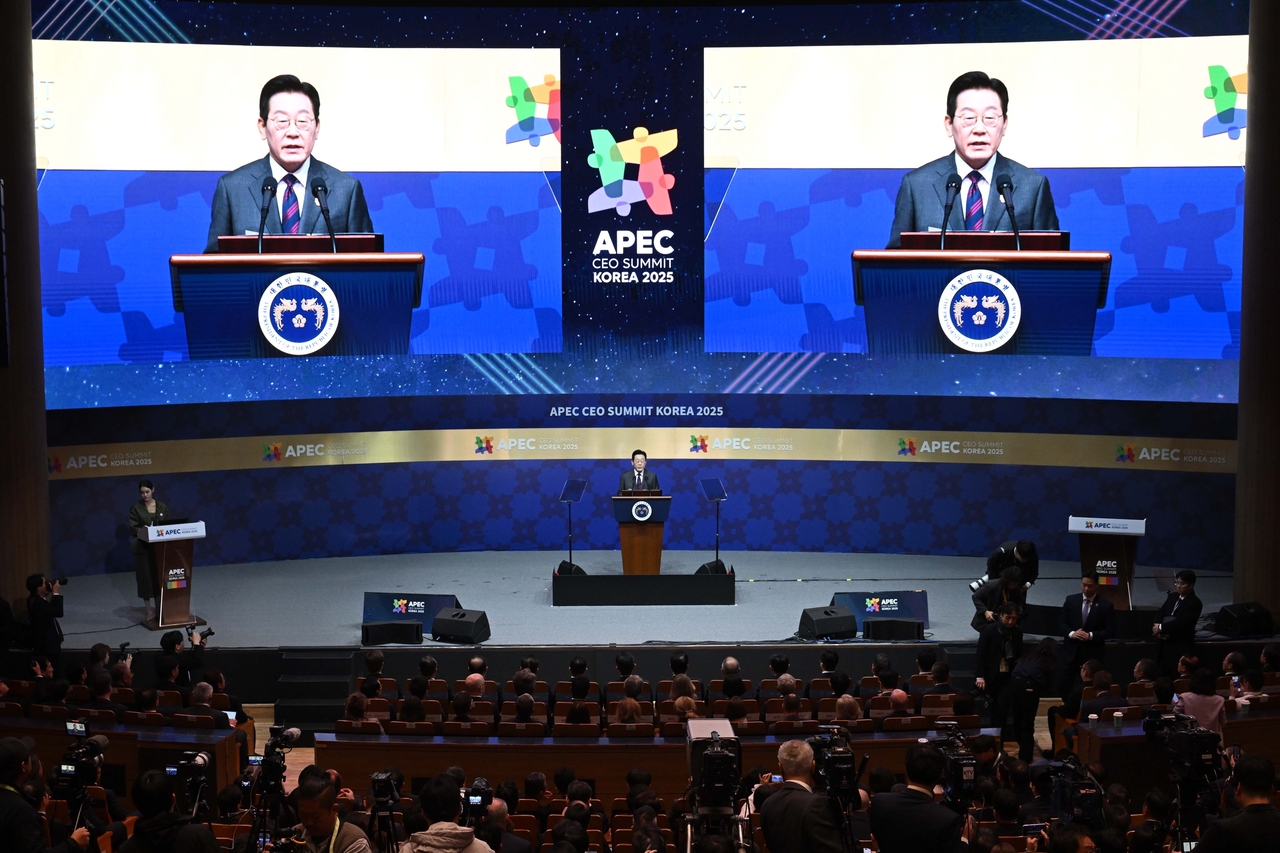
World leaders gathered at the Asia-Pacific Economic Cooperation summit Friday as they seek ways to boost resilience and spur growth amid global trade uncertainties, with President Lee Jae Myung calling for "cooperation and solidarity" among APEC member economies.
The two-day gathering has brought together the leaders of 21 APEC member economies, guest nations and representatives of international organizations, with discussions on sustaining free trade and bolstering regional economic integration topping the agenda.
During the first session, which will be run under the theme of "Towards a More Connected Resilient Region and Beyond," Lee emphasized the importance of the APEC gathering amid a shifting free trade order and rising global economic uncertainty.
"Cooperation and solidarity is the surest path for a better future," Lee said in his opening address. "We all stand at a critical turning point as the international order undergoes rapid transformation."
He also noted that the technological revolution led by artificial intelligence presents both unprecedented crises and opportunities.
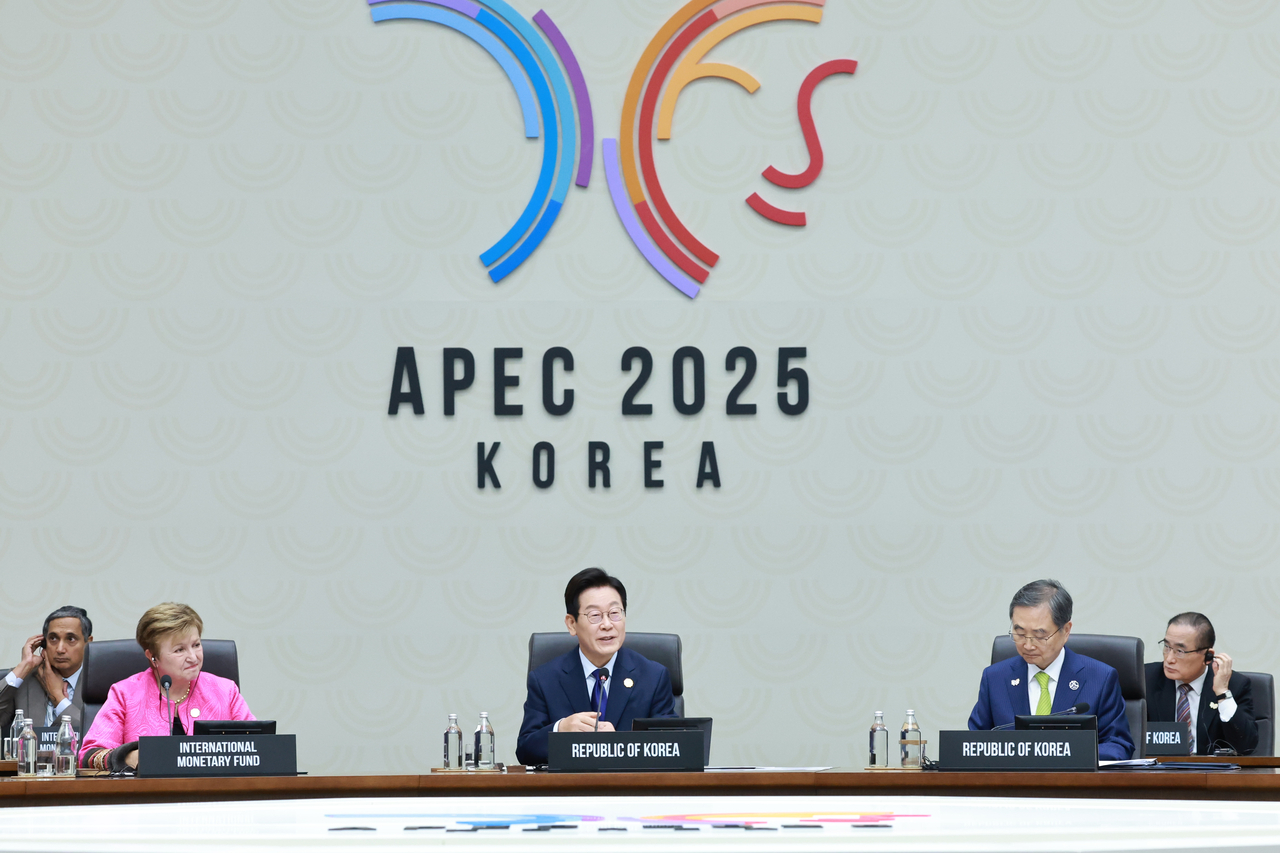
Before the session, Lee welcomed his visiting counterparts and participating guests, including Chinese President Xi Jinping, whom he greeted and briefly spoke with as they entered the summit hall. This marks the first time the two leaders have met since Lee took office in June.
Lee also greeted other APEC leaders who arrived in Gyeongju to attend this week's forum, including Japanese Prime Minister Sanae Takaichi. US President Donald Trump is skipping the leaders' summit, having departed after attending a business forum and holding talks with Lee and Xi.
The presidential office said the leaders plan to discuss ways to make the Asia-Pacific region "more open, dynamic and resilient" at the session.
"President Lee will take on the role of a bridge for leaders to help build consensus on the need for closer cooperation. We aim to restore the region's commitment to collaboration and explore concrete measures for APEC to remain the region's key economic forum and a relevant platform for the future, it said.
South Korea, as the host of this year's APEC events, seeks to produce an outcome endorsed by all APEC participants in its envisioned "Gyeongju Declaration" and put on spotlight its own initiatives, such as AI and demographic changes.
Over the two sessions, the leaders will review the suggestions made by top foreign and trade officials of the APEC members on ways to make the Asia-Pacific region more prosperous, through such efforts as strengthening cooperation in supply chains and digital transition.
Drawing attention is whether and to what extent the leaders will reach a consensus on charting the path for international trade, as they hold differing views on the global free trade order underpinned by multilateralism and the WTO system.
In recent years, most of the APEC economies have endorsed free trade based on the WTO system and reaffirmed their commitment to multilateralism.
Between 2021 and 2024, all APEC summit declarations included the phrase: a rules-based multilateral trading system with the WTO "at its core," which first appeared in the 2021 declaration, after Trump's first term ended.
A leaders' declaration can only be adopted by consensus, with support from every single APEC member.
Following the final APEC ministerial meeting Thursday, South Korean Foreign Minister Cho Hyun said the forum is "very close" to adopting a joint declaration, with last-minute negotiations under way on the ministerial statement, which will be forwarded to the leaders' session.
"We expect the ministerial document to be adopted by Saturday, when we will have the leaders' retreat," Cho said.
Trade Minister Yeo Han-koo, who co-led the ministers' session with Cho, said a broad agreement has been reached in the supply chains, digital and environment sectors, calling them "the core of today's trade agenda and the pillar of the future economy."
"We will continue to uphold the multilateral regime based on the WTO, but as the WTO system is at stake, we are also in support of plurilateral cooperation," he said.
Plurilateralism refers to the concept of an international cooperation among a smaller group of countries, in contrast to multilateralism. (Yonhap)