
A $350 billion investment fund has emerged as the last critical challenge in tariff talks between South Korea and the US, with key negotiators from both sides making a final push to hash out details to strike a deal.
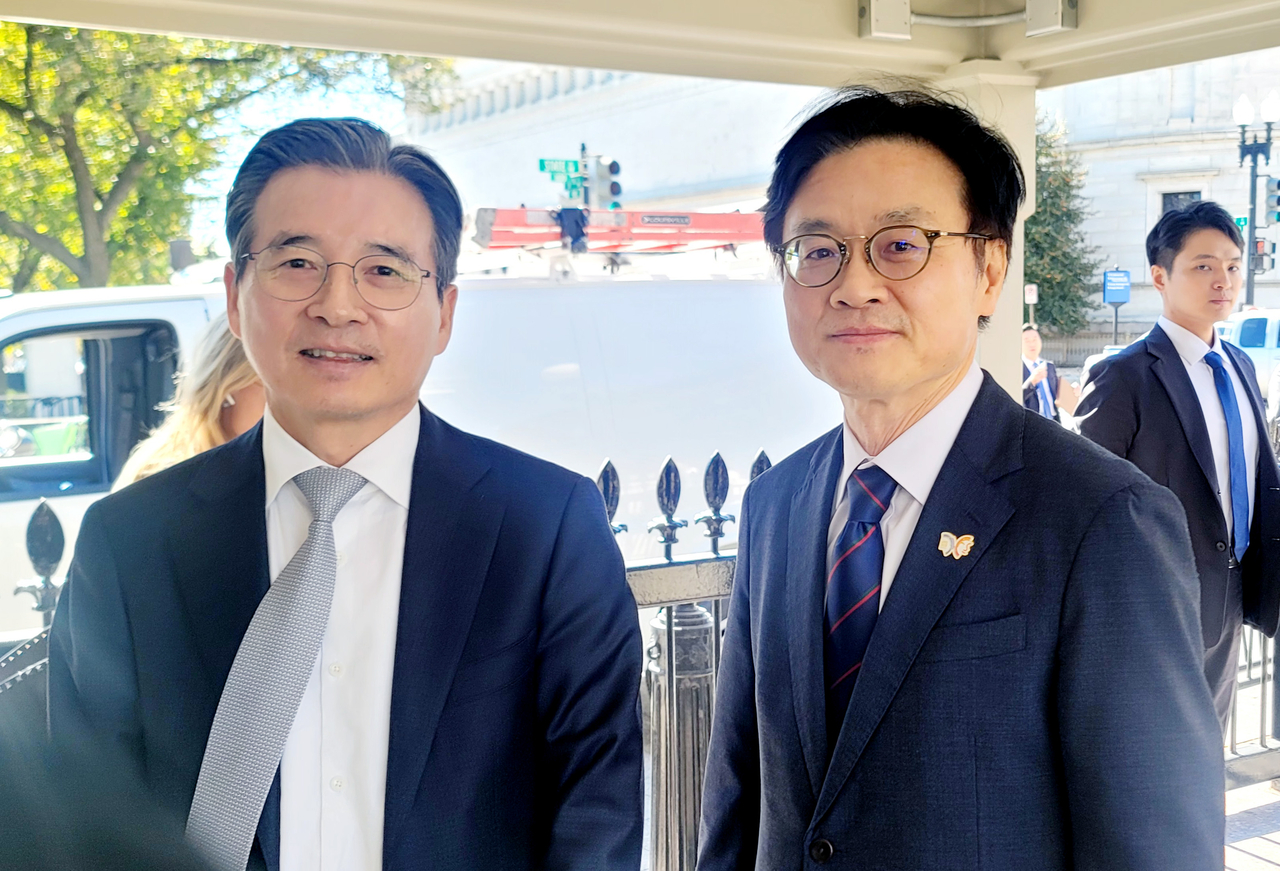
South Korea’s Industry Minister Kim Jung-kwan and US Commerce Secretary Howard Lutnick held more than two hours of talks in Washington on Thursday, seeking to narrow gaps on executing Korea’s $350 billion investment pledge that forms part of the framework deal signed between the two sides in July. Kim Yong-beom, presidential chief of staff for policy, and Trade Minister Yeo Han-koo also joined the meeting.
“We had sufficient discussions for two hours,” policy chief Kim told Yonhap News Agency after the meeting, without elaborating further on whether tangible progress was made.
The latest round of talks come as Seoul has ramped up efforts to finalize the trade agreement’s details by dispatching high-level officials to Washington. Seoul aims to conclude the deal by late this month, in time for US President Donald Trump’s visit to South Korea during the Asia-Pacific Economic Cooperation summit.
The major sticking point has been how to structure and finance the $350 billion investment in the US, which Seoul had agreed to, in return for a reduction in “reciprocal tariffs” from 25 percent to 15 percent. Due to discrepancies over execution, the July deal has yet to take effect, leaving South Korean exports subject to steep duties.
The US has been pushing for an upfront cash injection, while the Korean government has made clear it cannot pay the full amount in cash at once. It maintains that the sum should combine direct investments, loans and loan guarantees as agreed in the original pact, citing Korea’s lack of foreign reserves, which if paid directly could risk a dollar shortage and financial instability.
To cushion the potential impact on its foreign exchange market, Seoul has also requested a currency swap with Washington.
Finance Minister Koo Yun-cheol, who arrived in the US earlier this week for the IMF and World Bank annual meetings, is also backing the negotiation effort. Koo met US Treasury Secretary Scott Bessent on Wednesday and reiterated that an all-cash upfront payment could undermine Korea’s currency stability.
In response, Koo said Bessent is aware of Seoul's challenges. Koo also asked that Bessent convey Seoul's position to senior Trump administration officials, including Commerce Secretary Lutnick, and Bessent agreed to explain the matter.
But Koo acknowledged uncertainty on whether US officials will be able to convince Trump to accept Seoul’s offer.
“It is my understanding that a swift upfront payment of $350 billion is what the US has talked about,” Koo told reporters in Washington. “While the secretaries in charge understand (Korea’s position), there is really an uncertainty as to how much they can do to persuade Trump to accept it.”
sahn@heraldcorp.com


![[World Class] HUFS bets on Songdo, AI to redefine what a global university can do](https://wimg.heraldcorp.com/news/cms/2026/10/18/news-p.v1.20260930.7e4dbeacfc1d4d16848c0e2a441c04e6_R.jpg?type=h&h=120)
