
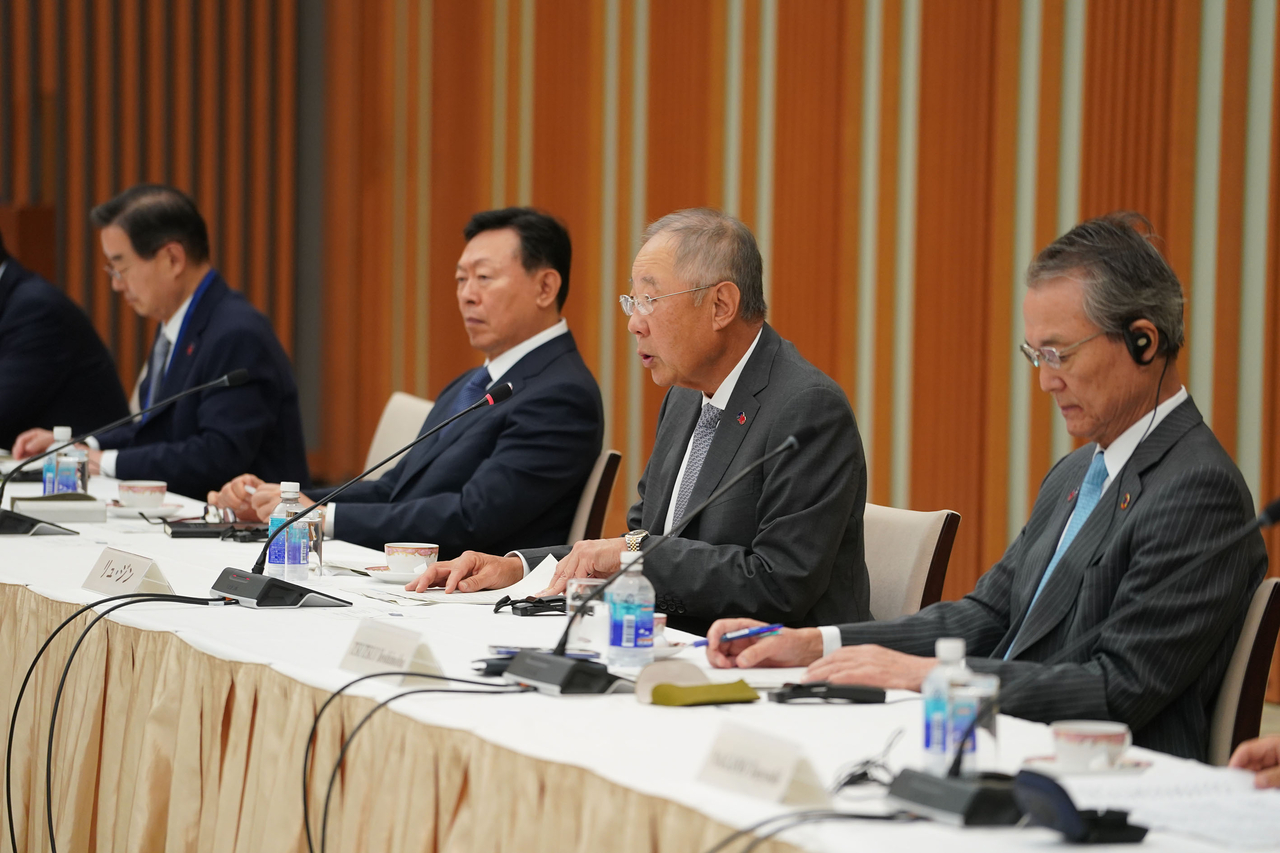
Marking the 60th anniversary of diplomatic normalization between South Korea and Japan, business leaders from both countries vowed Friday to elevate their partnership and deepen bilateral cooperation on trade, technology and supply chains.
The Federation of Korean Industries said it held the 32nd Korea-Japan Business Conference at Keidanren Hall in Tokyo on Friday with the Japan Business Federation, reaffirming the commitment to strengthen ties and jointly respond to the fast-changing global trade environment.
The meeting was attended by 14 top Korean executives, including FKI Chair Ryu Jin, Lotte Group Chair Shin Dong-bin, Samyang Holdings Chair Kim Yoon, Hyosung Group Chair Cho Hyun-joon and LS Group Chair Koo Jae-eun, as well as 11 in attendance from the Japanese side, including Yoshinobu Tsutsui, chair of the Japan Business Federation.
In his opening remarks, Ryu said the two countries should usher in a new future of “Korea-Japan economic cooperation 2.0,” based on the foundation of trust and partnership forged over the past six decades.
“In a world facing rapid changes and uncertainty, Korea and Japan, with their similar industrial structure, should speak with one voice on supply chain reorganization and global trade norms,” said Ryu, calling for joint efforts to support Korea’s entry to the Comprehensive and Progressive Agreement for Trans-Pacific Partnership, a major trade agreement comprising 12 countries, including Australia, Canada, Japan, Mexico and Vietnam.
Tsutsui echoed the call, emphasizing the need to “promote fair, multilateral free trade” through World Trade Organization reform and deeper integration under trade frameworks such as the Regional Comprehensive Economic Partnership and CPTPP. He added that Tokyo and Seoul must strengthen trilateral cooperation with Washington to achieve a free and open Indo-Pacific region.
Participants agreed that businesses face “an era of extreme uncertainty” amid the prolonged war in Ukraine and US tariff measures. They stressed the need to cooperate in key areas such as artificial intelligence, green transition and trade responses, where both governments are pursuing similar policies.
Regarding the free trade agreement between Korea, Japan and China, participants called for the need to speed up negotiations that would exceed RCEP standards in market liberalization and trade rules.
The business leaders also proposed opening the automated immigration systems of South Korea and Japan to each other to improve convenience amid rising bilateral tourism.
Following the meeting, the two business groups adopted a joint statement pledging to maintain a rule-based, free and open trade order and support Korea's CPTPP entry, strengthen cooperation on supply chains and global trade issues. They also agreed to deepen coordination at multilateral stages, such as with the Asia-Pacific Economic Cooperation and Organization for Economic Cooperation and Development.
sahn@heraldcorp.com


![[World Class] HUFS bets on Songdo, AI to redefine what a global university can do](https://wimg.heraldcorp.com/news/cms/2026/10/18/news-p.v1.20260930.7e4dbeacfc1d4d16848c0e2a441c04e6_R.jpg?type=h&h=120)
