
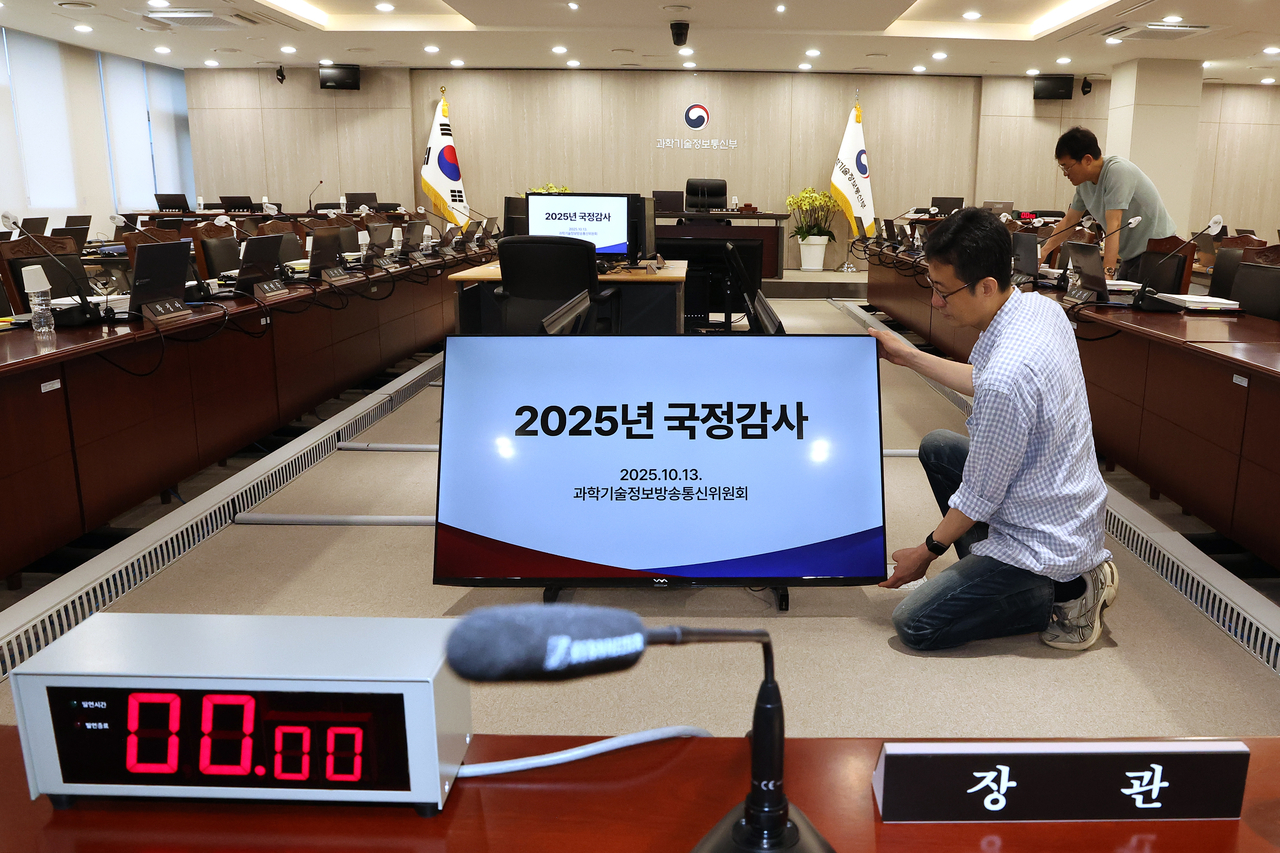
South Korea’s National Assembly is set to open its first parliamentary audit under President Lee Jae Myung on Monday, setting the stage for weeks of political sparring over the early performance of the Lee administration and its policy direction.
Lawmakers are bracing for clashes over judicial reform, controversies surrounding the appointment of a Lee aide and a recent fire at a national data center that disrupted the state’s administrative network, among other issues.
The audit, encompassing 834 government agencies across 17 standing committees over 25 days until Nov. 6, will serve as the first comprehensive evaluation of Lee’s administration since he took office in early June — and a barometer of how his reform agenda is resonating with lawmakers and the public.
The two major parties are expected to use the hearings to advance sharply different narratives. The ruling Democratic Party of Korea is portraying the audit as a chance to restore stability after months of political unrest. The main opposition People Power Party is framing it as an opportunity to expose what it calls mismanagement and overreach by the new government.
The audit is also expected to impact the political landscape ahead of the upcoming local elections in June.
Hearing on top judge
One of the fiercest clashes is expected at the Assembly's Legislation and Judiciary Committee, where the Democratic Party has summoned Supreme Court Chief Justice Jo Hee-de to testify over allegations he attempted to interfere in the June 3 presidential election.
Jo was previously summoned by the Assembly twice — once in May and again in September — over suspicions that he influenced a key ruling involving President Lee’s 2022 election law violation case during his first presidential campaign, but did not appear on either occasion.
While past audits have typically allowed court leaders to depart after opening remarks as a courtesy to judicial independence, the Democratic Party has vowed to keep Jo at the hearing for questioning and warned of issuing a compulsory attendance order should he fail to appear. The party is also demanding access to internal court log records related to how the ruling on Lee’s case was reached.
Democratic Party senior spokesperson Rep. Park Soo-hyun said Sunday that the party will also move forward with its judicial reform agenda this week, including the release of its first set of judicial reform proposals, regardless of the outcome of Jo’s hearing.
The People Power Party has called the move unconstitutional. “This is not judicial reform, it is judicial annihilation,” spokesperson Rep. Choi Bo-yun said, accusing the Democratic Party of attempting to control the judiciary through legislative overreach. “Forcibly summoning the head of the judiciary would go down as a record of constitutional destruction.”
Lee’s longtime aide
Another flash point centers on Kim Hyun-ji, a senior presidential secretary and longtime aide to the president.
The People Power Party claims Kim intervened in high-level appointments during her previous role as secretary for general affairs — a position responsible for managing personnel and administrative affairs at the presidential office. The Democratic Party rejects the summons, claiming Kim was not involved in any controversial matters in her previous role.
Kim served as the first general affairs secretary under the Lee administration, but was appointed on Sept. 29 to head the first office, which oversees the president’s schedule, movements and public engagements. Unlike her previous role, the current position traditionally does not require attendance at audit hearings.
People Power Party floor spokesperson Rep. Choi Eun-seok said the Democratic Party’s refusal to cooperate shows “hypocrisy at its worst.” “The party once demanded jail time for government aides who ignored summonses. Now it’s shielding a powerful figure in the president’s inner circle,” he said.
The Assembly's House Steering Committee will vote Tuesday on whether to summon Kim. The People Power Party has suggested calling her in to other committees.
Ex-KCC head
Key figures also include Lee Jin-sook, who was appointed chair of the Korea Communications Commission under the previous Yoon Suk Yeol administration.
She was dismissed in September when the agency was dissolved under the Democratic Party’s initiative to establish a new media oversight body — a move the People Power Party sees as an attempt to tighten control over national broadcasters.
Lee was arrested in early October for failing to appear at a parliamentary summons over an election law violation case, but was later released by the court.
The Democratic Party argues that the court’s decision to release her reflects the judiciary's favorable treatment toward the former Yoon administration, while the People Power Party says her testimony is unnecessary, as she is now an ordinary citizen following her dismissal.
Daejeon data center
A recent fire at the National Information Resources Service in Daejeon, which disabled parts of the state’s administrative network, will also come under scrutiny at the Assembly's Public Administration and Security Committee later this week.
The incident marks the first large-scale destruction of South Korea’s national data network, reigniting concerns over cybersecurity and digital vulnerabilities.
The People Power Party is demanding an investigation into how the outage occurred and whether contingency systems were properly managed.
Foreign, economic issues
Stalled tariff negotiations with the US, visa concerns following the detention of Korean workers in Georgia, and uncertainty over the Lee administration’s North Korea policy are expected to take center stage at audits by the Foreign Affairs and Unification Committee.
On the economic front, the People Power Party is set to challenge the Lee administration’s fiscal expansion measures, including a stimulus coupon program that offered up to 250,000 won ($176) per person to boost spending.
The People Power Party has said the stimulus coupon policy reflects “reckless populism” and adds fiscal strain amid mounting national debt. The party also plans to scrutinize the government’s industrial and labor policies in high-tech sectors such as semiconductors and artificial intelligence.
flylikekite@heraldcorp.com

![[Exclusive] Ateez to return in November](https://wimg.heraldcorp.com/news/cms/2026/09/02/news-p.v1.20260902.76162fb0ba55493aad1c076f240d0750_R.jpg?type=h&h=120)