
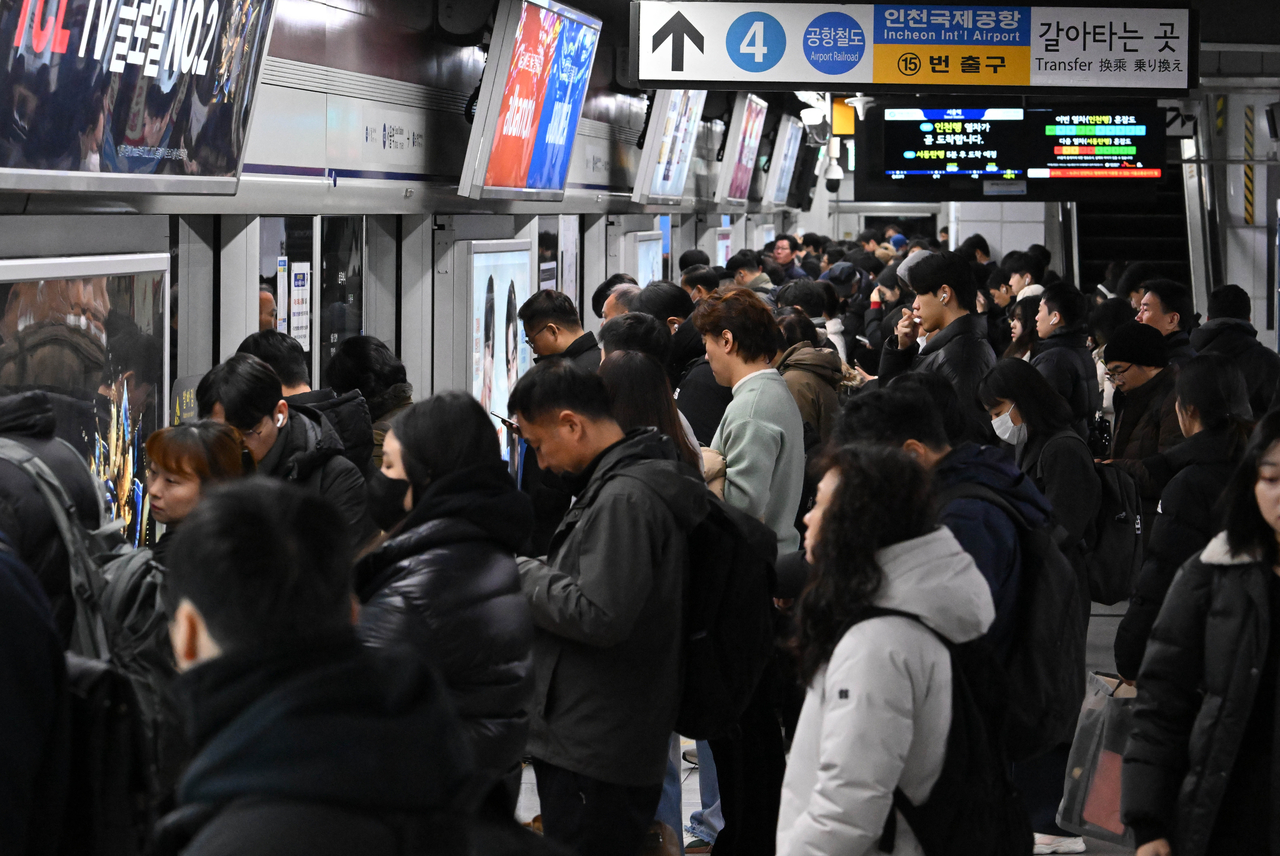
Negotiations between Seoul’s subway operator and its labor unions are set to officially begin Friday, but management and the unions remain divided over key issues related to wages and personnel cuts.
Failure to narrow the differences could mean a high risk of a subway strike.
Since mid-August, Seoul Metro has engaged in informal talks centered on wage increases with its three labor unions.
So far, union officials have warned that a failure to reach a consensus in the coming weeks could prompt collective action — echoing last year’s near-strike, which was narrowly averted after all-night talks in December.
Wage proposals made by the three unions remain a core point of contention.
The largest union is seeking a 5.2 percent raise, while the second and third unions by size are requesting 3.4 and 3.7 percent increases, respectively.
Seoul Metro, however, insists it cannot raise wages by more than 3 percent. The operator said such an increase would cost 328 billion won ($231.2 million), but with only 199 billion won in funds projected to remain this year, even a 3 percent raise would leave a shortfall of about 129 billion won.
The operator and the unions’ ongoing dispute over personnel cuts since 2021 continues to be another key point of contention.
In a plan introduced four years ago, Seoul Metro sought to reduce up to 2,212 personnel by 2026 to streamline operations and address chronic deficits. The first- and third-largest unions have collectively demanded that the plan be scrapped, while the second-largest union has been pushing for an increase in personnel, mainly citing safety concerns.
While this was also a key issue during last year’s talks between Seoul Metro and its workers’ unions, consensus has yet to be reached, as significant differences in stances between unions and management remain.
In November, the unionized workers staged a “work-to-rule” protest after mediation efforts had failed between the unions and Seoul Metro. A full-blown strike was planned for Dec. 6, but was called off after a breakthrough was reached on the day strikes were due to begin.
This year, each of the unions has also put forward additional proposals to improve working conditions, including moving their underground resting areas above ground and installing single beds as well as air conditioning and heating systems in all resting areas.
According to Seoul Metro, it proposed in August to move up first-train departure times by 30 minutes to 5 a.m. for the convenience of workers who start work in the early morning. However, this was swiftly rejected by all three unions, who raised concerns citing worker fatigue. Seoul Metro is not expected to push the plan further.
Despite decentralized negotiations, the main union is seen to hold considerable leverage in union-management talks, as it has a great majority of employees under its wing.
Seoul Metro has a total of three unions, with the main union, affiliated with the Korean Confederation of Trade Unions, representing 57.4 percent of the workforce.
It is followed by two other unions: one affiliated with the Federation of Korean Trade Unions, representing 16.4 percent of the workforce, and another, the Seoul Metro Allbaleun Union, representing 12.6 percent and primarily composed of workers in their 20s and 30s.
According to Seoul Metro, it has mainly conducted discussions with the largest union, totaling 12 meetings as of the beginning of October.
The subway operator added that it plans to conduct separate talks with each of its three unions, rather than pursuing a consolidated negotiation channel.
lee.jungjoo@heraldcorp.com


![[Exclusive] Ateez to return in November](https://wimg.heraldcorp.com/news/cms/2026/09/02/news-p.v1.20260902.76162fb0ba55493aad1c076f240d0750_R.jpg?type=h&h=120)