
Monthly foreign exchange data sharing expected to strengthen swap negotiations
South Korea agreed to provide the US with monthly data on foreign exchange interventions instead of the current quarterly figures, as part of efforts to boost transparency in forex market operations at the request of Washington.
The Finance Ministry and US Treasury announced a joint agreement on forex policy on Tuesday as a follow-up to dialogue held in Washington in April, where the US government officially brought up the issue of currency on the agenda.
“The US did not pressure Korea to appreciate its currency artificially," Jeong Yeo-jin, director of the foreign exchange system division at the Finance Ministry, said during a press briefing at the government complex in Sejong on Tuesday.
“At no point during the consultations did Washington call for a forced appreciation of the won.”
As part of the agreement, Korea will provide the US Treasury with monthly intervention data on a confidential basis, shortening the frequency. The Bank of Korea currently discloses the figures every quarter. The exact timeline of the implementation was not disclosed.
Seoul will release the annual currency composition of its reserves and continue publishing monthly data on reserves and forward positions in line with International Monetary Fund requirements.
Through the agreement, Korea would have stronger grounds regarding the US Treasury’s currency manipulator designation, as the US announced in its June report that it would take “qualitative factors into account” in the assessment, Jeong explained.
Korea was placed back on the US' currency watchlist in November 2024, due to quantitative factors such as its trade surplus with the US and a current account surplus relative to gross domestic product. Though not designated a manipulator, the move has been weighing on uncertainty in the forex market.
“The agreement can be interpreted as setting shared standards between Korea and the US on currency policy, meaning that as long as Korea adheres to these, it is unlikely to be designated a currency manipulator,” Jeong said.
While there are concerns that sharing monthly data with the US Treasury would limit Korean authorities’ room to intervene for forex market stabilization, Lee Hyo-seob, a senior research fellow at the Korea Capital Market Institute, said the impact would likely be limited.
“Korea has only intervened in cases of excessive volatility with the understanding that it is difficult to outweigh the market. Sharing data with US authorities will not bring a significant change,” Lee said.
“By agreeing to the US demand to boost forex transparency, Korea may gain an upper hand in the upcoming trade talks, such as negotiations over a currency swap with the US.”
Seoul-Washington trade talks have been stalled, as the two sides remain at odds over the $350 billion investment included in their July trade package. With the US pressing for more upfront cash, Seoul has proposed an unlimited swap arrangement to reduce volatility in the forex market.
"The US is likely to partly give in. If a currency swap deal can be secured through the latest bilateral agreement, Korea can avoid the worst-case scenario," Lee said.
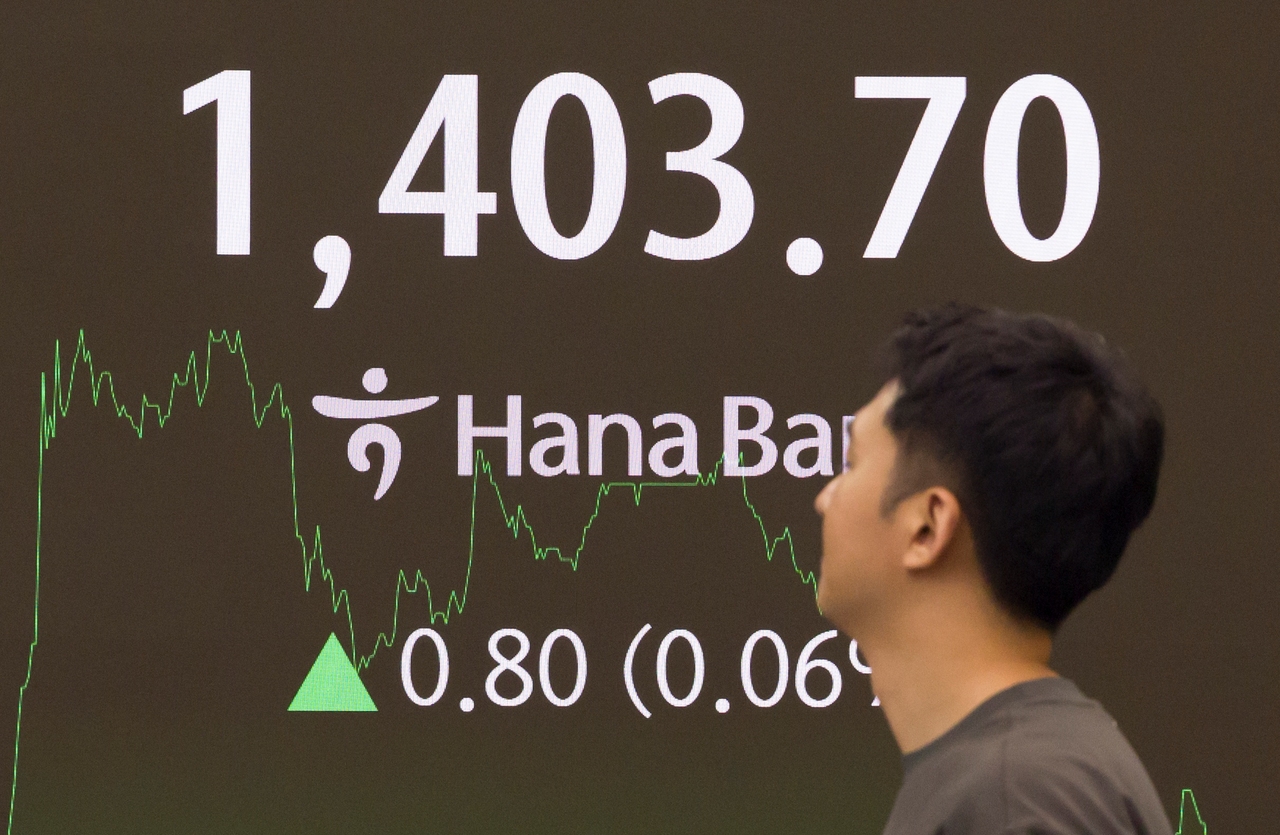
The local won remained relatively stable on Wednesday, closing daytime trading at 1,403.2 per dollar, strengthening by 1.8 won from the previous trading session. After opening at 1,404.2 won per dollar, the won briefly weakened to 1409.23 after news of the Korea-US currency policy agreement surfaced, but swiftly recovered throughout the session.
silverstar@heraldcorp.com