

Along with KCC chief, former justice ministers, prosecutors-general consider constitutional remedy against DP-led bills that PPP-led filibusters fail to stop
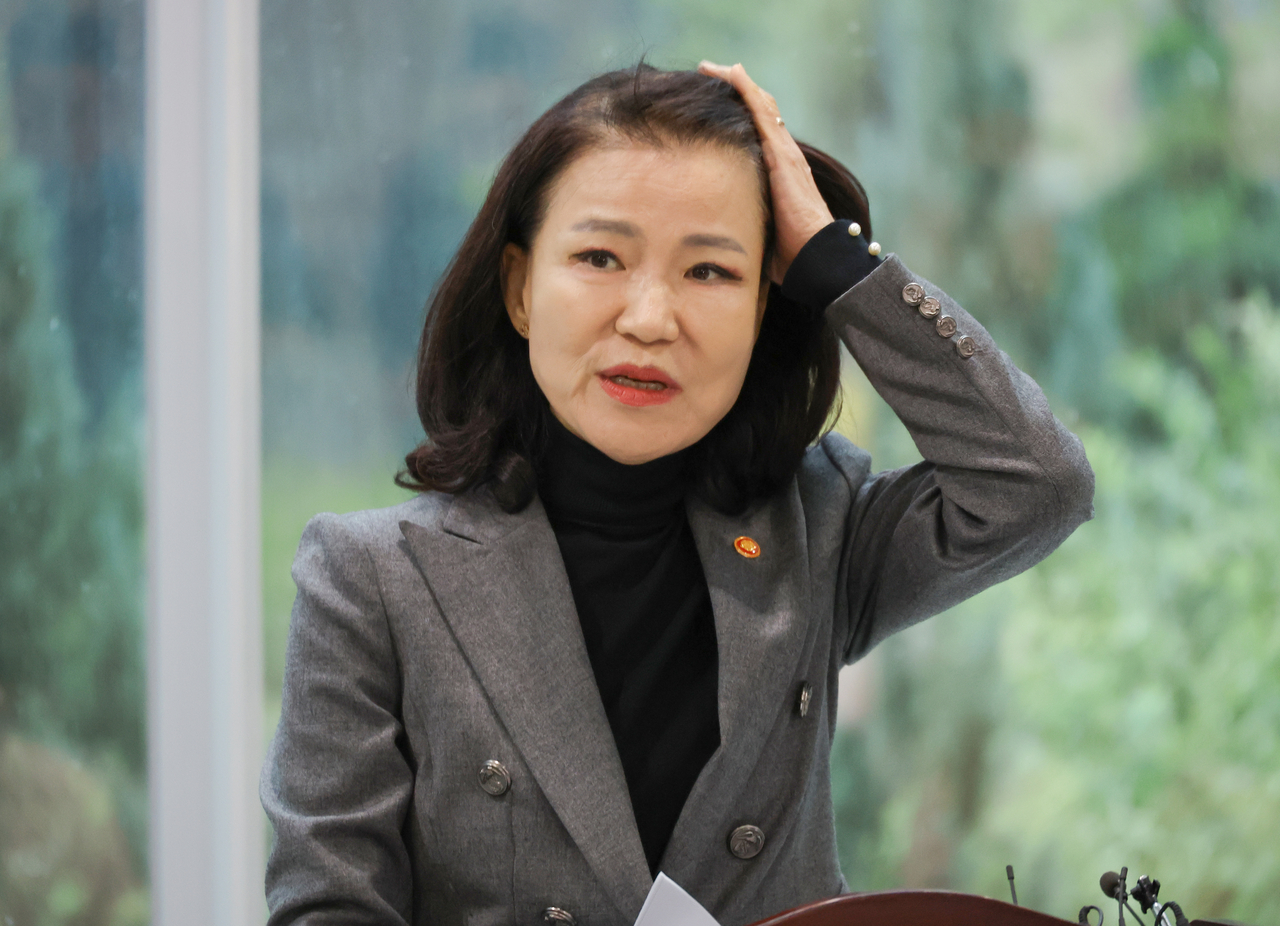
Lee Jin-sook, chair of Korea Communications Commission, said Sunday she would take legal action if she is removed from her post under recently passed legislation to replace the commission with a new broadcasting and communications body.
The KCC chief told reporters at the National Assembly in Seoul that if the bill becomes law and she is dismissed, she would "initiate legal procedures such as a constitutional petition or an injunction."
"This is targeted legislation against me," she said, adding that she intends to report to work until the Cabinet approves the bill.
The Democratic Party of Korea-led National Assembly passed a bill Saturday to establish a new Broadcasting, Media and Communications Commission under the presidential office.
The bill would transfer the broadcasting policy functions of the Ministry of Science and ICT to the new commission, and increase the number of standing commissioners from five to seven. It is expected to become law after deliberation at a Cabinet meeting on Tuesday.
The bill was initially introduced in the Assembly on Friday but was delayed after the main opposition People Power Party launched a filibuster, labeling it the "Lee Jin-sook ouster bill."
Lee, who was appointed to the post in 2024 under conservative former President Yoon Suk Yeol, also denounced a series of Democratic Party reform bills on public broadcasters.
"The so-called three broadcasting reform bills, which they claim would return broadcasting to the people, in fact hand broadcasting over to the power of the labor unions," Lee said.
She argues that the bill's provision for equal labor and management representation on programming committees would effectively give unions decisive influence over major decisions at broadcasters.
Lee was not the only figure who expressed a bid to seek legal remedies against legislation pushed through by the Democratic Party.
The Prosecutors’ Alumni Association repeated its warning that it would file a petition with the Constitutional Court if the revision of the Government Organization Act takes effect to split the Supreme Prosecutors' Office into separate investigative and indictment agencies.
In a statement released Sunday, together with seven ex-justice ministers and seven ex-prosecutors-general who are not its members, said it would take all available actions.
"We have repeatedly stressed that abolishing the Supreme Prosecutors' Office through the Government Organization Act is unconstitutional, and must be withdrawn. Nevertheless, the Democratic Party pushed the bill through the Assembly," the statement read.
The Prosecutors’ Alumni Association is currently headed by Han Sang-dae, a former prosecutor general who also served as director of the Justice Ministry’s Criminal Affairs Bureau and as Seoul Central District Prosecutor during the Lee Myung-bak administration.
Such announcements follow a series of Democratic Party-led legislation, which filibusters staged by the main opposition People Power Party could not stop.
On Thursday, the People Power Party filibustered the revision bill to split and undermine the prosecution, but the bill eventually passed Friday evening, 24 hours after the Assembly voted to end the filibuster.
Under the National Assembly Act, a filibuster can be ended with the approval of three-fifths of the Assembly’s total members. The Democratic Party has enough voting power to do that, as long as it has the support of other parties on the center-left.
Similarly, a revision to the National Assembly Act — to rename standing committees and adjust their jurisdictions in line with the Government Organization Act revision — passed after the Assembly voted to end a People Power Party filibuster on Sunday evening.
A revision to the Act on Testimony and Appraisal Before the National Assembly is set to be introduced next, with the People Power Party likely to stage yet another filibuster.
flylikekite@heraldcorp.com