
Removal of works on district chief’s order sparks backlash from local artists over censorship
An art exhibition in Daegu featuring works satirizing former President Yoon Suk Yeol was shut down by the district office, drawing complaints from local artists, news reports said Friday.
Starting Thursday, the Daekyung Art Research Institute began hosting a special exhibition titled "Art for the Future: Daegu, Art, Answer the Zeitgeist" at the district-run Bongsan Cultural Center.
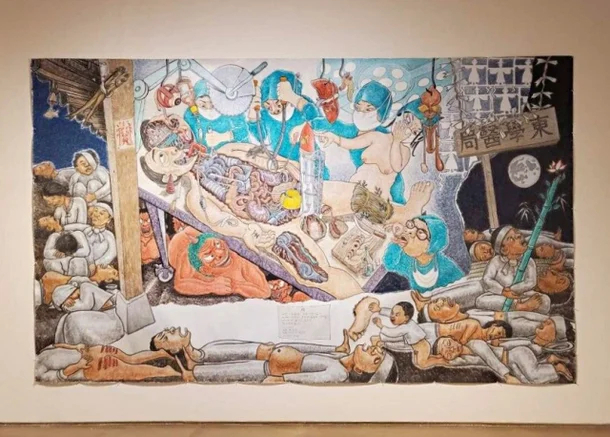
At the center of the controversy are three works by artist Hong Sung-dam — "Donghak-uiguk," "Ddong-gwang" and "Pal-gwang."
In "Donghak-uiguk," a term combining donghak — the main ideology of a major 19th-century peasant movement — and uiguk, a historical term for a medical bureau, a male figure is shown completely naked with his organs cut open, resembling a medical dissection. The painting evokes the clash between the Yoon administration and doctors that resulted in nationwide strikes.
The then-government’s plan to increase medical school admissions by 2,000 a year in February last year prompted thousands of junior doctors to resign en masse, causing serious disruptions in hospital services.
The other two works, "Ddong-gwang" and "Pal-gwang," also feature a male figure who looks like Yoon. "Ddong-gwang" portrays a face resembling that of Yoon next to a fox thought to symbolize his wife, Kim Keon Hee.
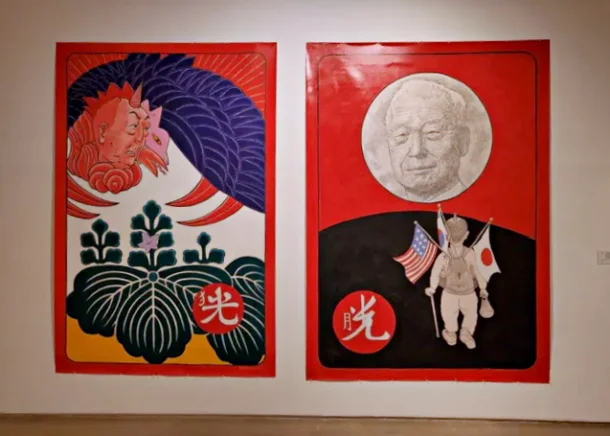
In "Pal-gwang," the visage of South Korea’s first president, Syngman Rhee, is depicted as the face of a large full moon. Below it, a man carries a backpack adorned with the flags of South Korea, the United States and Japan — an image strongly evoking Yoon’s conservative leanings.
On the first day of the exhibition, the Bongsan Cultural Center asked the Daekyung Art Research Institute to remove all three works, but the institute refused. The center then decided to proceed with the display after requiring the artists to sign a pledge taking responsibility for any potential problems arising from the paintings.
However, the satirical works were ultimately kept from public view after Ryu Kyu Ha, head of Daegu's Jung-gu District Office, ordered the center to close the exhibition hall displaying them, saying that “political works cannot be exhibited under the center’s operating regulations.”
Currently, aside from the closed hall, two galleries are still open, showcasing around 50 pieces by 19 artists.
The move has sparked strong backlash from Daegu's local art community.
“Artists had their exhibition space shut down overnight, and citizens were deprived of the opportunity to appreciate the works. It is problematic to view art not as art itself but as political activism. The notion that an administrative office can censor the content of artworks at any time is also unjust,” said Shin Kyung-ae, head of DARI, during an interview with a local news outlet.
Established on Oct. 7, 2015, by the late Park Nam-hee, a professor at Kyungpook National University, and others, the non-profit research organization DARI is dedicated to promoting and advancing research on art and art history in the Daegu region.
cjh@heraldcorp.com