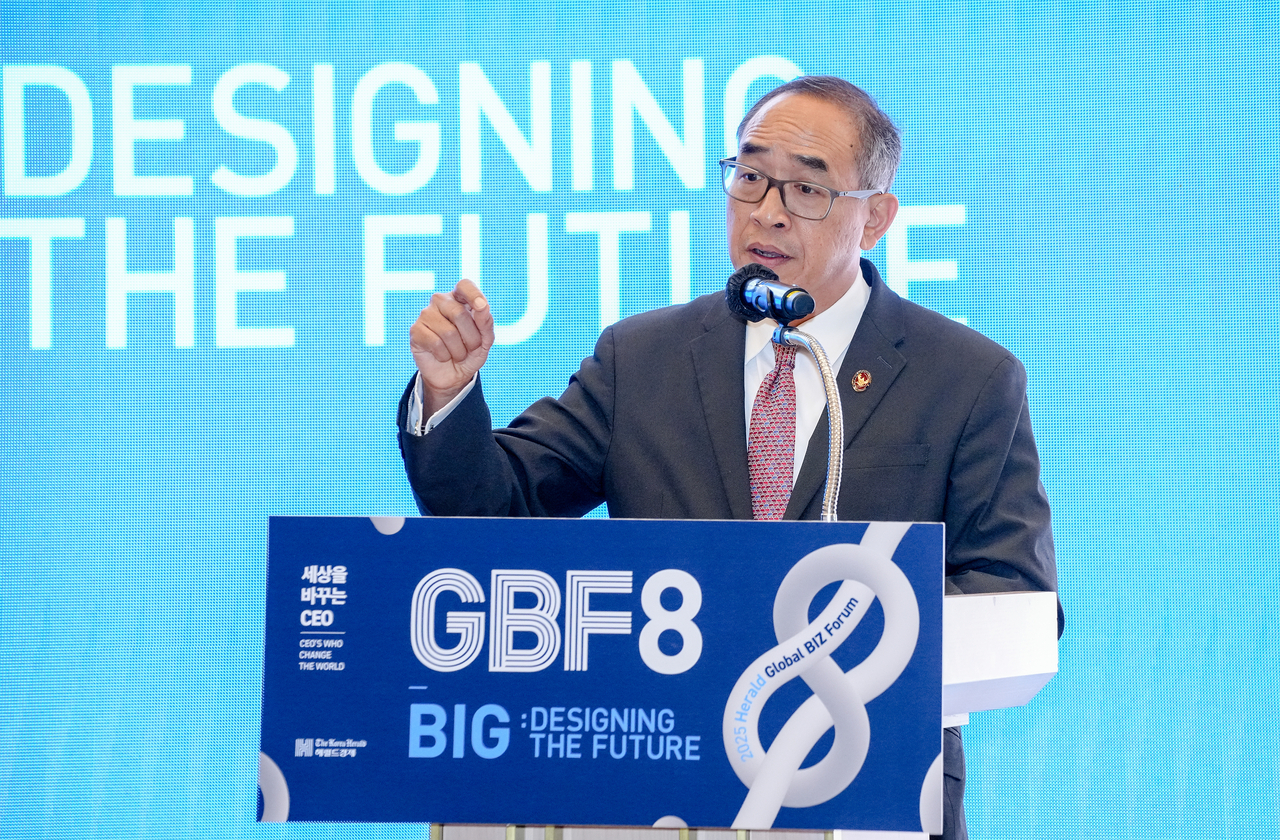
Thai Ambassador to South Korea Tanee Sangrat highlighted the importance of advancing bilateral trade ties through finalizing the Korea-Thailand Comprehensive Economic Partnership Agreement at the 2025 Global Biz Forum in Seoul on Wednesday.
“Since assuming my duties, one of my top priorities has been to advance the economic partnership between Thailand and the Republic of Korea,” Sangrat said in his keynote address at the forum, co-hosted by The Korea Herald and Herald Business. “With rising global trade uncertainties, including protectionism, supply chain disruptions and US tariff measures, bilateral economic cooperation serves as a safety net for both our countries.”
The ambassador underscored that the two governments are actively working toward finalizing the KTCEPA, a bilateral trade agreement designed to boost trade and investment opportunities. The seventh round of negotiations is currently underway in Seoul, with hopes of announcing the agreement’s successful conclusion during the APEC Economic Leaders’ Week in October.
Once implemented, the pact is expected to strengthen private sector confidence and significantly expand trade between the two countries, particularly in sectors such as bio-based and green industries, electric vehicles, semiconductors, the creative economy and tourism.
Sangrat also addressed political stability in Thailand following the election of Prime Minister Anutin Charnvirakul, assuring Korean businesses that Thailand’s key economic policies and megaprojects will continue without disruption.
“With our strong fundamentals, supportive policies, natural advantages and highly skilled labor, I am confident that the Thailand-Korea partnership will continue to flourish,” he said.

Following the envoy’s address, Hong Sung-kook, chairperson of the National Economic Advisory Council, delivered a lecture on what he described as Korea’s transition into a “contracting society.”
He pointed out that Korea’s economic growth rate has now fallen into the 0 percent range for the first time in its modern economic history.
“For an economy to function normally, we need at least 2 percent growth,” he said, stressing that persistent low growth fuels inequality and social polarization.
Hong linked structural challenges such as population decline, environmental risks and technological disruption to rising populism and zero-sum competition globally. He emphasized the need for policies that connect growth with welfare, suggesting that investment in education — particularly the creation of artificial intelligence-focused high schools in regional areas — could drive both balanced development and new engines of growth.
“The ultimate growth strategy is not one that overlooks social equity or the environment,” Hong said. “Policies that reflect these realities are what constitute true growth policies.”

The final lecture was delivered by Cho Wung-rae, chairperson of Sunyang Soju, who spoke about entrepreneurship and unconventional thinking. Sharing his own business journey, Cho emphasized the importance of self-belief, social contribution and strong products to lead the market.
“Innovation often comes from going against the grain,” Cho said. “What matters most in starting a business is conviction — the confidence that your idea and your product can create value, even in a limited market.”
Cho added that companies should not only compete for market share, but also focus on how they can give back to society, suggesting that corporate growth and social responsibility must go hand in hand.
shinjh@heraldcorp.com