
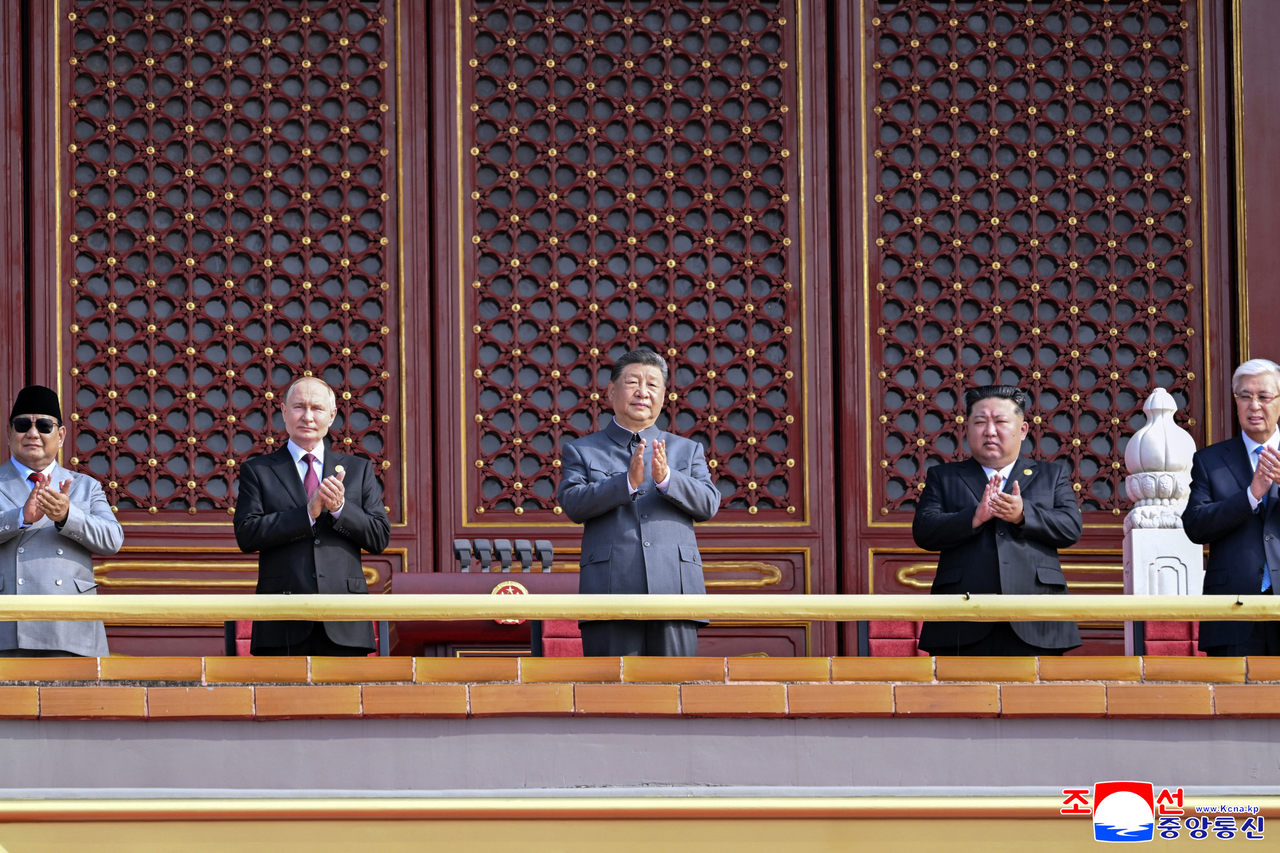
Sixty-six years is a long time to wait for a photo opportunity. Yet on Wednesday in Beijing, Xi Jinping, Vladimir Putin and Kim Jong-un stood shoulder to shoulder on Tiananmen Square, reviewing troops and missiles as if history had rewound to 1959.
사진 한 장을 기다리기엔 66년은 너무 긴 세월이다. 그러나 지난 수요일 베이징 천안문 광장에선 시진핑, 블라디미르 푸틴, 김정은이 나란히 서서 마치 역사가 1959년으로 되돌아간 듯 군대와 미사일을 사열했다.
The tableau was designed to impress: three leaders, long cast negatively in Western capitals, reclaiming center stage to signal solidarity against the US-led order.
이 장면은 분명 의도된 연출이었다. 서방에서 오랫동안 부정적으로 비춰진 세 지도자가 무대 중앙에 다시 등장해 미국 주도의 질서에 맞서는 연대를 과시한 것이다.
For Xi, the occasion marked both China’s wartime triumph and signaled its present ambitions. By parading hypersonic missiles and stealth fighters, Beijing underscored that its reach now extends beyond the Taiwan Strait.
시 주석에게 이번 행사는 중국의 전쟁 승리를 기념함과 동시에 현재의 야심을 드러내는 자리였다. 극초음속 미사일과 스텔스 전투기를 등장시킨 열병식은 중국의 힘이 이제 대만해협을 넘어섰음을 과시했다.
For Putin, it was a chance to thank Pyongyang for dispatching troops to Ukraine and to bind Moscow more tightly to Asian partners as Western sanctions continue to bite.
푸틴 대통령에게는 우크라이나 전장에 병력을 보낸 평양에 감사를 전하고, 서방 제재가 계속되는 가운데 모스크바를 아시아 파트너들과 더 단단히 묶어내는 기회였다.
For Kim, the spectacle was his debut on a multilateral stage, a chance to shed the image of an isolated ruler and to showcase his daughter as heir apparent. If the scene looked like the opening act of a new Cold War, that was the intended message.
김 위원장에게는 다자 무대 데뷔였다. 고립된 통치자의 이미지를 벗고 딸을 후계자로 과시할 기회였다. 그 장면이 새로운 냉전의 서막처럼 보였다면, 바로 그것이 의도된 메시지였다.
Behind the choreography lies calculation. Moscow, bogged down in Ukraine, needs manpower and munitions. Pyongyang, by sending soldiers and arms, has pocketed both political recognition and material rewards. Beijing, though wary of entanglements, gains leverage over both neighbors while presenting itself as their indispensable patron.
이 연출 뒤에는 철저한 계산이 깔려 있다. 우크라이나 전쟁에 발이 묶인 모스크바에는 병력과 탄약이 필요하다. 병력과 무기를 제공한 평양은 정치적 인정과 물질적 보상을 챙겼다. 얽힘을 경계하는 베이징은 두 이웃에 대한 지렛대를 확보하며 자신을 필수적 후원자로 부각시켰다.
The three leaders’ interests diverge — China, a global power with economic ambitions; Russia, a besieged petrostate; North Korea, a survivalist regime — yet for now, convenience suffices to unsettle the region.
세 지도자의 이해관계는 갈린다. 중국은 경제적 야심을 가진 글로벌 파워이고, 러시아는 제재에 갇힌 산유국이며, 북한은 생존을 최우선으로 하는 정권이다. 그럼에도 지금은 편의적 연대만으로도 지역을 흔들기에 충분하다.
The symbolism is troubling for Seoul. The Beijing parade came barely a week after President Lee Jae Myung joined US President Donald Trump and Japanese Prime Minister Shigeru Ishiba in reaffirming trilateral security cooperation. Two blocs are crystallizing: the US, South Korea and Japan on one side, China, Russia and North Korea on the other.
서울에는 불길한 상징이다. 베이징 열병식은 불과 일주일 전, 이재명 대통령이 도널드 트럼프 미국 대통령, 기시다 후미오 일본 총리와 함께 한·미·일 3자 안보 협력을 재확인한 직후에 열렸다. 한쪽에는 한·미·일, 다른 한쪽에는 중·러·북이라는 두 개의 진영이 굳어지고 있다.
square: 광장
negatively: 부정적으로
stage: 무대
solidarity: 연대
triumph: 승리
ambition: 야망
underscore: 강조하다
sanction: 제재
isolate: 고립시키다
heir: 후계자
intend: 의도하다
calculation: 계산
munition: 탄약
pocket: 챙기다
recognition: 인정
reward: 보상
patron: 후원자
diverge: 갈라지다
reaffirm: 재확인하다
khnews@heraldcorp.com

![[Exclusive] Ateez to return in November](https://wimg.heraldcorp.com/news/cms/2026/09/02/news-p.v1.20260902.76162fb0ba55493aad1c076f240d0750_R.jpg?type=h&h=120)