
Victor Cha calls Georgia raid a clash of Trump’s immigration and investment policies, says Seoul's push for visa changes shows bid to keep Korean capital flowing
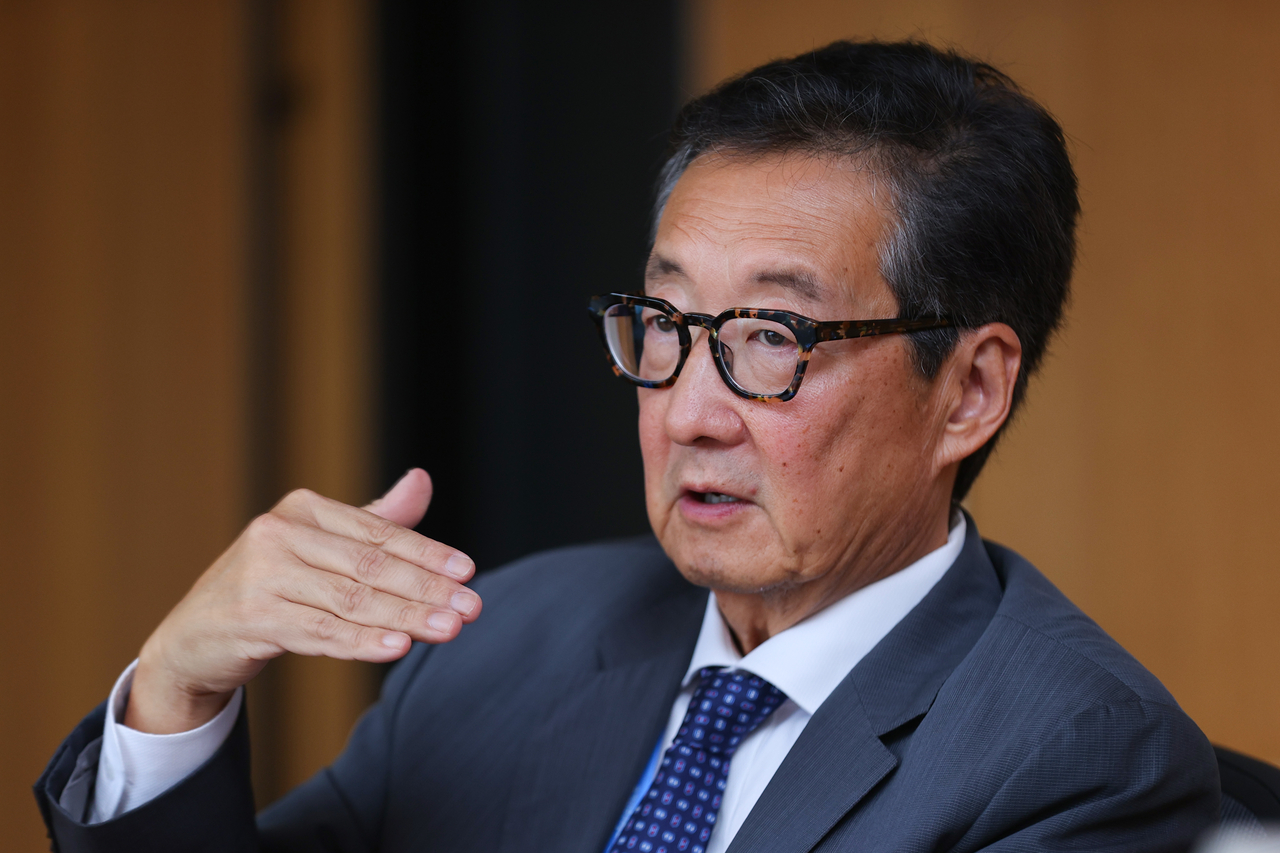
A trilateral meeting between US President Donald Trump, Chinese President Xi Jinping and North Korean leader Kim Jong-un in Beijing “might be a possibility,” Victor Cha, Korea Chair at the Center for Strategic and International Studies, said Friday during a joint press interview at a conference hosted by the Institute for Global Economics in Seoul.
“We don’t know if Trump is thinking of going to Beijing,” Cha said. “(But) he likes big, spectacular news events like that. And he made a big statement during his Oval Office press meeting with President Lee Jae Myung, saying he wanted to meet Kim before the end of the year.”
With Trump confirmed to attend the October APEC summit in Gyeongju and Xi Jinping increasingly likely to join, attention is on whether the two leaders will meet for the first time since Trump’s second term began in January. Xi’s visit would be his first to South Korea in 11 years.
Cha said a potential Trump-Xi meeting would likely focus on economic issues.
“Some say he might raise Taiwan or South China Sea issues. I don’t think so. The main focus will be trade and tariffs,” he said. “He doesn’t like the large merchandise trade deficit between the US and China, and that is what he will focus on.”
Cha added that a second meeting between Lee and Trump, “almost certain” to take place, will also focus on the ongoing trade talks, including the business visa and investment framework.
He said the recent Georgia raid, where more than 300 South Koreans were arrested at the site of a planned Hyundai and LG Energy Solution plant, may give Seoul leverage in negotiations.
“This was clearly a situation where President Trump’s immigration policy and investment policy contradicted each other,” Cha said, noting that Trump likely did not anticipate the incident, in which the detainees were eventually allowed to leave for Korea after eight days in detention.
The rapid dispatch of Deputy Secretary Christopher Landow and moves to negotiate a new business visa for Korea show Trump’s direct involvement, he said.
“These sorts of things don’t happen that quickly unless the president is directly involved,” Cha said. “That shows the US recognized the problem, wants Korean investment, and is trying to solve it quickly.”
Cha called the raid “very ill-timed and embarrassing" for Trump, saying it could work to Korea’s advantage in talks.
“It’s quite significant that Trump said they would negotiate a special visa agreement for Korea. That completely contradicts his anti-immigration policy. Many of his Make America Great Again base were very angry to hear that, but Trump’s response was: ‘We want the investment, so of course we’re going to try to get a visa.’”
Cha also warned of a shifting power paradigm on the Korean Peninsula, pointing to the deepening Russia-North Korea partnership.
Calling the relationship “deeper and more dangerous than during the Cold War,” he said it is the most pressing security threat in the region.
“The most dangerous part is that I cannot think of any policy tools that the US, China, Japan or South Korea have that could divide Russia and North Korea,” Cha said.
Sanctions will only push North Korea closer to Russia, while carrots will be taken without reducing ties, the analyst noted.
He added that China has largely lost its ability to restrain Pyongyang.
“If Iran, after being bombed by the US, goes to North Korea to ask for help in rebuilding its nuclear program, I’m sure China would discourage it. But China has no influence now, and Russia doesn’t care. That’s what makes this situation so dangerous.”
He warned that Trump must not rush into a peace agreement at the risk of undermining the core goal of denuclearization.
“I don’t think President Trump will ever say he’s giving up the goal of denuclearization. US policy will never explicitly abandon it,” Cha said.
But agreeing to a peace deal that merely freezes nuclear and missile tests would “de facto” amount to accepting North Korea as a nuclear weapons state, he added. According to Cha, many in Washington already believe denuclearization is unrealistic in the near term, with estimates that Pyongyang holds about 50 nuclear weapons and material for as many as 90.
Cha suggested Trump’s eagerness to add Korea to his list of foreign policy wins could drive him toward a peace declaration.
“He says he ended seven wars already — I’m sure the next one on his mind is Korea,” Cha said, noting his lack of progress in Ukraine and Gaza. “It’s important for the US president never to give up the goal, but also not to be too eager to declare peace on the Korean Peninsula prematurely.”
jwc@heraldcorp.com