

Hyundai Motor Company said Thursday it would invest 77.3 trillion won ($56 billion) over the next five years — an increase of 7 trillion won from last year — to navigate tariff pressures and slowing electric vehicle demand, while reinforcing its mid- to long-term strategy.
Under the investment, the auto giant plans to add 1.2 million units of annual production capacity across its global facilities by 2030. That is 20,000 units more than announced at last year’s announcement.
This includes boosting output at its Hyundai Motor Group Metaplant America (HMGMA) in Georgia to 500,000 units, and expanding its India plant and Ulsan facilities to 250,000 units and 200,000 units, respectively. Additionally, production in Saudi Arabia and other regions of complete knock-down kits — disassembled cars produced for assembly as a finished product elsewhere — will contribute over 250,000 units.
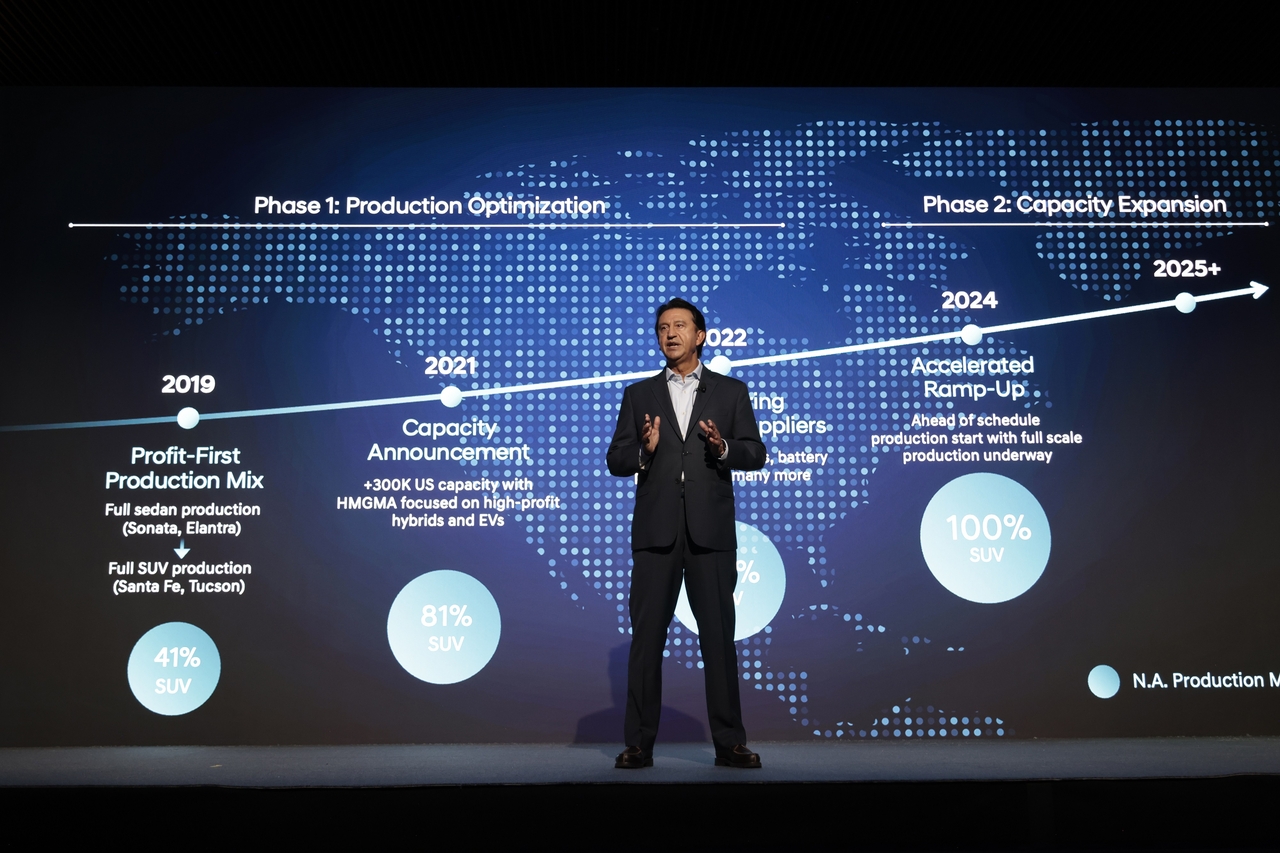
The automaker unveiled the plan at its 2025 CEO Investor Day in New York, the first time the event has been held abroad. Hyundai Motor Company President and CEO Jose Munoz mentioned during the event, “We selected the US as our venue because it truly embodies the driving force behind our company’s growth.”
Having entered the US market nearly 40 years ago, Hyundai Motor operates a manufacturing plant in Alabama and a newly launched HMGMA in Georgia. This year, the company aims to achieve sales of 1.2 million units — with 1 million expected to be sold in the US.
Munoz acknowledged North America as the largest and most strategically important market, noting that it accounted for 30 percent of total vehicle sales and 38 percent of overall revenue in the first half of this year.
Hyundai Motor Group’s $260 billion investment in the US between 2016 and 2028 includes building a low-carbon steel mill, expanding production capacity, and establishing an advanced robotics innovation hub, which together are expected to create over 2,500 new jobs.
To counter US tariff pressures, Hyundai plans to produce over 80 percent of its US vehicle sales locally by 2030, increase local supply chain procurement from 60 to 80 percent and maintain plant utilization above 95 percent. Supporting this expansion, HMGMA is set to boost its production capacity by 200,000 units by 2028, with a primary focus on hybrids and electric vehicles, targeting a total US production of 1 million units this year.
When asked about a potential price hike in the US, Munoz stressed the company’s data-driven approach to price adjustments, rather than simply following competitors’ moves.
For its long-term global sales target, Hyundai aims to sell 5.55 million vehicles by 2030, with eco-friendly models — including electric vehicles, hybrids and hydrogen fuel cell cars — making up 60 percent or 3.3 million units.
In response to slowing full-EV demand, the company said it would double its hybrid lineup to 18 models, spanning entry-level to luxury, with Genesis introducing its first rear-wheel-drive hybrid next year. A next-generation hybrid system, debuting on the Palisade SUV, will be rolled out more broadly.
Outside the US, region-specific EVs are planned, including the Ioniq 3 compact EV in Europe in 2026, two new models in China and a compact electric SUV in India by 2027.
In addition, the company is developing an extended-range EV with a smaller, lower-cost battery for launch in 2027, alongside next-generation hydrogen fuel cell vehicles. By 2026, Hyundai also plans to complete its software-defined vehicle project, with its new “Pleioth Connect” infotainment system rolling out next year.
Hyundai updated its 2025 guidance to account for the prevailing risk of 25 percent tariffs in the US, raising its revenue growth outlook to 5-6 percent from 3-4 percent, while lowering the operating profit margin target to 6-7 percent from 7-8 percent.
Munoz stated that if the tariff rate was reduced to 15 percent, as agreed between Korea and the US, the company will be better positioned to achieve its goals.
It maintained its 2030 global sales target of 5.55 million units, which would be up 33 percent from this year’s goal of 4.17 million. Eco-friendly models will account for 60 percent, compared to 25 percent this year.
hyejin2@heraldcorp.com