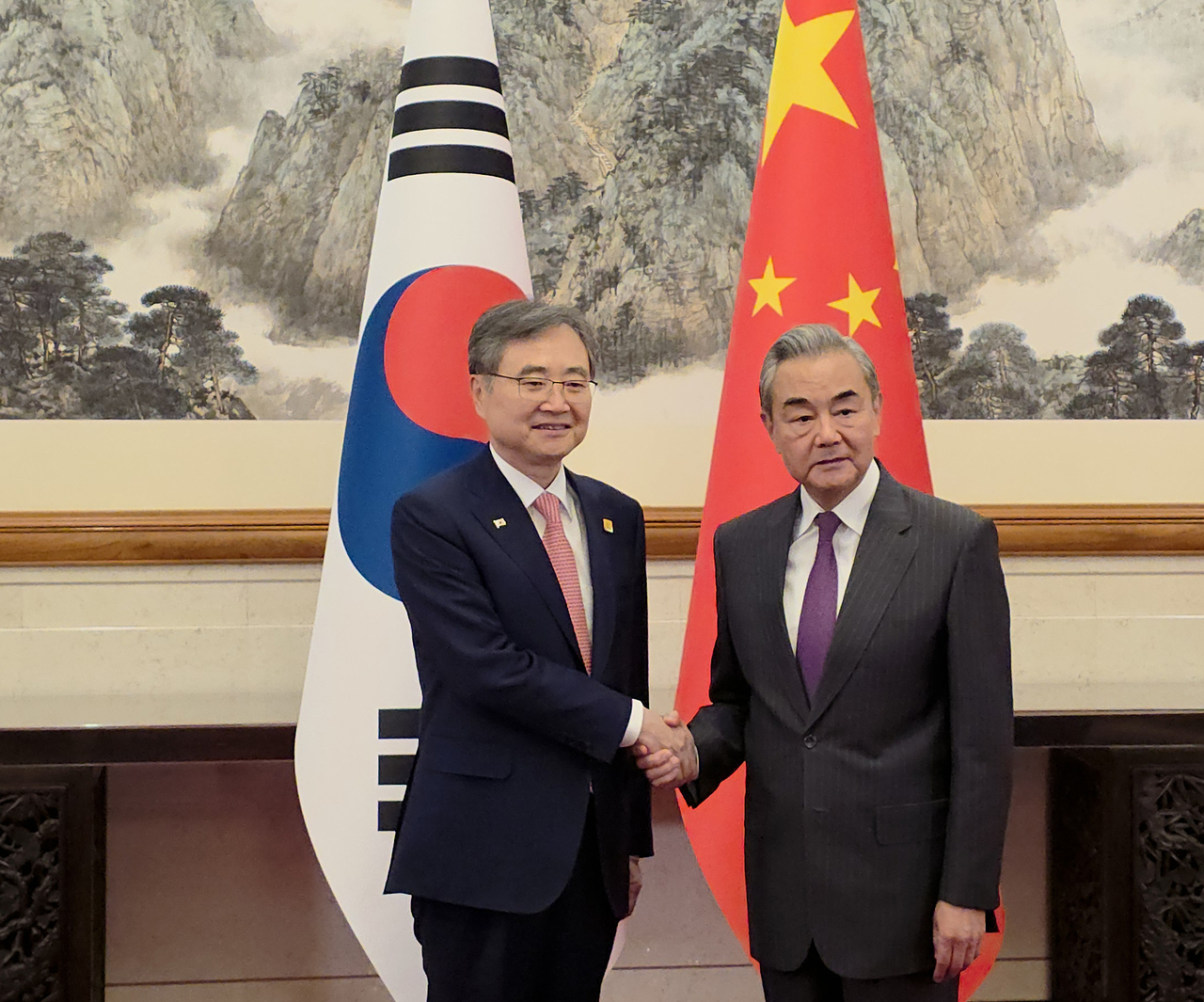
Foreign Minister Cho Hyun expressed hope Wednesday that bilateral relations with China will further advance if Chinese President Xi Jinping visits South Korea for the Asia-Pacific Economic Cooperation (APEC) summit next month.
Cho made the remarks at the start of the talks with Chinese Foreign Minister Wang Yi in Beijing, the first such top-level diplomatic talks between the two countries since the launch of President Lee Jae Myung's government in early June.
"It's very meaningful that APEC will be held in South Korea this year and then again in China next year," he said. "I hope this will serve not only as an opportunity to advance APEC, but also to further develop Korea-China relations."
"We look forward to President Xi attending the APEC summit and making a visit to South Korea as well, so that we can work together to further develop our ties," Cho said.
Wang noted that bilateral ties with Seoul are firmly based on the "spirit of firmly staying on the course of good neighborliness and friendly ties and pursuing the goal of mutual benefits and win-win cooperation."
"As close neighbors, China and South Korea need to meet often and have extensive exchanges," he said. "This is conducive to deepening understanding, avoiding misperceptions, enhancing mutual trust and strengthening cooperation."
Cho's two-day trip comes as South Korea seeks to balance relations with Beijing amid a deepening US-China rivalry, while maintaining strong ties with its sole ally, the United States, and the trilateral partnership with Washington and Tokyo.
After his summit with US President Donald Trump late last month, Lee noted that Washington's push to counter China leaves South Korea with limited room to maintain the economic ties it had with Beijing in past decades, pushing Seoul to align more closely with US policy.
Beijing responded that bilateral relations should not be influenced by a third country.
The Lee government wants to restore the inter-Korean relations that deteriorated under the preceding conservative government and resume dialogue with Pyongyang despite the North's repeated rejection of Seoul's overtures amid its close alignment with Russia.
In the foreign policy line finalized Tuesday, the Lee government said it will seek to advance relations with China in various areas, such as supply chain stability, while also securing Beijing's support for North Korea's denuclearization and improved inter-Korean ties.
Seoul believes that, if realized, Xi's visit next month for the APEC summit, set to be held in southern South Korea, would help reaffirm stable bilateral ties and allow leaders to discuss key issues of mutual interest, including North Korea.
Although Beijing has yet to confirm, Xi is widely expected to attend the APEC summit, set for Oct. 31-Nov. 1. China is the host for next year's APEC.
Cho and Wang will also likely share their assessments on North Korea after leader Kim Jong-un made a rare appearance at China's Victory Day celebrations in Beijing earlier this month, where he stood alongside Xi and Russian President Vladimir Putin.
"As Chairman Kim Jong-un (of North Korea) recently visited China, I will also hear their views on that and discuss North Korea-related issues," Cho said at Gimpo airport.
Cho is expected to call for Beijing's role in supporting Seoul's efforts to restore ties and resume dialogue with Pyongyang, a core part of the Lee government's inter-Korean policy.
Cho may also use the talks to clarify Beijing's stance on the North's denuclearization, as Beijing made no mention of it after Xi's summit with Kim on the sidelines of the anniversary event marking the end of World War II.
The North's state media reported last week that Kim will unveil a policy of simultaneously pursuing nuclear forces and conventional weapons at its upcoming party congress.
Other outstanding bilateral issues are also expected to be addressed, including China's steel structures in the overlapping area of the Yellow Sea, a row that has heightened tensions between the two countries.

![[Exclusive] Ateez to return in November](https://wimg.heraldcorp.com/news/cms/2026/09/02/news-p.v1.20260902.76162fb0ba55493aad1c076f240d0750_R.jpg?type=h&h=120)