
Auteur's darkly comic thriller transcends anti-capitalist framework through pure cinematic virtuosity
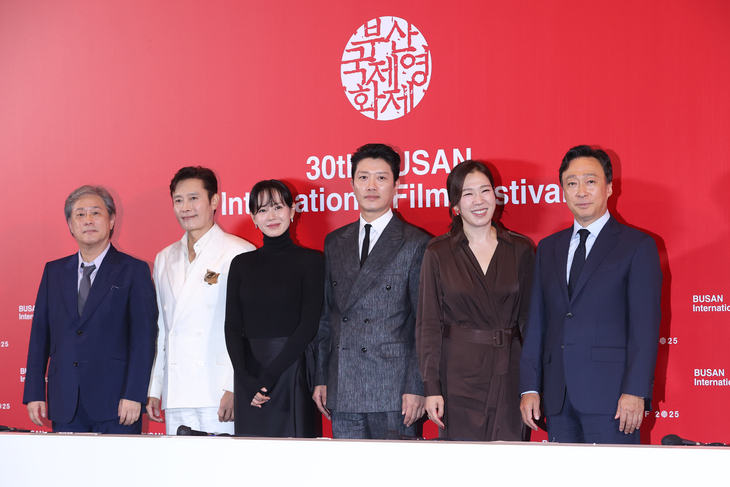
BUSAN -- "The personal and the social — they're completely intertwined, pointing both outward and inward," Park Chan-wook offered Wednesday afternoon, attempting to articulate the dialectical tension animating his new film.
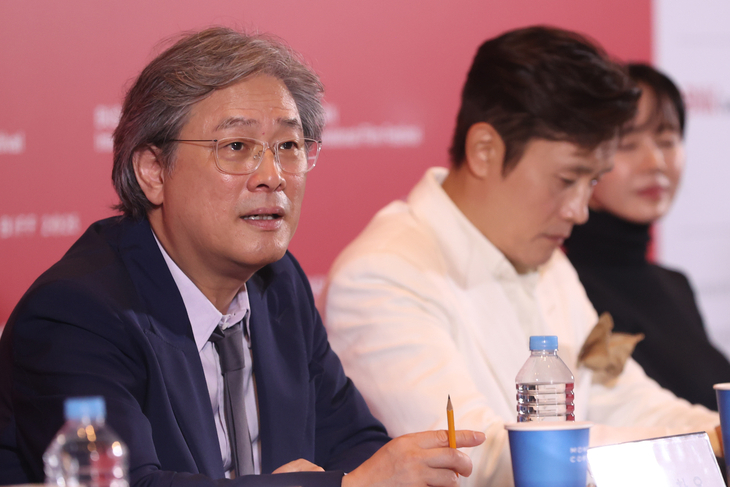
The director was addressing reporters at Busan Cinema Center, where a press-only screening of "No Other Choice" had just unofficially launched the 30th Busan International Film Festival ahead of that evening's opening ceremony.
Fresh off its world premiere in Venice and a stopover at Toronto where it won the international audience award, the film's homecoming marked a milestone.
"This is my first time opening BIFF," Park noted with uncharacteristic vulnerability. Lee Byung-hun, who inhabits the film's desperately spiraling protagonist Man-su, checked his own history: "Never happened for me either. So yeah, I'm genuinely nervous."
Adapted from Donald Westlake's 1997 novel "The Ax," the film tracks a laid-off manager at a paper company who eliminates potential competitors for a coveted position.
Yet what emerges transcends the absurdist critique of late-stage capitalism's dehumanizing machinery that many have noted. Park has constructed something more earnest in tone — a self-reflexive statement where paper manufacturing becomes a surrogate for cinema itself, both industries rendered archaic by digital disruption, both populated by middle-aged craftspeople clinging to obsolete expertise.
"Viewers will project their own narratives onto this," Park explained. "But as a filmmaker, I know some dismiss movies as mere entertainment, offering no practical help. But there are those of us who stake everything on this work. Despite knowing nothing about paper manufacturing, I recognized that obsession immediately."
Lee Byung-hun connected the dots explicitly: "People keep asking about parallels to our dying industry. Sure, film has problems, but the real crisis is in the theaters. How do we get audiences back into those spaces? That's the question haunting every one of us."
The ongoing reality of technological disruption drove the conversation, particularly the potential of artificial intelligence to render everyone in the system equally obsolete. Park confirmed adding an AI-automated factory scene during postproduction, so late that the cast hadn't seen it coming. "AI is coming for actors too," Lee Sung-min said. "That existential fear of replaceability permeates everything now. That's the film's real message — we're all potentially disposable."
Beyond its thematic weight, the film delivers as pure visual spectacle — a riveting kinetic experience that justifies itself through craft alone.
Park's camera becomes its own character, lunging forward when the audience expects stillness, pulling back at moments of confrontation, lingering until viewers squirm before punctuating with sudden zooms. He drops into scenes midaction, creating momentum that mirrors Man-su's unraveling. Violence arrives with Park's trademark precision — beautiful and brutal — while desire simmers through voyeuristic frames that make viewers complicit.
"Every scene contained maybe 10 layers of physical business beneath the dialogue," Lee Byung-hun recalled, describing Park's notoriously baroque direction. "I'd deliver monologues while dodging reflected sunlight, nursing a toothache, suppressing leg tremors — all simultaneously. Exhausting, but this is why you work with Park Chan-wook."
The production process itself became performative commentary. Park Hee-soon described the director's unexpected on-set demeanor: "Between takes he'd wander off, photographing random objects, seemingly relaxed. Then he'd return demanding something completely different — each take accumulating into something neither of us anticipated."
Son Ye-jin's performance as Mi-ri provides crucial counterweight, grounding the film's increasingly baroque flights. "I approached her as the sole realist in this chaos," she explained. "While everyone spirals toward extremity, Mi-ri maintains almost disturbing optimism. Her pragmatism becomes its own survival mechanism."
The film's centerpiece — a violent confrontation set to Korean pop classic "Red Dragonfly" — emerged through controlled improvisation, according to the cast. "We had perfect storyboards," Yeom Hye-ran revealed, "but Park kept adding layers. Lee Byung-hun and Lee Sung-min threw out suggestions, transforming a simple scene into elaborately choreographed chaos."
When the discussion turned to Busan itself, where some of the film was shot, the cast's affection felt genuine rather than obligatory. "Those hillside neighborhoods look almost Mediterranean," Lee Byung-hun observed, "houses stacked impossibly up slopes in wild colors — simultaneously exotic and familiar."
The conversation returned repeatedly to the film's universal resonance. "Some materials demand immediate adaptation, but 'The Ax' proved timeless," Park reflected. "The gap between 1990s America and today's Korea is negligible. Every generation faces this same fundamental anxiety — the fear of being cast aside, of becoming irrelevant."
Lee Byung-hun's final plea carried urgency: "This demands theatrical viewing. The details, scale, how sound and image interconnect — only theaters can properly deliver what we've created."
moonkihoon@heraldcorp.com