

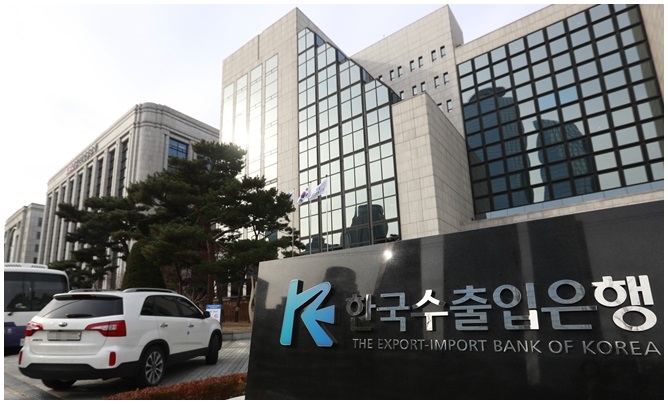
The Export-Import Bank of Korea said Tuesday it had issued a total of $1.5 billion in global bonds, achieving the lowest-ever spread for a five-year Korean bond.
The issuance comprises $500 million in three-year variable-rate notes and $1 billion in five-year fixed-rate notes.
The bonds were designed to capture strong demand for five-year fixed bonds, driven by expectations of a US interest rate cut, alongside the popularity of shorter-term bonds among Asian banks.
The latest five-year bonds were priced at a spread of 26 basis points over the US treasury yields, narrowing significantly from 48 basis points seen in January and breaking the previous record of 28 basis points set during the US quantitative easing program in 2021.
The bank’s bonds drew orders worth up to $7.7 billion, approximately 5.1 times the target amount, from 175 global investors.
Traditional high-quality investors such as international organizations and central banks accounted for the largest share. By type, official institutions made up 47 percent of demand, followed by asset managers at 26 percent and banks at 22 percent. By region, orders came from the US and Latin America with 45 percent, Asia with 29 percent, and Europe and the Middle East with 26 percent.
Meanwhile, Eximbank held one-on-one investor meetings and online briefings, while also becoming the first Korean issuer to host deal roadshows in Shanghai and Hong Kong, ahead of the issuance.
The move aimed to tap into Greater China’s growing offshore investment demand, fueled by abundant liquidity, limited domestic opportunities, and loosened restrictions on overseas investment.
“Despite recent unfavorable external challenges from rapid shifts in the global trade environment, the results reaffirm the trust of foreign investors in the Korean economy,” an Eximbank official said.
“At the opening of the Asian markets, we secured a strong order book backed by anchor orders from Asian and Greater Chinese investors. By the time the US markets opened, excess demand had already been achieved, enabling the issuance at a record-low spread.”
andreahaneu@heraldcorp.com