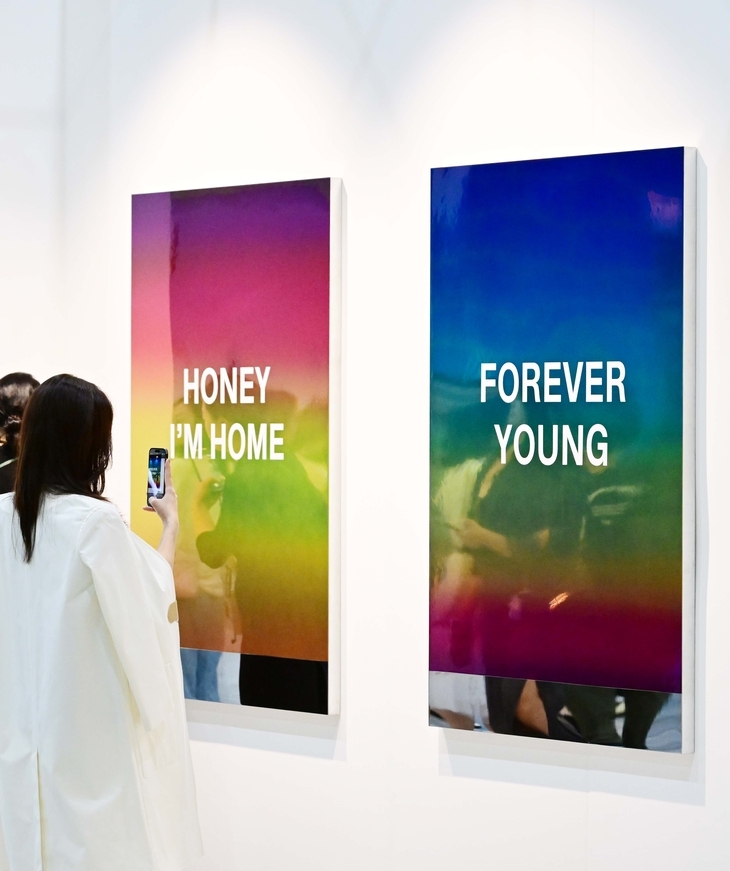
Having become the biggest art event in Seoul, the fourth collaboration between Frieze Seoul and Kiaf Seoul wrapped up Sunday at Coex, attracting more than 80,000 visitors, including representatives from over 160 leading museums and institutions, according to the two fair organizers.
Frieze Seoul, inaugurated in 2022, has swept in the whole city, immersing the capital in art every year from late August to early September. The city responded with the introduction of Seoul Art Week to coincide with Frieze Seoul and Kiaf Seoul, the capital's biggest annual international art fair.
While results were mixed, sales at Frieze Seoul turned out to be more resilient than feared amid a slowdown in the global art market, according to reports released by the two fairs.
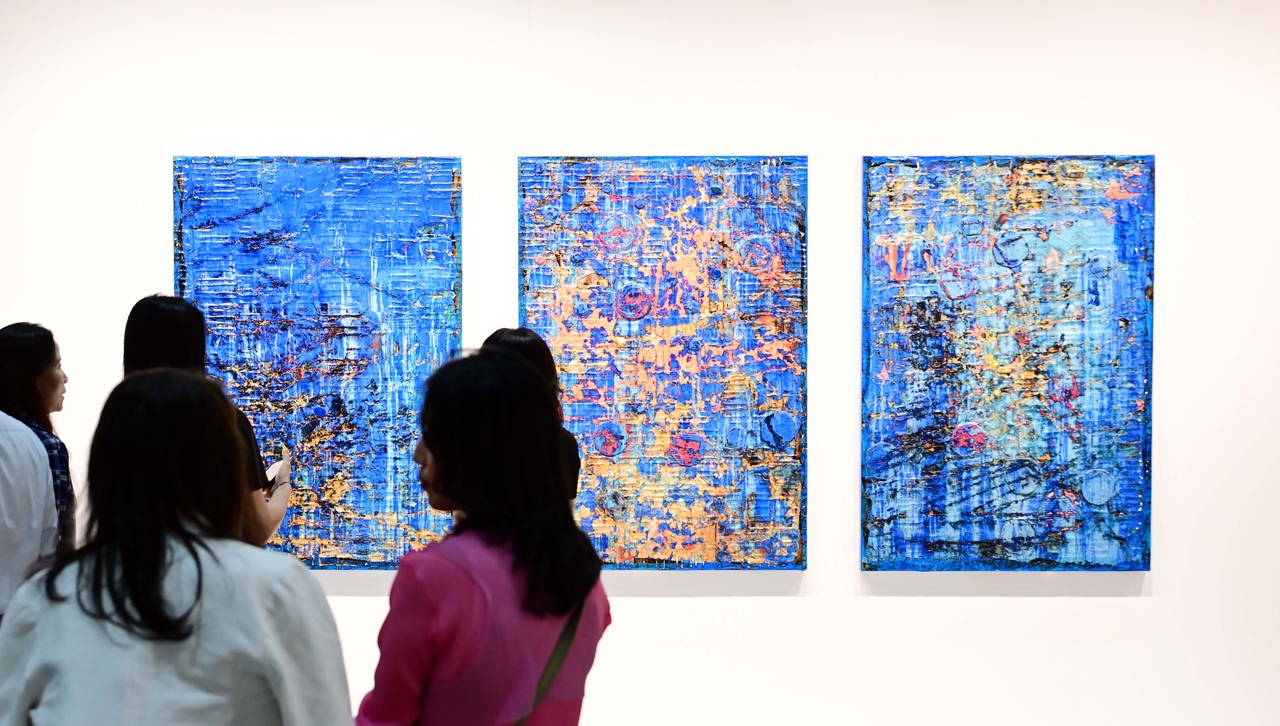
This year’s edition saw the highest-priced work ever sold at Frieze Seoul — a triptych of paintings by American artist Mark Bradford, whose solo exhibition is also on view at the Amorepacific Museum of Art. They sold for $4.5 million by Hauser & Wirth on the VIP preview day on Wednesday to an Asian private collector, according to the gallery.
Several galleries at Kiaf Seoul also reported that overall interest and inquiries for works have increased. Among local galleries, Kukje Gallery drew attention for selling an "Ecriture" painting by Korean dansaekhwa master Park Seo-bo for around 400 million won ($288,000) and all works from Ugo Rondinone’s Color Mountain sculpture series.
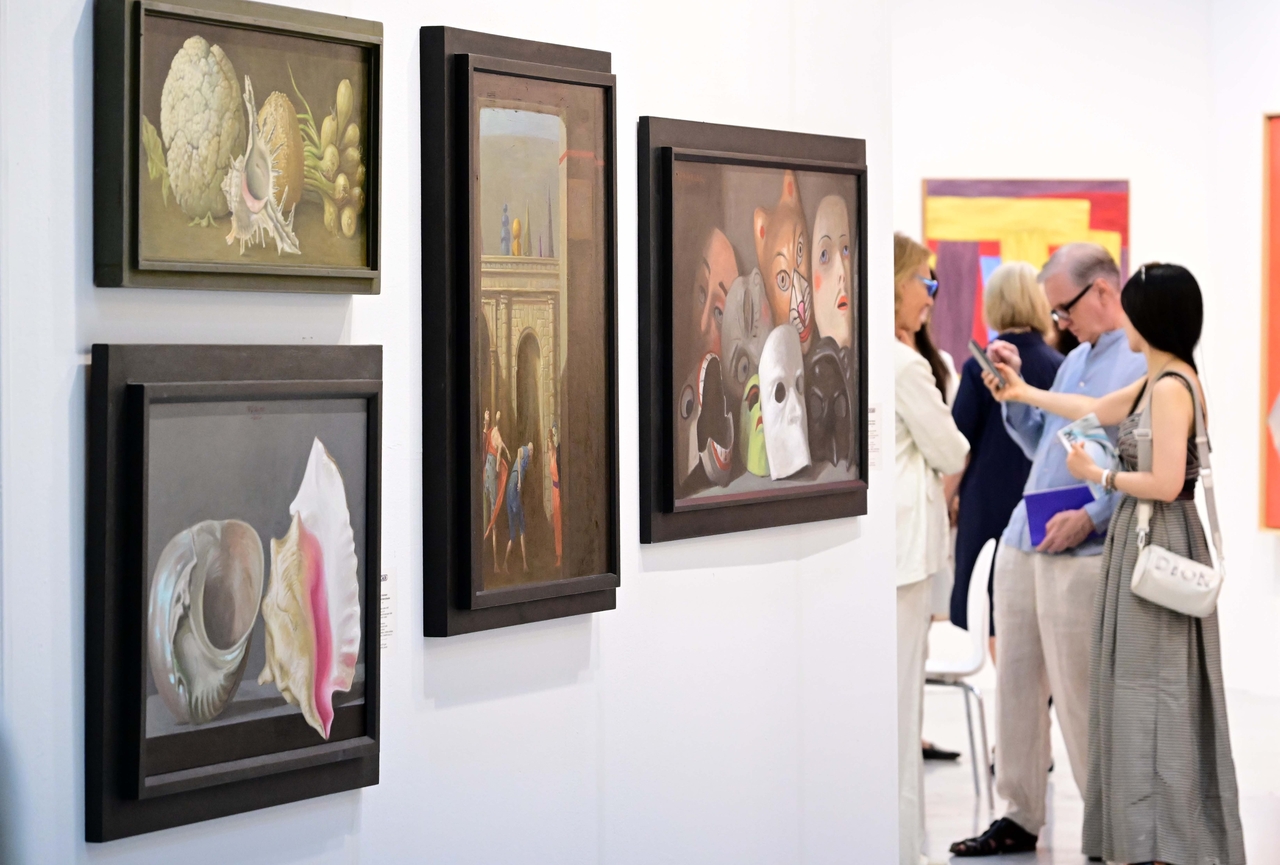
“Despite concerns over the global economic downturn and instability, collectors, curators, art professionals and enthusiasts from Asia, the US and Europe — as well as a wide range of Korean visitors — came to the fair,” said Lee Hyun-sook, founder of Kukje Gallery, in a statement.
Galleries and museums in the city’s art clusters kept doors open late throughout the art week, offering special programs and parties. One of the more popular programs was Gallery Hyundai’s “Manshin (all-gods)” performance by Korean shaman Kim Hye-kyung on Thursday night.
Drawing some 1,500 people, the performance took place at the gallery's yard where video art pioneer Paik Nam-june in 1990 staged "In the Steps of the Wolf" with a shaman to honor German artist Joseph Beuys, according to the gallery.

Strong Asian market, but conservative collectors
One significant change seen over the span of four editions of Frieze Seoul is the increase in the number of Asian galleries, which Frieze CEO Simon Fox noted this year.
“It is exactly what we wanted to happen,” he told reporters Thursday, mentioning that each Frieze fair needed to reflect its region. The global art fair is currently also held in London, New York and Los Angeles.
The fair’s fourth edition was joined by around 120 galleries this year, of which 75 percent were international with a focus on Asia and the wider Asia region, according to Frieze. The number of participating Korean galleries rose to 32 from 12 in the inaugural edition.
A Japanese gallerist, who declined to be named, said sales were weaker this year than last, but she hopes to join again next year because of the international atmosphere of Frieze Seoul.
“I feel like far more people come from overseas here than to Japan, for example the Tokyo Gendai. Seoul seems more international as an art scene,” the gallerist told The Korea Herald on Saturday.
Another gallerist from Southeast Asia, who has been coming to Frieze Seoul since the first edition, said she wants to come back because the fair has a “wider range of visitors as clients and more galleries” from Asia and beyond, although there are art fairs in Southeast Asia as well.

Some galleries that The Korea Herald contacted at the fair said the ratio of Korean to international collectors was about 60:40, noting that Korean collectors remained relatively conservative in their purchases.
Chinese gallery Hive Center for Contemporary Art, coming to Frieze Seoul for the first time, presented works by Chinese artists such as Huang Yuxing’s “Shape of the Universe.” Jeon Young-hwa, the gallery’s adviser, said Korean collectors tend to be more cautious than those from other Asian regions about buying works by artists they are unfamiliar with, which is why galleries with a physical presence seem to have an advantage at the fair.
“We came not only for sales, but also to explore opportunities to collaborate with overseas and Korean institutions or galleries,” she said.
Claudia Chen, co-founder of Taipei-based Liang Gallery, said that while she met collectors from Taiwan, Hong Kong and Singapore here, she saw more international visitors last year, coinciding with the Gwangju Biennale and Busan Biennale.
"There are a lot more local entrepreneurs and collectors this year. It gave me an opportunity to really connect with the local," she said. “Compared with Hong Kong, where local and Taiwanese collectors make decisions very quickly, Seoul’s market tends to move at a slower pace."
Paris-based gallery Mennour presented works by globally renowned artists such as Lee Ufan and Japanese French artist Leonard Tsuguharu Foujita. After a “very difficult” market last year, the market here seemed to have recovered somewhat this year, according to the gallery.
“In the previous editions, Korean collectors mostly looked for works by well-known and familiar artists, such as Lee Ufan. That is still the case, but it seems to be improving little by little,” said Beili Wang, the gallery’s sales director for Greater Asia. “While we would like to meet Korean collectors, it also feels like many (galleries) come to see a wider range of international collectors.”
yunapark@heraldcorp.com


![[Exclusive] Ateez to return in November](https://wimg.heraldcorp.com/news/cms/2026/09/02/news-p.v1.20260902.76162fb0ba55493aad1c076f240d0750_R.jpg?type=h&h=120)