
US government urges swift Supreme Court review to protect tariff drive, while experts warn new duties could follow even if current ones are struck down
US President Donald Trump’s legal difficulties over his signature tariff policy have raised fresh uncertainty for South Korea, with the possibility that a related trade deal could become obselete, and trade experts predicting Trump would maintain an aggressive approach even if current levies are struck down.
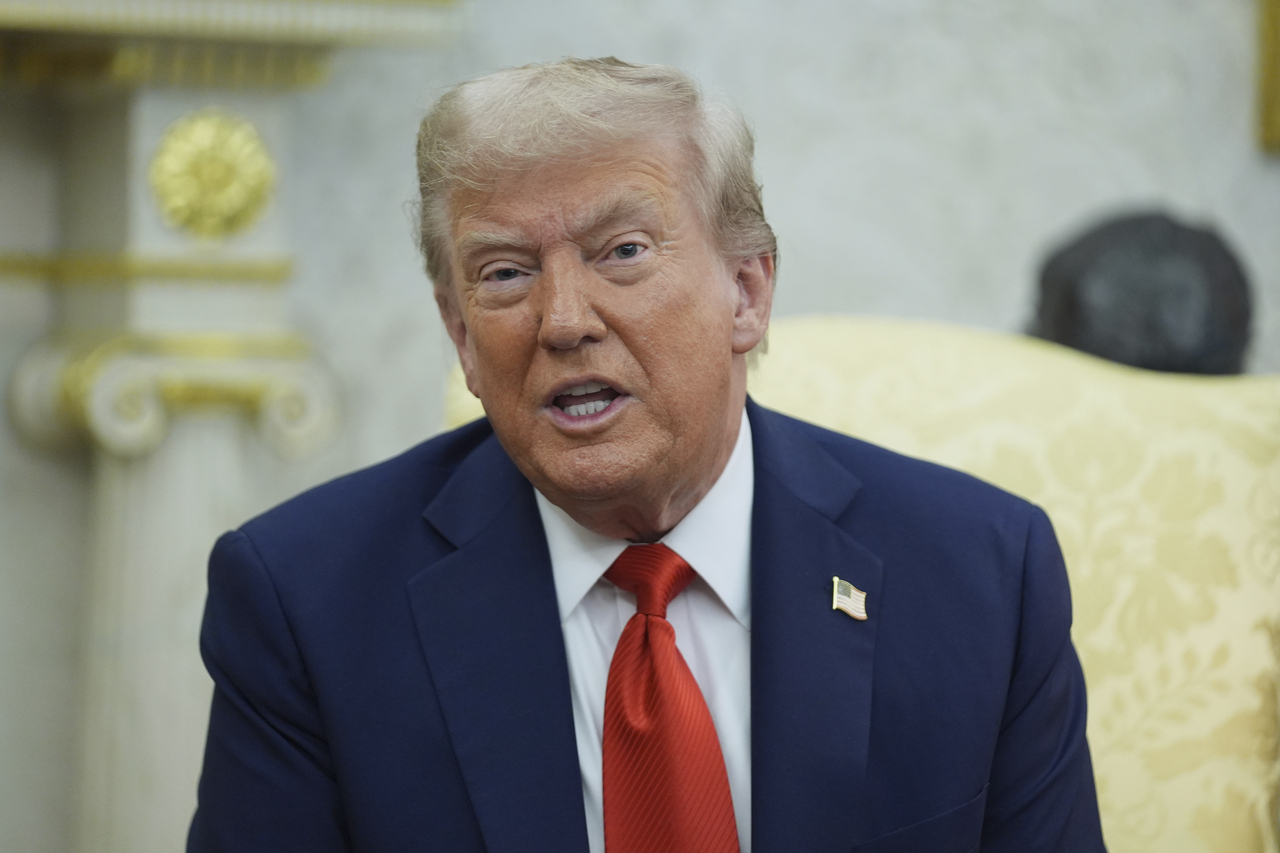
On Wednesday, Trump warned that trade deals with countries and regions such as the European Union, Japan and South Korea could be invalidated if the Supreme Court rules his “reciprocal” tariffs to be unlawful.
"Now, we made a deal with the European Union where they are paying us almost a trillion dollars, and they are happy to do it. ... These deals are all done. I guess we would have to unwind them," Trump told reporters at the White House during the summit with Polish President Karol Nawrocki.
"We've done deals with Japan, with South Korea. We've done deals with many countries and others to come,” he said, adding that if he loses the case, it would cause the US “to suffer so greatly.”
A federal appeals court ruled Friday that many of Trump’s tariffs were illegal, saying he had overstepped his presidential authority when using emergency power to impose the duties. The decision upheld a previous decision by the Court of International Trade in New York in May.
When he announced sweeping tariffs on nearly all trading partners, Trump had invoked the International Emergency Economic Powers Act, or IEEPA, arguing that the US’ trade deficit with other countries constitutes a threat to national security and the economy. But the court on Friday said that tariffs are “a core Congressional power,” and do not fall within the president’s mandate.
The court did not suspend the tariffs, but has allowed them to remain in place until Oct. 14 to allow an appeal. On Wednesday, the Trump administration filed an appeal with the Supreme Court seeking to overturn the lower court decision.
The administration has asked the court to expedite the ruling to the “maximum extend feasible,” citing the high stakes of the case, arguing that denial of tariffs would expose the US to trade retaliation.
If the Supreme Court agrees to take up the case by Sept. 10 — as the government has urged — observers expect the court to deliver a final decision by early next year.
Until them, it remains unclear whether the justices will uphold the lower court’s ruling or side with Trump. Either way, South Korean exporters face months of uncertainty as the case plays out.
"At this point, it's difficult to be either optimistic or pessimistic," said an industry official who requested anonymity. "The tariffs are still in place, along with sectoral tariffs on steel, and we can only respond once the final decisions are made. Until then, we are monitoring the situation."
Under a deal reached between South Korea and the US in July, the tariff rates were reduced from an initial 25 percent to 15 percent on all Korean goods, in exchange for Seoul’s commitment to $350 billion in investments in the US and a $100 billion purchase of American liquefied natural gas and other energy products.
While some hold out hope that the US Supreme Court upholds the ruling and cancels the duties, trade experts say that Trump will continue with aggressive trade actions regardless. The Korea International Trade Association, in a report released Monday, said even if current tariffs were struck down, new duties could be reimposed under Section 122 of the Trade Act — aimed at addressing trade deficits — or Section 338 of the Tariff Act, which targets unfair trade practices.
The separate sector-specific tariffs, including those on automobiles and auto parts, as well as steel and aluminum, were not affected by the latest ruling, and remain in place under Section 232. With Trump vowing to impose further levies on semiconductor and pharmaceuticals, he could lean more heavily on sectoral tariffs to continue his tariff policy, observers say.
“It is uncertain how the US court will ultimately rule, making it difficult to predict the outcome at this stage,” said Lee Jae-min, professor of law at Seoul National University.
"Even if the Supreme Court rules that reciprocal tariffs are unlawful, the Trump administration is likely to turn to other statutes to continue with the president’s tariff-imposing powers,” said Lee. “So it is reasonable to say that no significant, tangible changes will be felt by us for now."
The KITA report also noted that, given the Supreme Court’s conservative majority and its recent tendency to issue rulings favorable to the Trump administration, it is uncertain whether the appellate court’s ruling will survive at the high court.
“America’s unilateralism and the normalization of tariffs represent a new standard for US trade policy,” said Han Joo-hee, a researcher at KITA.
“Korean exporters and investors should prepare long-term strategies to adapt to this ‘new normal’ by adjusting production and product strategies, strengthening cooperation with state governments and Congress, and bolstering their technological and quality competitiveness.”
sahn@heraldcorp.com