
At investor day, auto parts-maker unveils three-pillar strategy spanning electrification, software-driven cars, global expansion
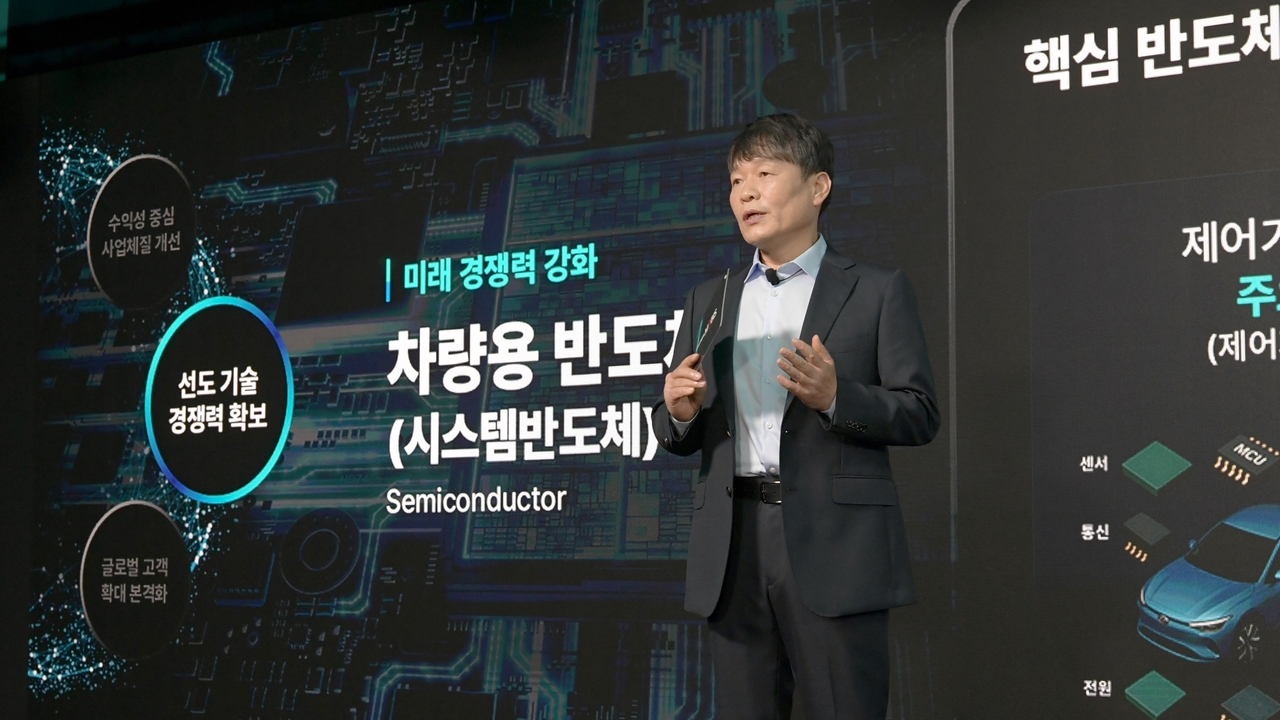
Hyundai Mobis on Wednesday laid out plans to accelerate its electrification and software-defined vehicles, or SDVs, while entering the automotive semiconductor and robotics business, as it seeks new growth in a fast-changing mobility market.
At its 2025 CEO Investor Day in Seoul, Hyundai Mobis CEO Lee Gyu-suk outlined a three-pillar strategy to secure growth: strengthening technology competitiveness, improving profitability and expanding its global client base.
The auto parts-maker highlighted a pipeline of advanced technologies, including a next-generation holographic windshield display codeveloped with German optics firm Zeiss. First unveiled at CES 2025, the windshield display uses holographic optical film to transform the windshield into a transparent screen. The company is also developing an SDV platform that enables software-based control and a battery system designed to block thermal runaway.
Commercial rollout of the windshield display is targeted for 2029, while SDV platform deployment is planned for after 2028.
Hyundai Mobis said it will strengthen in-house capabilities in next-generation automotive semiconductors and robotics. Pursuing a two-track strategy, the company said it is developing Communication SoCs and Battery Monitoring ICs, while accelerating in-house mass production of power semiconductors — critical components for EV drive systems.
Hyundai Mobis has so far developed 16 types of semiconductors and expects to produce 20 million units this year. Its research and development process has earned the highest ISO 26262 safety rating, and it is currently developing 11 next-generation chips.
The company said it is also working with automakers, fabless firms and foundries to strengthen South Korea's semiconductor ecosystem, and plans to host a dedicated forum next month.
The auto parts-maker is also entering the actuator market, leveraging its expertise in vehicle steering systems. Actuators control robot movement, sharing core components with electronic steering systems, and account for over 60 percent of humanoid robot production costs. Starting with actuators, the company plans to expand into sensors and controllers.
For sustainable growth, Hyundai Mobis said it is restructuring its portfolio and is targeting annual sales growth of more than 8 percent and an operating margin of 5-6 percent by 2027. The company said it is currently evaluating the competitiveness of around 60 products and enhancing its profit management system across all stages — from development to mass production.
The company also plans to lift the share of global customers in its core parts business to 40 percent by 2033. The company said it will strengthen ties with customers in North America and Europe, while boosting orders in China and India by tailoring products and reinforcing local supply chains.
On shareholder returns, Hyundai Mobis said it remains committed to "transparent and predictable" policies, including dividends and buybacks. The company repurchased and canceled treasury shares worth 620 billion won — nearly four times last year's amount — this year.
"Hyundai Mobis will continue to actively implement its transparent and predictable shareholder return policy based on trust with its shareholders," the company said.
herim@heraldcorp.com


![[Exclusive] Ateez to return in November](https://wimg.heraldcorp.com/news/cms/2026/09/02/news-p.v1.20260902.76162fb0ba55493aad1c076f240d0750_R.jpg?type=h&h=120)