

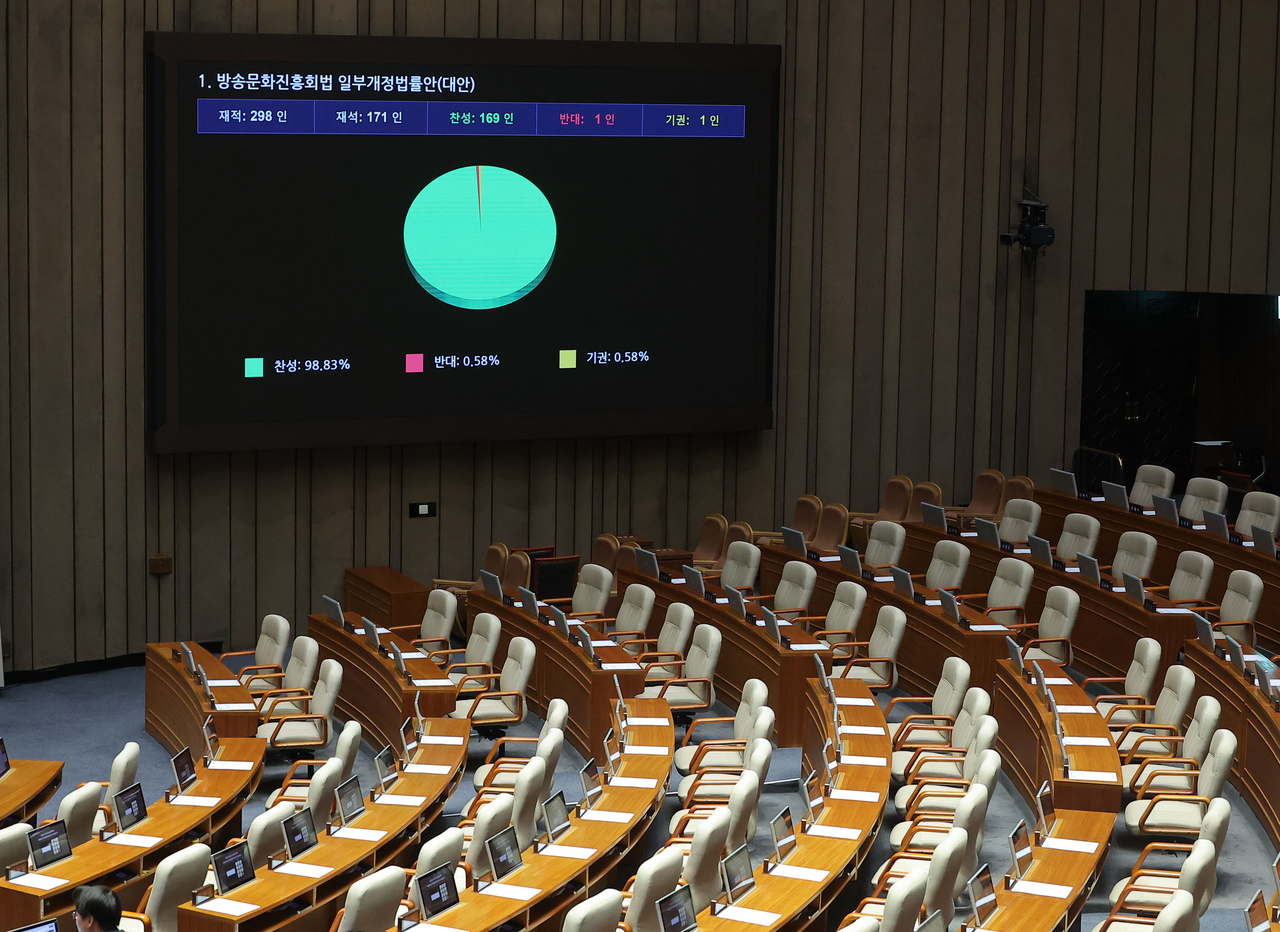
South Korea’s National Assembly on Thursday passed a revision to the law governing the largest shareholder of public broadcaster MBC, in a move led by the ruling Democratic Party of Korea aimed at "ensuring political neutrality in public broadcasting."
The bill was passed with 169 votes in favor, one against and one abstention, out of 171 lawmakers present. The main opposition People Power Party lawmakers did not participate in the vote.
The revision was first brought to a vote during the July parliamentary session but was stalled after People Power Party lawmakers launched a filibuster.
The revision increases the number of board members at MBC's largest shareholder, the Foundation for Broadcast Culture, from nine to 13 and changes how they are appointed.
Under the bill, FBC board members will be recommended by the National Assembly, the MBC viewers’ committee, its employees, academic societies in broadcasting and media, and legal associations.
The bill also introduces a new mechanism for selecting a CEO for the broadcaster. Candidates will be proposed by a 100-member citizen recommendation committee comprising ordinary citizens and reflecting diversity in gender, age and region. The FBC board will then vote to finalize the appointment.
The revision is part of a broader legislative initiative long pursued by the Democratic Party to overhaul the governance of major public broadcasters, including KBS, MBC and EBS.
The bill has faced opposition from the People Power Party, which argued that it is being pushed by the Democratic Party and labor unions as a means to bring public broadcasters under their control.
Before the vote, President Lee Jae Myung voiced support for the bill.
"With today’s passage of the (amendment to the) FBC Act, we will lay the legal foundation for the independence of public broadcasting and the people’s right to know," he wrote on Facebook.
The Democratic Party first proposed a version of the bill targeting KBS in 2022 as part of its broader reform drive.
While the party — then holding 155 out of 296 Assembly seats — passed the bill on its own, it was later vetoed by then-President Yoon Suk Yeol. An attempt to override Yoon's veto failed to meet the required quorum.
A similar outcome followed in 2024, when the Democratic Party again pushed through revisions affecting KBS, MBC and EBS, only to face another veto from Yoon and a failed override vote.
The Democratic Party currently holds 166 out of 298 Assembly seats, while the People Power Party holds 107. The minor progressive Rebuilding Korea Party and the Progressive Party hold 12 and 4 seats, respectively.
Following Thursday’s vote, the Assembly also tabled a bill aimed at restructuring the governance of EBS. In response, the People Power Party launched another filibuster in an effort to block its passage.
Earlier this month, on Aug. 5, lawmakers passed a separate bill requiring the replacement of KBS board members within three months.
flylikekite@heraldcorp.com