
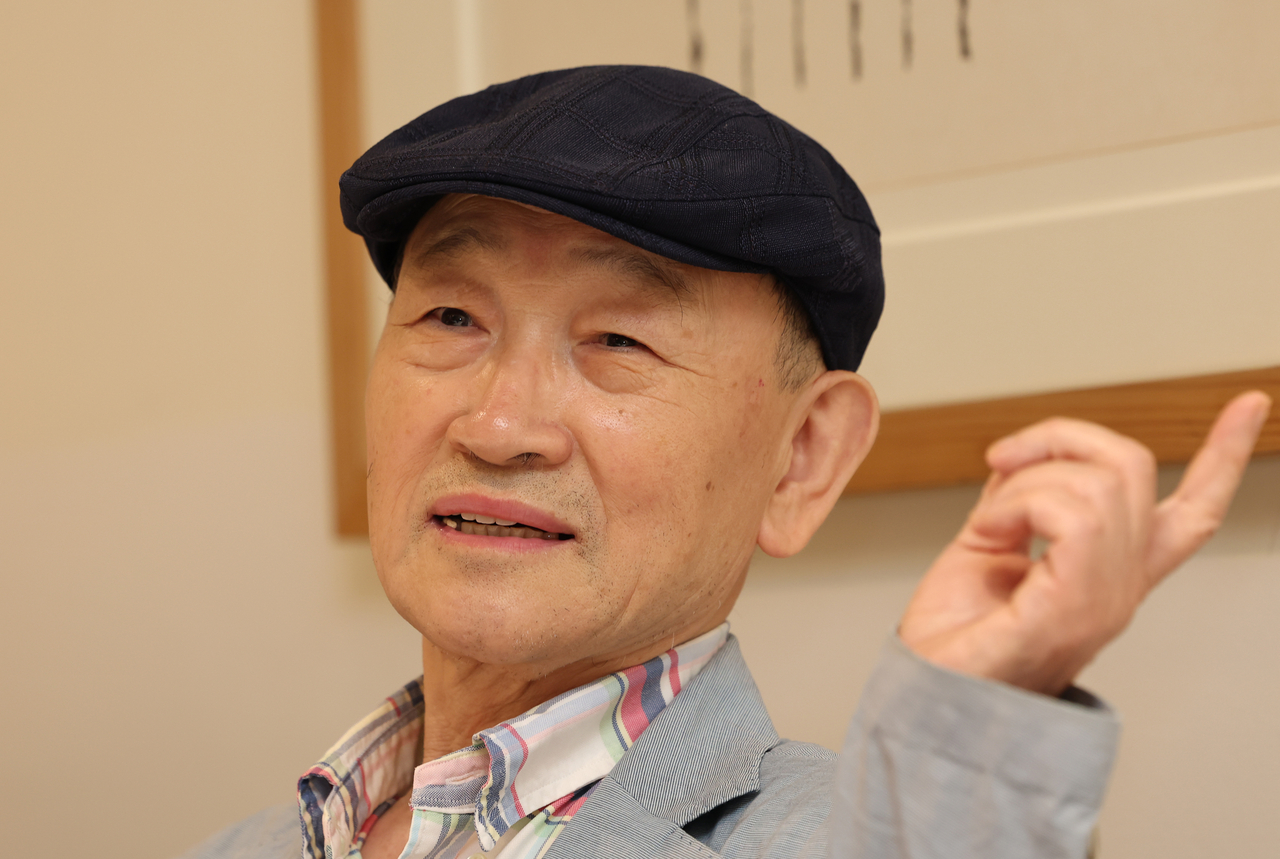
Soon after his inauguration, Youn Bum-mo, the newly appointed president of the Gwangju Biennale Foundation, shared his concerns about how to expand the "May 18 spirit" to the global stage as a new generation emerges.
Youn, a former director of the National Museum of Modern and Contemporary Art, Korea, said Gwangju was a rare case globally as the city is associated with a “spirit." In turn, this has formed the identity of the biennale.
The May 18 spirit derives from the May 18 Gwangju Democratic Uprising in 1980 against the military dictatorship, which brutally suppressed the uprising, resulting in hundreds of deaths and injuries. The spirit remains today as a symbol of resistance to oppression and commitment to democracy and human rights.
“Now that a generation has passed, younger people are less familiar with the May 18 spirit. It is time to move toward a more mature phase. But how do we move forward? That is the question, and we need specific strategies and actions for that,” Youn said.
Youn's remarks come at a time when the 30-year-old biennale, which has become one of the leading art events in Asia, faces challenges to its identity with the need to expand the discourse.
He said there was a growing sense that the spirit of Gwangju should be presented in a more indirect way. “But at the same time, we should pursue a biennale that only Gwangju can realize — one that is distinct and has a clear character.”
Youn said the demand to dilute the "Gwangju spirit" in the biennale has existed for many years, even within the city. There are also calls from local communities to better support and promote artists from the region at the biennale, he noted.
When asked whether such demands could affect the artistic director’s autonomy, he said that would not be the case, pledging that the foundation would fully support the director.
"There are many other opportunities to present those regional artists, not particularly at the biennale but at other diverse programs that we run," he said.
Singaporean artist Ho Tzu Nyen will helm the 16th Gwangju Biennale in 2026 as artistic director. The upcoming 2025 Gwangju Design Biennale in September will be curated by Choi Soo-shin, a professor at the Savannah College of Art and Design in the US, exploring how design embraces humanity.
Youn, who will serve a three-year term, previously served as a member of the executive committee for the inaugural Gwangju Biennale in 1995.
“Gwangju (Biennale) has grown into a leading art event not only in Korea but also internationally. I was entrusted with its leadership at a turning point where we began writing the next 30 years of its history. I feel the weight of that responsibility.
“There is a significant gap between how things appear on the outside and the complex realities I face from within,” Youn said.
Next year’s biennale will have national pavilions on a similar scale as last year, when 31 national pavilions participated, according to Youn.
“We will have to come up with ways to secure better spaces for the national pavilions next year. We have been receiving a lot of applications,” he said.
Applications for national pavilions opened earlier this year.
yunapark@heraldcorp.com