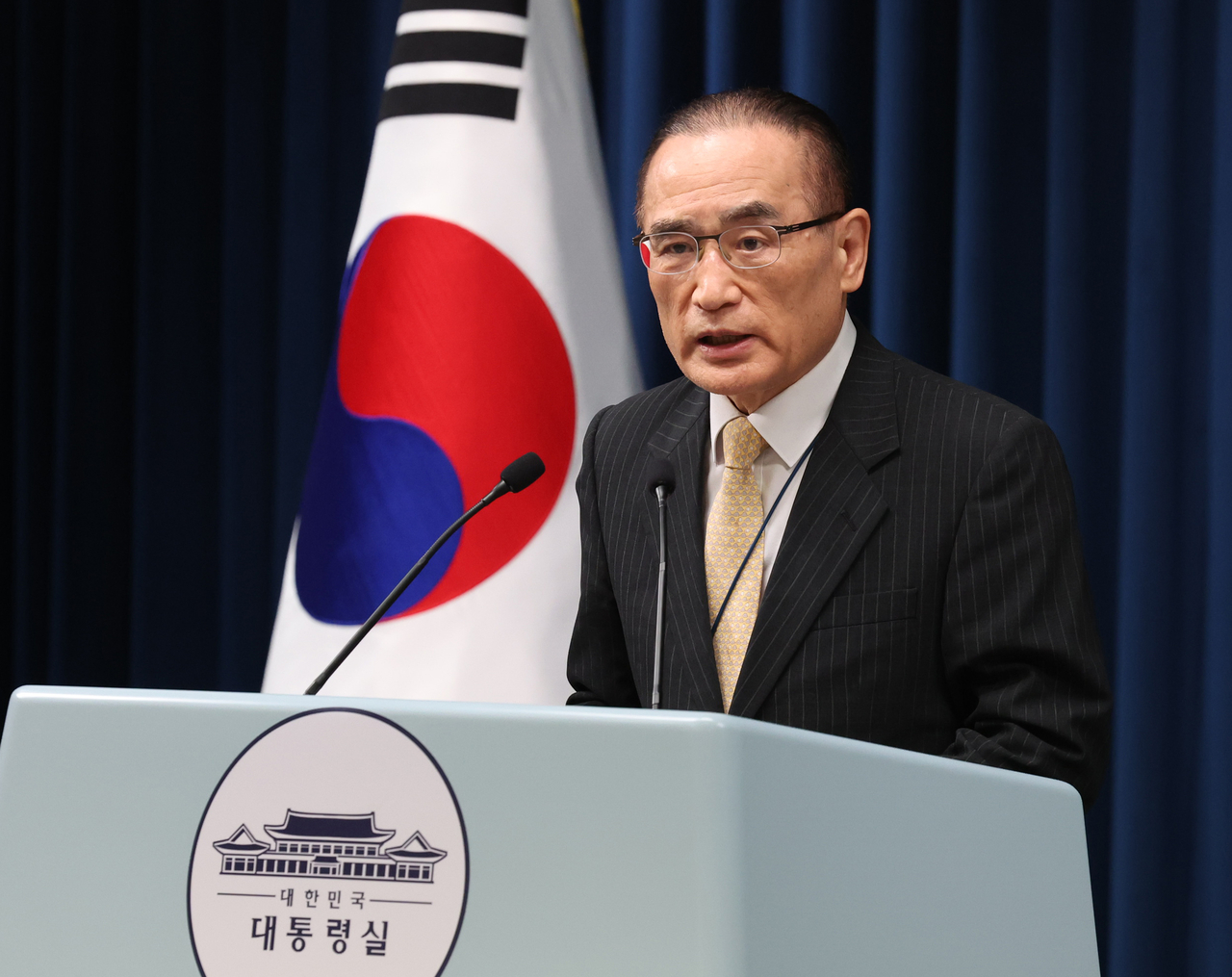
National Security Adviser Wi Sung-lac said Wednesday that South Korea has proposed a "package deal" encompassing economic and security considerations in bilateral tariff negotiations, while also suggesting an early summit between President Lee Jae Myung and US President Donald Trump.
Speaking to reporters following a four-day visit to Washington, Wi said he held "in-depth" discussions on trade negotiations and broader alliance issues in meetings with US Secretary of State Marco Rubio and other senior officials.
During his trip, Trump sent a letter to Lee that said the United States would start imposing 25 percent tariffs on all South Korean products imported on Aug. 1, which effectively extended the initial tariff deadline and allowed more time for negotiations.
While Trump's letter primarily addressed tariff and non-tariff barriers, Wi said he proposed broadening the discussions to include trade, security and alliance-related issues in his meeting with Rubio.
"We raised a range of issues spanning trade, investment, procurement and security, and suggested moving forward with negotiations by taking this comprehensive package into account," Wi said.
To advance negotiations on these matters, Wi proposed that President Lee hold a summit with Trump in the near future.
"I proposed holding a Korea-US summit at an early date to help facilitate mutually beneficial agreements on key pending issues, and Secretary Rubio expressed his support," he noted, adding that a specific date was not discussed.
Addressing Trump's claim that South Korea contributes "very little" to US military support, Wi defended that South Korea is making substantial contributions to the 28,500-strong US Forces Korea (USFK), citing the Special Measures Agreement (SMA) signed between the allies.
Last year, Seoul and Washington signed the 12th SMA for the 2026-2030 period, under which Korea is to pay 1.52 trillion won ($1.11 billion) next year, up from 1.4 trillion won this year.
"We're paying around 1.5 trillion won, and on top of that, there are separate contributions under the cost-sharing arrangement," he said.
"Beyond the SMA, we're gradually increasing our overall defense spending in line with international trends. Our contribution is substantial and there's potential for it to grow further."
Following Trump's remarks, Seoul's foreign ministry said it will comply with the existing terms of the defense cost-sharing deal, saying the 12th SMA is "validly concluded and in effect."
Aside from the USFK cost, the Pentagon said recently that South Korea and other Asian allies are subject to the new "global standard" of spending 5 percent of their gross domestic product on defense, a target similar to that set for North Atlantic Treaty Organization allies.