
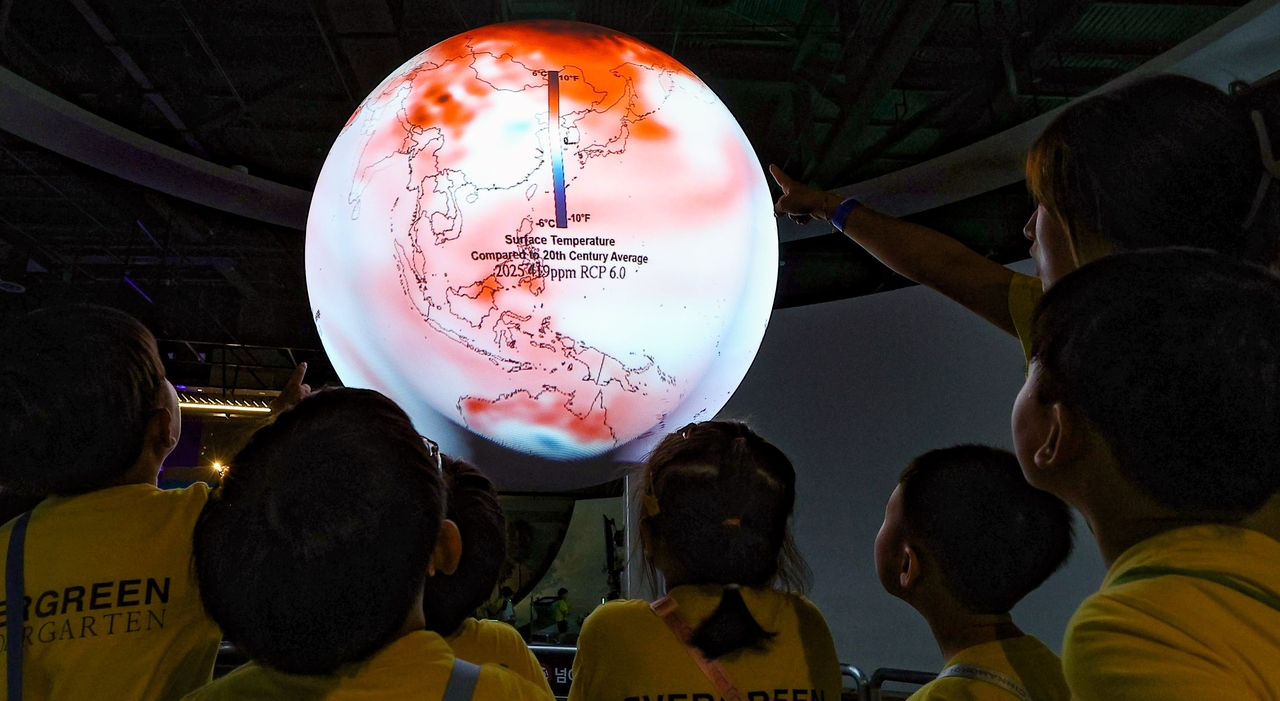
As a heat wave swept through South Korea on Friday, children visiting the Daegu National Science Museum stood beneath a glowing digital globe showing a sobering climate projection for 2025.
The exhibit, part of the “Science on a Sphere” system, visualized global surface temperature changes compared to 20th-century averages. Deep red hues covered much of Asia, with the display reading “419 ppm, RCP 6.0,” referring to current carbon dioxide levels and a mid-range emissions scenario used by climate scientists.

Daegu, often dubbed “Daefrica” for its extreme heat, had already reached 33.8°C in late June. Forecasters now expect highs between 36 and 37°C across the city and much of the surrounding North Gyeongsang Province.
Local governments are scrambling to protect residents. Over 9,000 heat-sensitive individuals are receiving supplies like cooling sprays, ice packs, and portable fans. In Daegu’s parks, thousands of ice water bottles are being distributed daily. Sprinkler trucks are making multiple passes each day to cool pavement. Public shade structures have also been expanded across districts.
But the heat is not just hotter. It’s arriving earlier and lasting longer. This summer’s rainy season, typically South Korea’s buffer against peak heat, has been erratic and dry.
With no meaningful rainfall expected in the coming days, meteorologists warn the conditions mirror those of 2018, when Korea experienced its longest and hottest summer on record.
mjh@heraldcorp.com