
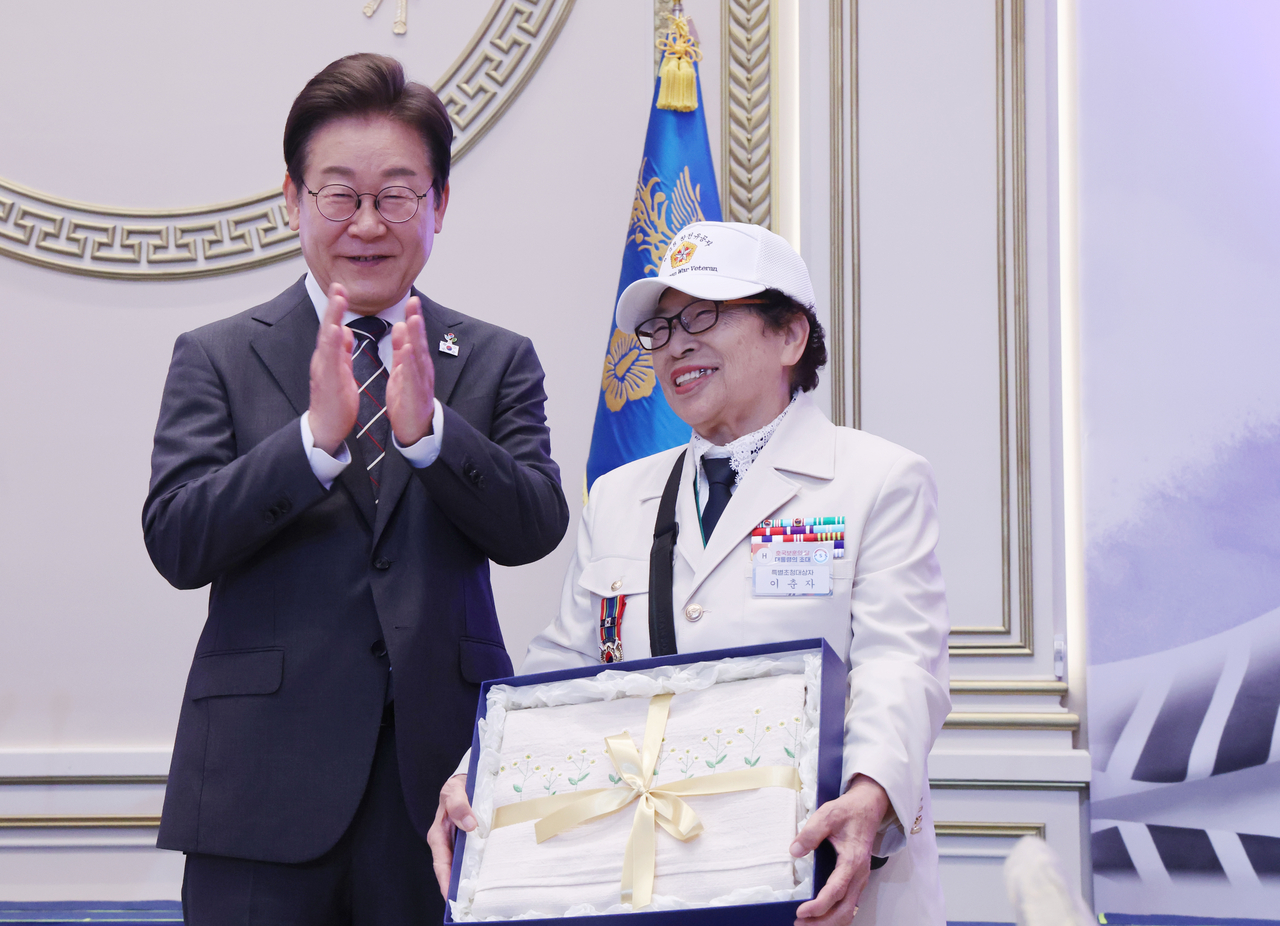
President Lee Jae Myung on Friday invited family members of those who made "extraordinary" sacrifices for the country throughout its decades of modern history, at a lunch held in Cheong Wa Dae, former presidential compound in Seoul.
Reiterating a need for "extraordinary rewards and respect for extraordinary sacrifices," albeit not elaborating what that would be, the president said a proper compensation for sacrifice will encourage people to be willing to make their own sacrifices when the country is in danger.
"No matter whether it was an independence movement (against Japan's colonial rule), the Korean War or a battle in a foreign country due to the country's troop dispatch, anyone who sacrificed for South Korean citizens' better quality of life and safety ... must be rewarded with special attention and care from the community," Lee said at the event at the state guest house inside Cheong Wa Dae.
Before some 160 participants in the event, Lee said those who made such sacrifices deserve a greater level of compensation and respect than what they are now.
"Unfortunately, South Korea's modern history suggests that the country has insufficiently treated those who sacrificed for the people of the country," Lee told participants.
"It's often said that the poverty of a freedom fighter's family will pass three generations, and the wealth of a pro-Japanese collaborator's family will last for three generations. This should not happen again," Lee added.
Among the participants were families of independence fighters during Japan's colonial rule, the Korean War, a democratic movement in 1960, soldiers dispatched to the Vietnam War, the Gwangju uprising in 1980 and, most recently, a battle in the West Sea in early 2000s.
Attending the event were Lee Chun-ja, a veteran who fought against communist forces during the Korean War, parents of the soldiers who perished due to North Korea's attack against South Korean forces on the West Sea border zone.
Also at the event was Kim Gil-ja, mother of late Moon Jae-hak who was an inspiration for a character in Nobel literature laureate Han Kang's novel "Human Acts." Moon was a 17-year-old high school student when he was killed during the Gwangju Uprising in 1980.
Lee was accompanied by his wife Kim Hea Kyung at the event.
Friday's event was the first occasion Lee officially visited Cheong Wa Dae, as the Lee administration is working to relocate his office in Yongsan-gu, Seoul near the Ministry of National Defense headquarters back to where it used to be.
consnow@heraldcorp.com