
Postelection optimism fuels sharp rally, lifting hopes of a market renaissance
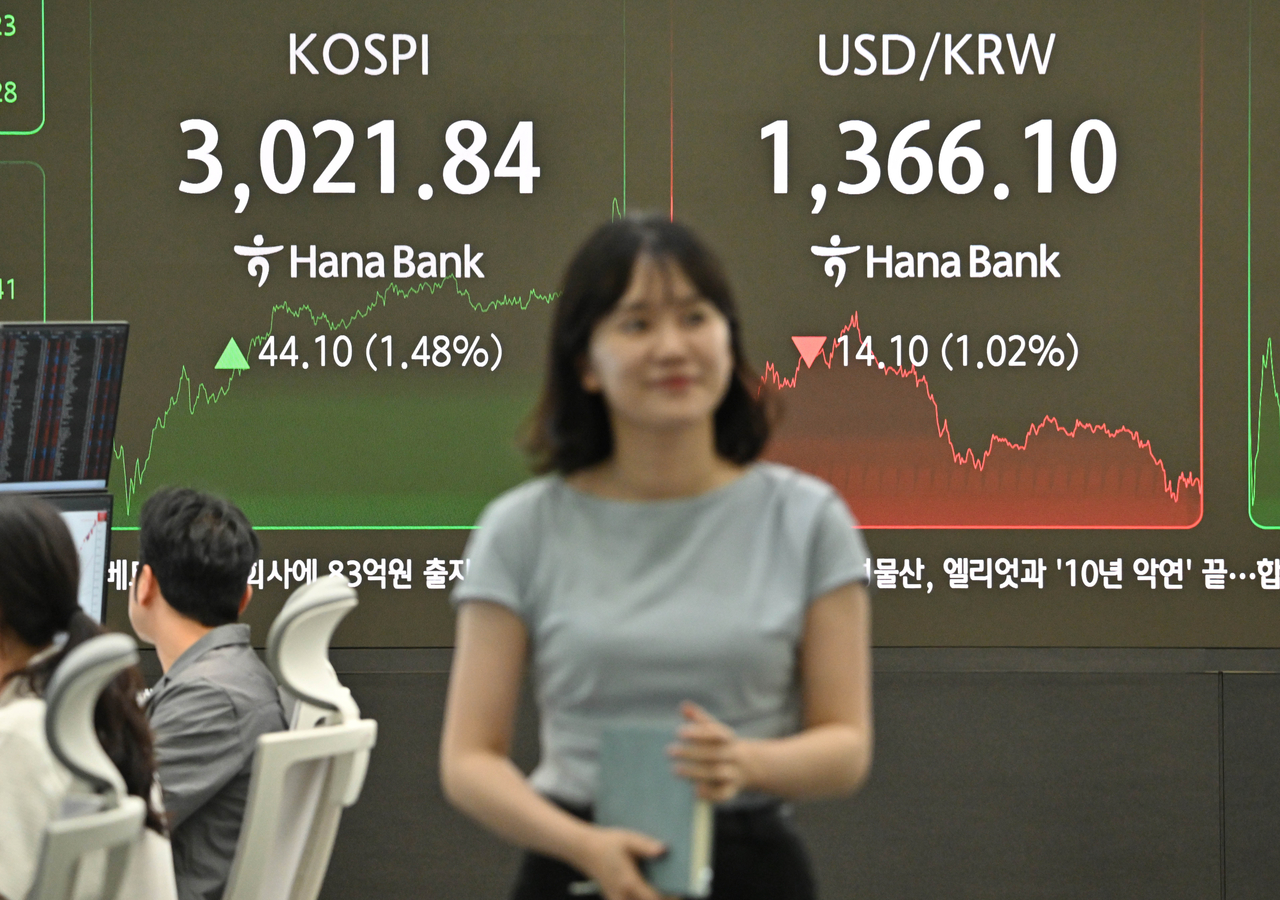
The Kospi did not just return — it roared back.
On Friday, South Korea’s benchmark index surged past the long-awaited 3,000 mark and kept climbing, closing at 3,021.84, up 1.48 percent from the previous session. It was the first time the Kospi ended above 3,020 since Dec. 28, 2021.
The rally seemed modest at the start, with the index opening just 0.29 percent higher at 2,986.52. Retail investors led early gains with net buying, while foreigners and institutions sold into strength, keeping the benchmark tightly anchored below the key level.
That restraint vanished once the Kospi cracked 3,000 around 10:45 a.m. Momentum took over, lifting the index past 3,010 by 11:20 a.m. The market stayed buoyant throughout the afternoon, hovering near 3,010, before accelerating again in the final minutes of trading. The Kospi hit an intraday peak of 3,022.06 just before the close, settling near the high of the day.
It was a historic session: Not only did the Kospi reclaim the 3,000 level for the first time since January 2022, but total market capitalization hit a record 2,472 trillion won.
According to the Korea Exchange, the Kospi first crossed the 3,000 mark on Jan. 7, 2021, peaking at 3,305 in July that year. But post-COVID-19 momentum faded amid a global slowdown and recession fears, pushing the index into a prolonged slump. For much of the past year, it remained trapped in a narrow range between 2,200 and 2,800.
Gains were broad-based, with most of the Kospi’s top market heavyweights finishing higher. SK hynix and LG Energy Solution each rose more than 4 percent, while Naver surged nearly 7 percent. Hyundai Motor climbed 1.5 percent and Samsung Biologics added 1.7 percent.
The tech-heavy Kosdaq also posted solid gains, rising 1.15 percent to close at 791.5. Institutional and foreign investors bought a combined 84 billion won, offsetting retail selling.
Friday’s milestone extends a two-week honeymoon rally under President Lee Jae-myung’s new administration, reinforcing renewed investor confidence despite external headwinds, including Middle East tensions and lingering tariff risks.
The Kospi has staged a near-unbroken rally since June 2, the eve of the general election, logging only one down day on June 13. After crossing the 2,700 mark on Lee’s first full day in office, the index has jumped 12 percent, buoyed by expectations for policy reform and pro-growth momentum.
“The Kospi reversed course earlier this year as dip-buying resumed and the Trump administration announced tariff deferrals, with the rally gaining further traction around the presidential election,” the Korea Exchange said. “The launch of the new administration has eased political uncertainty and lifted sentiment on expectations of market-friendly policies.”
Analysts say the market is responding sharply to government signals. “The Kospi’s strength is being driven more by expectations of capital market reform and a valuation rerating than by earnings growth,” said Kang Jin-hyeok, analyst at Shinhan Securities.
He added that Friday’s rally reflected investor optimism following Thursday's unveiling of a 30.5 trillion won ($22.3 billion) supplementary budget. "This, combined with expectations of one or two additional rate cuts later this year, is fueling hopes for increased liquidity in the market.”
Market watchers expect momentum to persist, brushing aside concerns of postelection fatigue.
“If current earnings trends hold, the Kospi could reach 3,100 by year-end,” said Noh Dong-kil, strategist at Shinhan Securities. “And if rising liquidity drives a further rerating in valuations, the index could climb as high as the 3,400 range.”
“Despite the rally, Kospi’s valuation remains at a neutral level," said Lee Soo-jung of Meritz Securities, adding, "With stimulus measures such as the supplementary budget and revisions to the Commercial Act upcoming, there’s a strong possibility of an overshoot in the Korean stock market.”
Lee anticipated foreigners to remain key drivers. After nearly 10 months of net selling, foreign investors turned net buyers in May, purchasing 1.2 trillion won, followed by an additional 5.3 trillion won in June. They remain net sellers of 8 trillion won year-to-date.
Still, caution lingers as external risks and a slowing domestic economy continue to pressure sentiment.
“Despite strong policy momentum and supportive catalysts unique to the Korean market, broader fundamentals and external risks — such as weak earnings prospects, trade tensions and geopolitical instability — should not be overlooked,” said Han Ji-young, strategist at Kiwoom Securities. “A breakout above 3,100 this year is possible, but navigating volatility will be crucial at those levels.”
jwc@heraldcorp.com