
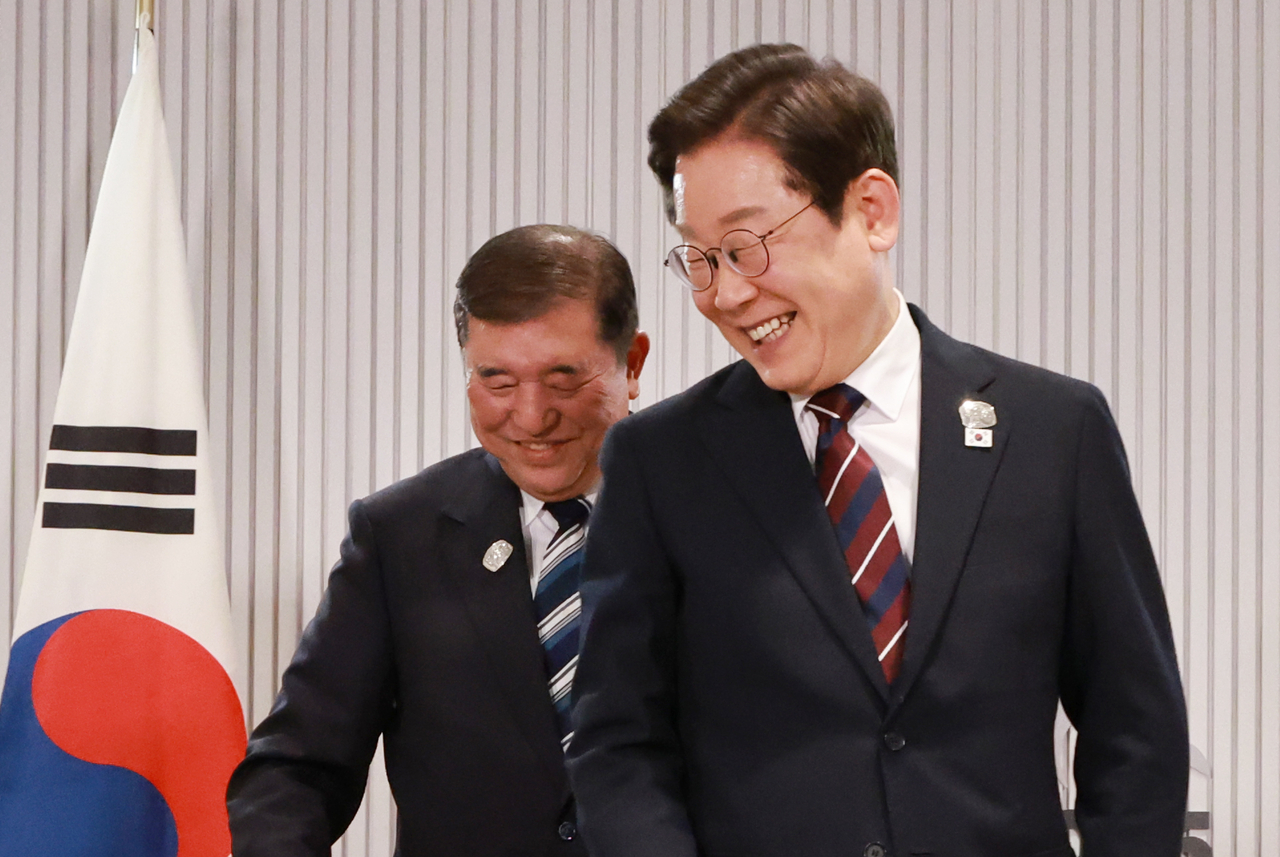
KANANASKIS, Alberta — President Lee Jae Myung and Japanese Prime Minister Shigeru Ishiba agreed to continue strengthening trilateral cooperation between South Korea, the United States and Japan in addressing regional geopolitical challenges, including the North Korean issue, during their first summit talks on the sidelines of the Group of Seven summit in Canada on Tuesday.
The two leaders also agreed to create a foundation for a stronger and more mature relationship between South Korea and Japan, according to the presidential office in Seoul. This year marks the 60th anniversary of diplomatic ties through the Treaty of Basic Relations between Japan and Korea in 1965, two decades after Japanese colonization ended on the Korean Peninsula.
Lee and Ishiba also reaffirmed their willingness to take turns visiting one another through so-called "shuttle diplomacy."
During the 30-minute meeting, Lee called for a "future-oriented partnership" in the face of international trade uncertainties and geopolitical unrest, and described the relationship between the two neighboring countries as "complementary."
"As challenges in the international trade and commerce environment and international relations weigh on (us), South Korea and Japan, which are close and are in a complementary relationship, can be mutually helpful if we cooperate in a wide range of areas," Lee said.
Ishiba responded by saying the two countries' partnership should be "helpful for the world."
He also said Japan recognized that the situations in Ukraine, the Middle East and Asia have become increasingly serious.
It was the first time the two leaders had met in person since Lee's election victory and immediate inauguration on June 4. The two leaders held phone talks on June 9.
"In South Korea, we often describe the relationship between Japan and South Korea as close yet distant," Lee said. "Like neighbors sharing a front yard, our ties, our relationship cannot be severed."
In the meantime, Ishiba expressed hospitality toward Lee during the meeting.
"You appear on Japanese television every day. It is my first time seeing you in person, but I rather feel like we have met before," Ishiba said.
Asked about past historical grievances between the two countries, particularly relating to the time when South Korea was under the colonial rule of Imperial Japan from 1910-45, an official said the two countries centered their conversation instead on future-focused discussions.
“It’s not that the word ‘history’ didn’t come up at all. It was mentioned, but the discussion did not center on contentious historical issues. The talks focused more on managing historical matters well and strengthening cooperation to build a future-oriented relationship," an official said under condition of anonymity. “It’s fair to say there was general agreement on that approach.”
Under the ousted former President Yoon, the diplomatic relationship between South Korea and Japan thawed.
While Yoon touted the close ties with Japan as an effort to "overcome the painful past," Lee, who was then the leader of the liberal opposition party, had long criticized Yoon for his "humiliating" approach to diplomacy.
consnow@heraldcorp.com