

While Filipino caregivers cite general satisfaction with the program, service costs remain a key barrier to broader adoption
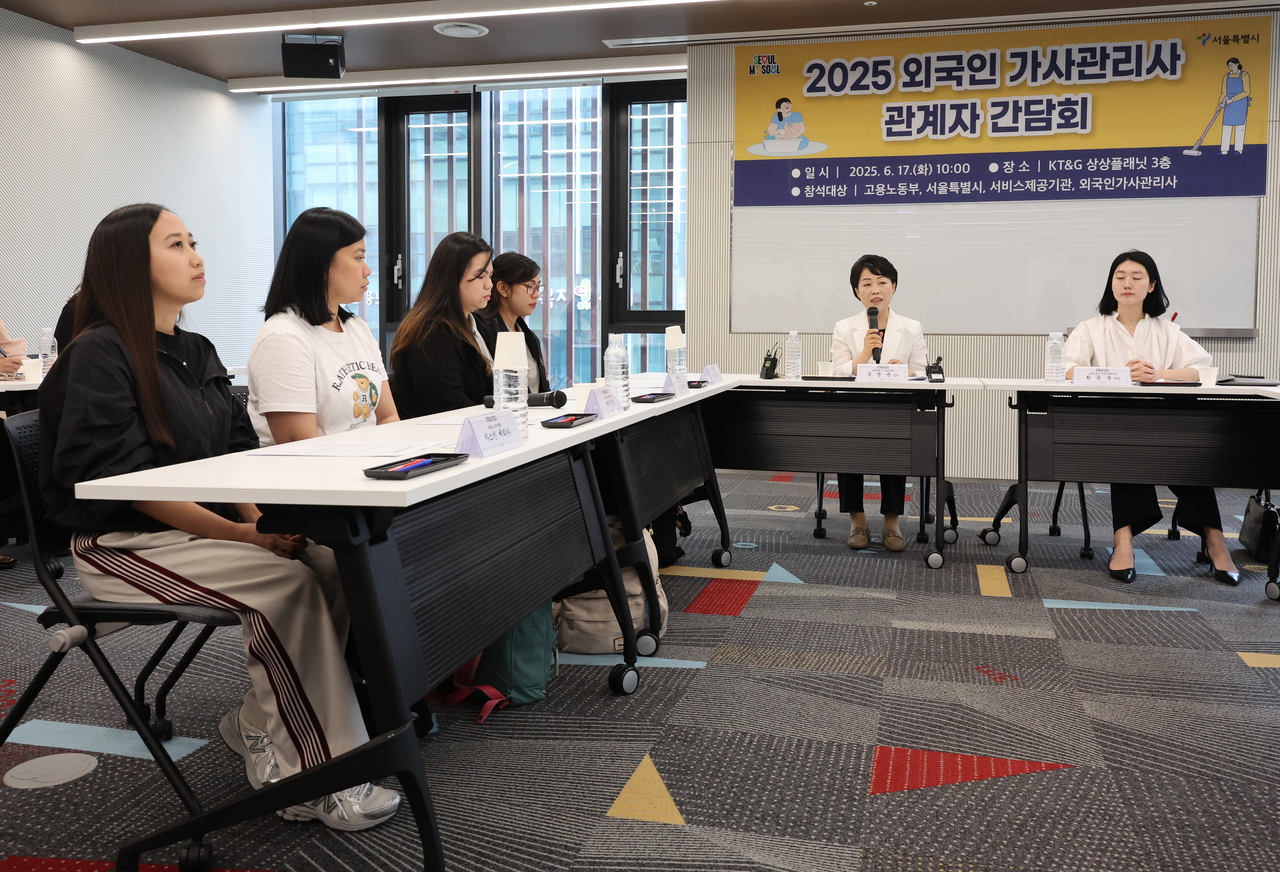
The South Korean government on Tuesday cast doubt on whether a program introducing foreign caregivers to Seoul would expand past the pilot stage, citing unresolved cost issues.
At a roundtable meeting hosted in Seongdong-gu, eastern Seoul, the director of the Ministry of Employment and Labor’s Foreign Workforce Division, Han Eun-sook, told the press that it would be “difficult to expand the foreign caregiver initiative into a full-fledged program” unless the problems surrounding caregiving costs are resolved.
The pilot program was launched in September 2024 as part of the city government’s response to low birth rates and efforts to ease pressure on working parents. It hired trained caregivers from the Philippines to assist with child care and housework in Seoul. According to the city government, 86 Filipino caregivers are employed by 143 households in Seoul, with each worker being assigned to one to two households.
Initially planned to run through February 2025, the pilot program shifted from a government-led model to one that’s managed by private companies Hubriz and Daeri Jubu from March and was extended again for another year.
However, the cost of the service — 16,800 won ($12.30) per hour — has emerged as a key barrier to broader adoption.
At four hours per day, five days a week, families would pay around 1.46 million won per month, including wages, insurance and administrative fees.
The Seoul Metropolitan Government previously requested that foreign domestic workers be exempt from South Korea’s minimum wage to reduce household costs, citing Singapore and Hong Kong as examples. In Hong Kong, foreign domestic workers are not covered by the standard statutory minimum wage and in Singapore, no legally mandated minimum wage applies to domestic workers, with their salary instead determined through individual contracts between the employer and worker.
However, the Labor Ministry rejected this proposal, citing the Labor Standards Act and the International Labor Organization’s conventions, which prohibit wage discrimination based on nationality.
“Because minimum wage and labor protections apply equally, the program struggles to fulfill its initial goal of easing the burden of costs that come with care services,” explained Han.
Still, Han clarified that the current group of foreign caregivers may continue working in South Korea for three more years, regardless of whether the pilot program transitions into a permanent one.
Noting that the city government currently provides subsidies for low-income families in need of domestic workers of Korean nationality, the city government’s director general of the Women and Family Office, Kim Sun-soon, stated that such subsidies could be extended to families using similar services provided by foreign domestic workers.
“If these families are also allowed to receive the same kind of support when using the service provided by foreign caregivers, the issue could be resolved,” said Kim.
“The city government sees that there is clearly strong demand among many families for foreign caregivers, as they are a lot younger and are more active than the Korean domestic workers. We hope to continue discussions with the new administration to carry the program forward.”
Despite entering Korea on contracts as childcare specialists, local reports have indicated in the past that many workers were reportedly tasked with a broader range of household chores, being required to clean houses and bathrooms, wash dishes, take out the trash and even care for pets or do work for their employers' relatives. This concern was also raised during a panel discussion hosted by the Seoul Metropolitan Council on Monday, which addressed the lack of oversight by authorities responsible for the caregiver pilot program.
CEO Jeon Chang-min of Hubriz added that it plans to distribute clear guidelines to households applying for the foreign caregiver service in the future.
“As domestic workers are seen to also be responsible for managing household chores, there were some misunderstandings that arose in the past between families and caregivers,” said Jeon. “We plan to continue to mediate any conflicts that arise due to this misunderstanding in the future and implement a sustainable care system that guarantees the rights of all care workers."
Meanwhile, foreign caregivers who attended the roundtable discussion spoke positively about their experiences of living and working in Seoul.
Two such workers, Jasmine Erika and May Ann, cited minor communication difficulties due to their lack of fluency in Korean. However, the two workers also mentioned that most of the families they work with “can speak English very well,” and that they are making efforts of their own to learn Korean during their spare time.
lee.jungjoo@heraldcorp.com

![[World Class] HUFS bets on Songdo, AI to redefine what a global university can do](https://wimg.heraldcorp.com/news/cms/2026/10/18/news-p.v1.20260930.7e4dbeacfc1d4d16848c0e2a441c04e6_R.jpg?type=h&h=120)