
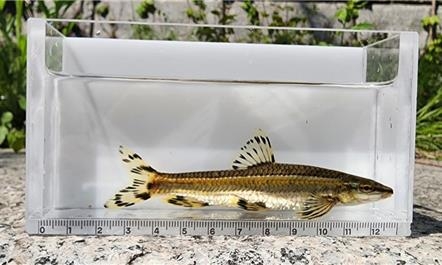
A "swiri" freshwater fish native to Korea that lives only in cleaner water, was confirmed to be living in the Cheonggyecheon, the stream that runs through the heart of Seoul, according to a new study released Monday.
Its discovery means the urban stream, restored in 2005, serves not only as a nice walking space, but as a hub of biodiversity with clean water quality, according to the Seoul Facilities Corp., which commissioned the biodiversity survey.
Swiri, also called Korean splendid dace or coreoleuciscus splendidus, are known to survive only in water rated Grade 2 or higher. In Korea, Grade 1 water is considered safe to drink without treatment, Grade 2 is drinkable after purification and Grade 3 is not suitable for drinking at all.
The discovery of a swiri in Cheonggyecheon is considered evidence that the stream’s ecological restoration has reached a meaningful level.
Previously a natural waterway, the Cheonggyecheon was filled with concrete and covered by an elevated expressway in a project begun in 1958 and completed in 1976. Revitalized when the highway was removed between 2003 and 2005 and water was artificially pumped in from the Han River, the Cheonggyecheon now stretches a total of 8.12 kilometers, starting from Cheonggye Plaza and continuing to its junction with the Jungnangcheon.
In the study, various fish species were found across different sections of the Cheonggyecheon: in the upper stream, species such as the pale chub (zacco platypus), striped shiner (opsariichthys uncirostris amurensis), and stone moroko (pseudorasbora parva) were observed; in midstream, including the area where the swiri was found, species like the striped bitterling (acheilognathus yamatsutae) were identified; and in the lower to midstream sections, and common carp (cyprinus carpio), Korean spined loach (cobitis sinensis), dark sleeper (odontobutis interrupta) and estuarine goby (Acanthogobius flavimanus) were found.
khnews@heraldcorp.com