
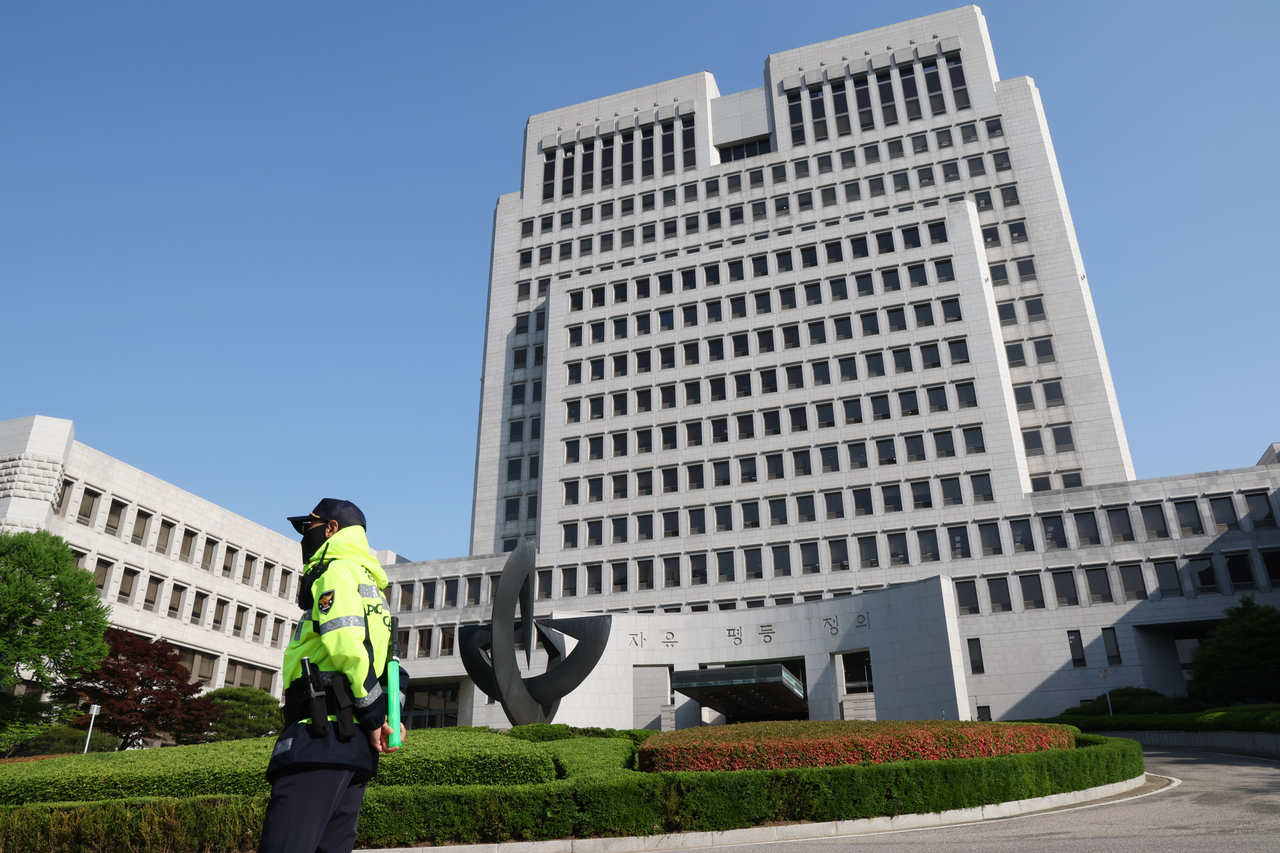
Judges are set to hold a rare nationwide meeting on Monday amid concerns over judicial independence sparked by the Supreme Court's recent ruling in presidential candidate Lee Jae-myung's election law violation.
According to the National Association of Judges, the representatives of South Korea's courts were asked to attend the special meeting and address suspicions over the court’s political neutrality and allegations that the judiciary has suffered damage.
The first major issue on the agenda is the association’s commitment to upholding the fairness of trials by monitoring the legal procedures in Lee’s case, analyzing the causes of the ongoing controversy, and discussing measures to resolve it.
The second issue up for discussion is whether judicial independence was undermined by the Democratic Party of Korea’s lawmaker-led decision to summon and investigate Supreme Court Chief Justice Jo Hee-de.
The meeting, which takes place about a week before the June 3 presidential election, is also expected to address ongoing criticism of the Supreme Court’s unusually swift handling of Lee’s election law violation case — including its expedited appeal trial and selective review of the lengthy case record — which raised doubts about the court’s political neutrality.
Controversy surrounding this case has been growing since the Supreme Court moved to review it in a full bench session on April 22.
The justices held their first hearing in the case on the same day it was assigned to the court. A second hearing followed just two days later, on April 24. This is an unusually swift move for cases referred to the full court, which typically convenes only once a month.
The controversy intensified on May 1, when the Supreme Court ruled to overturn Lee’s acquittal and sent the case back to the Seoul High Court for retrial, citing legal errors in the lower court’s decision.
Some liberal lawmakers and judges claimed that Jo’s alleged misconduct led to the unusually swift ruling and public distrust in the judiciary, but conservative politicians and former presidents of the Korean Bar Association argued that the top court handled the election law case promptly and lawfully, adding that holding the chief justice accountable for individual rulings threatens judicial independence.
Monday's meeting will also address a broad set of concerns, including the Democratic Party’s public call for Chief Justice Cho Hee-de’s resignation, and its push for various legislative measures, such as expanding the number of Supreme Court justices and introducing retrial petitions.
These moves have raised concerns that judicial independence is being undermined.
However, it remains uncertain whether a vote on the agenda will be possible at the meeting, as some 70 judges reportedly opposed holding the meeting.
The meeting also cannot be convened if a majority of the judges association's members do not attend.
The 125-member association decided to hold the meeting after the condition of consent from at least one-fifth of its members was met in early May.
Resolutions are passed when they receive a majority vote from the attending members.
Some in the legal community reportedly made an online post on the court’s intranet suggesting that the meeting be delayed until after the presidential election, fearing that it could be interpreted as a political move.
The meeting is set to take place at the Judicial Research and Training Institute in Goyang, Gyeonggi Province, at 10 a.m. on Monday.
sj_lee@heraldcorp.com


![[World Class] HUFS bets on Songdo, AI to redefine what a global university can do](https://wimg.heraldcorp.com/news/cms/2026/10/18/news-p.v1.20260930.7e4dbeacfc1d4d16848c0e2a441c04e6_R.jpg?type=h&h=120)
