
Seoul city government to inspect sites at risk of sinkhole formation
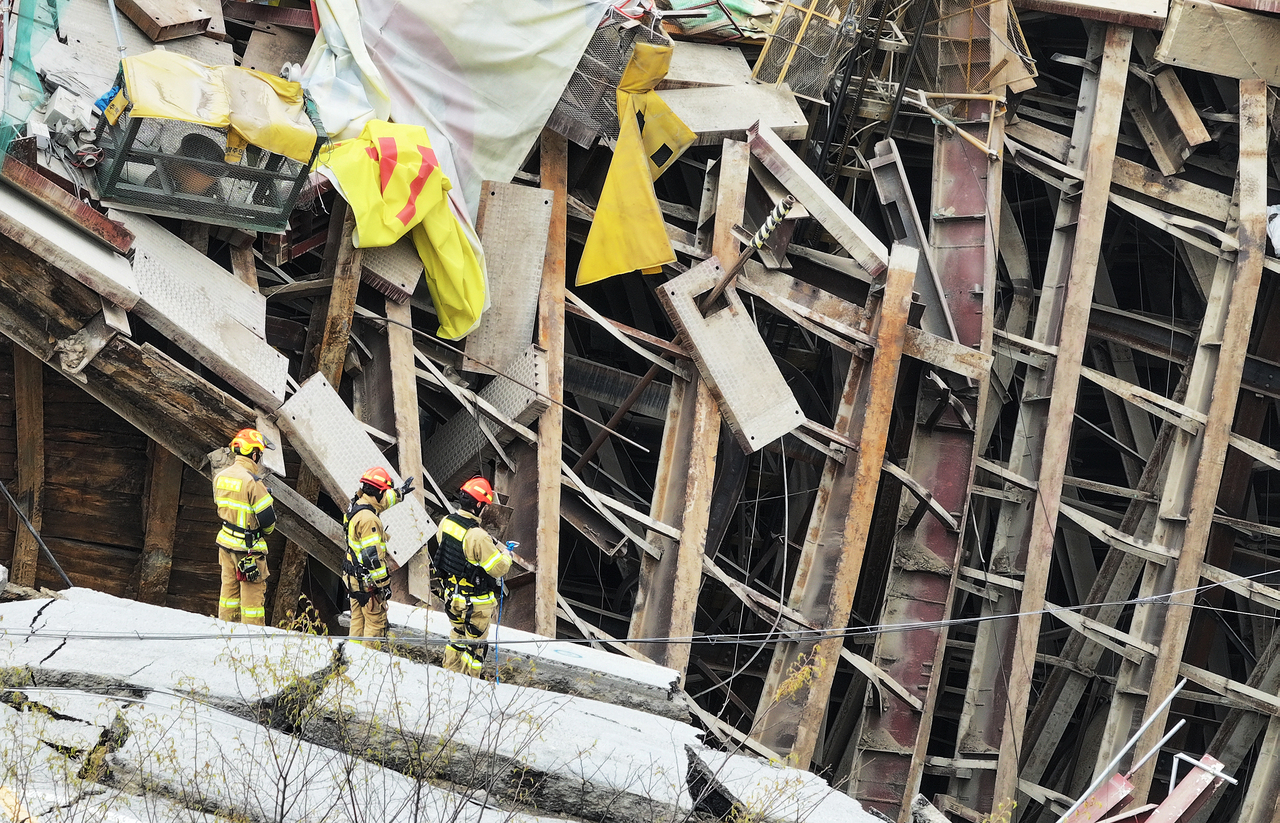
Although two days have passed since a subway construction site collapsed in Gwangmyeong, Gyeonggi Province, the cause of the accident remains unidentified, with rescue workers still grappling with the search for a missing laborer.
While possible structural defects and unstable ground conditions have been cited by experts, attention is turning to broader concerns about underground construction safety, prompting the capital city to expand large-scale safety inspections to dozens of excavation sites.
Authorities stated Saturday that they would begin inspections at the site to determine the cause of the accident once the missing worker is found. The worker has remained unaccounted for since the incident on Friday afternoon. Another person who was trapped in the collapse was rescued in the early hours of Saturday.
The rescue operation resumed at 2:10 p.m. Sunday, one day after it was suspended due to the risk of soil collapse following heavy rain.
"After conducting situational assessment tests with civil engineering and geological experts, it was determined to be safe to resume conducting search operations,” a Gwangmyeong Fire Station official told the press on Sunday.
A 600-unit apartment complex, an elementary school, and a church are located adjacent to the site.
The Gyeonggi Provincial Office of Education announced on Sunday that an elementary school located some 50 meters away from the collapse site will be temporarily closed on Monday and Tuesday to conduct safety inspections of the school grounds.
“As of now, there are no visible cracks in the school building or signs of uneven flooring. It appears that only a few cracks have formed on a part of the schoolyard adjacent to the (collapsed) road,” an official from the provincial education office told the press. “Academic schedules after Tuesday will be finalized later after conducting thorough safety inspections with the Ministry of Land, Infrastructure and Transport and other relevant agencies.”
Though the cause has yet to be announced by authorities, an initial situation report obtained by Rep. Moon Jin-seog of the Democratic Party of Korea from the Ministry of Land, Infrastructure and Transport offers some clues.
According to the report, damage to the central pillar of the underground tunnel’s "double arch" structure were observed by on-site workers at 9:50 p.m. on Thursday.
This was reported to Gwangmyeong City Hall hours later at midnight, and reinforcement work and safety inspections of the damaged pillar began at 7 a.m.
The tunnel then collapsed about eight hours later.
The report explained that the underground tunnel was being built using two separate arch-like structures within the same tunnel space to provide dual support and stability in challenging ground conditions.
“The double arch construction method is a common construction technique used to build underground structures such as tunnels, especially in urban environments where tunneling space is often constrained," architectural engineering professor Choi Chang-sik from Hanyang University told The Korea Herald.
Choi pointed out that it could be due to “several factors, but not due to the construction method" against that backdrop.
"Therefore, it doesn’t seem right to say that the construction method should be deemed at fault,” said Choi. “However, there may be other problems, such as structural issues leading to an increase in load and construction quality issues such as missing steel reinforcement."
Choi further explained that “besides issues in structure and quality, other problems such as the strength of the construction site’s foundations could also be at fault."
Although collapses of underground tunnels built using the double-arch method are rare, Friday’s incident is not the first to occur during construction. The Gurye Underground Tunnel in South Chungcheong Province saw two collapses during its construction, in November 2012 and July 2014.
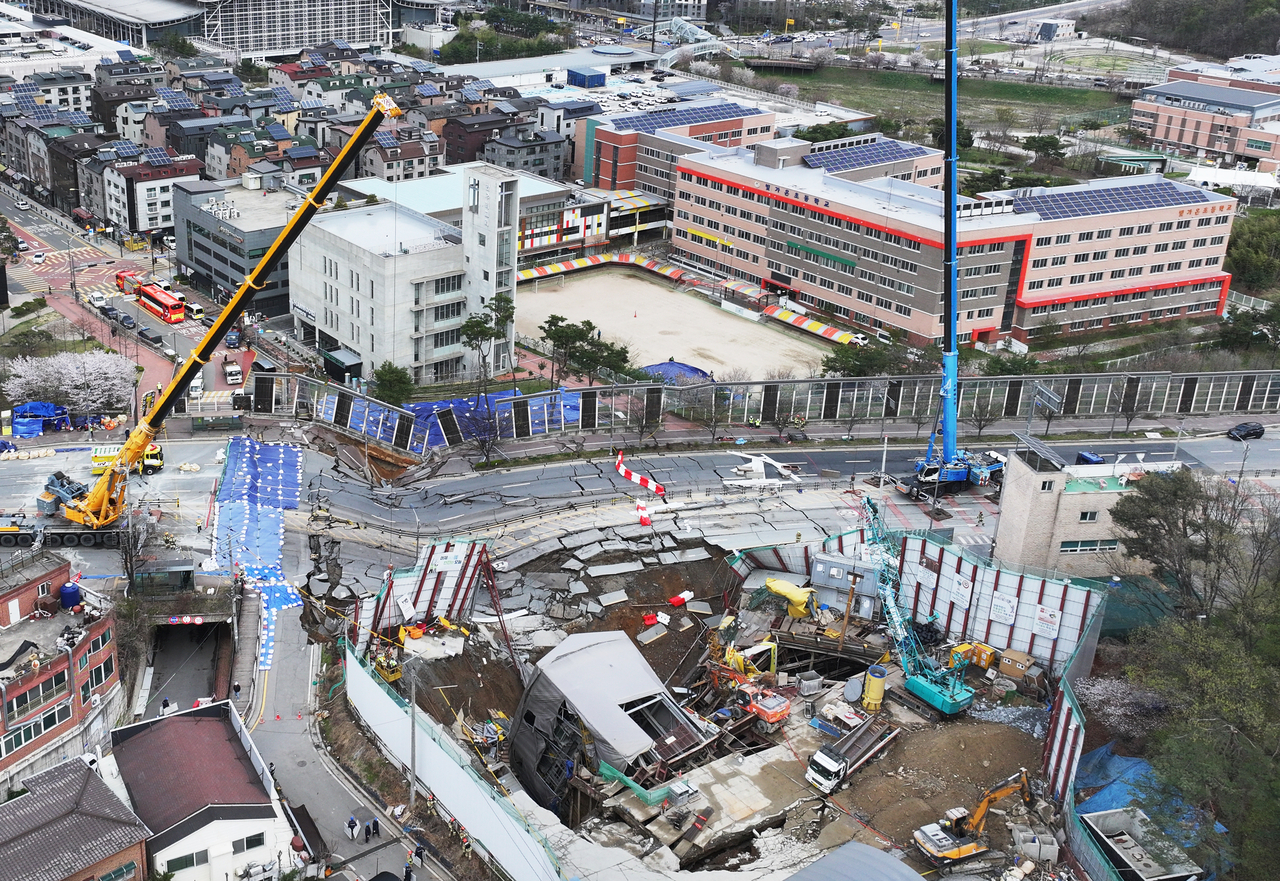
The Seoul Metropolitan Government also announced Sunday it will begin to conduct large-scale ground penetrating radar safety inspections of major underground excavation construction sites and surrounding areas.
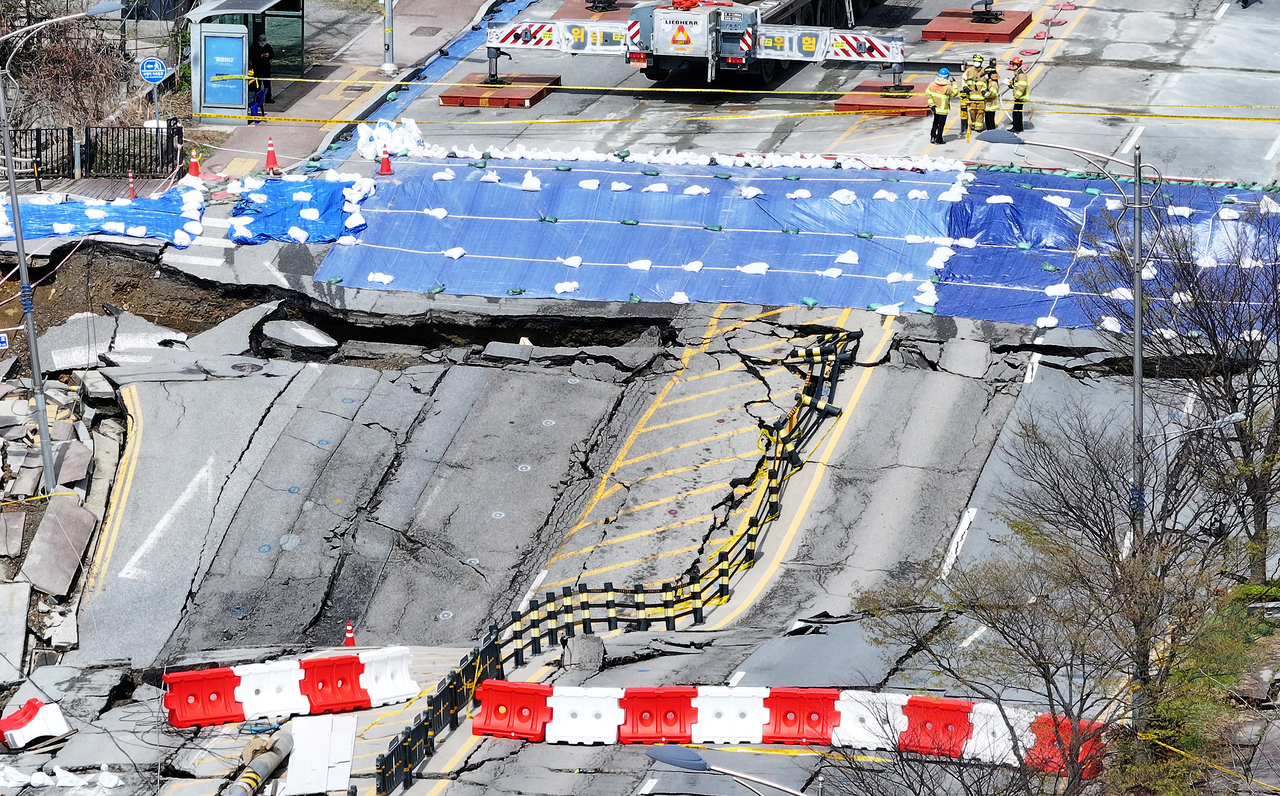
The city will first finish conducting GPR inspections at three railroad construction sites in Seoul, following the recent formation of a 20-meter-wide sinkhole near a subway line extension construction site in Gangdong-gu, eastern Seoul, on March 24.
By the end of April, the Seoul city plans to complete GPR inspections at 50 sites across the city seen as at risk of sinkhole formations, according to reports voluntarily submitted by eight district offices in late 2024.
According to the city government on April 8, Gwangjin-gu in eastern Seoul had the greatest risk in ground subsidence, with 22 locations identified. This was followed by Jongno-gu in central Seoul with nine identified locations and Geumcheon-gu in western Seoul with seven identified locations. Seongdong-gu in eastern Seoul and Guro-gu in western Seoul were reported to have three each, while Nowon-gu in northern Seoul, Gangnam-gu in southern Seoul and Mapo-gu in western Seoul reported to have two each.
As for the 17 districts that did not submit such reports in 2024, the city government plans to ask the district offices to submit additional reports and carry out additional inspections based on those results.
lee.jungjoo@heraldcorp.com