Court’s efforts to craft message of social cohesion may have delayed verdict, law experts suggest
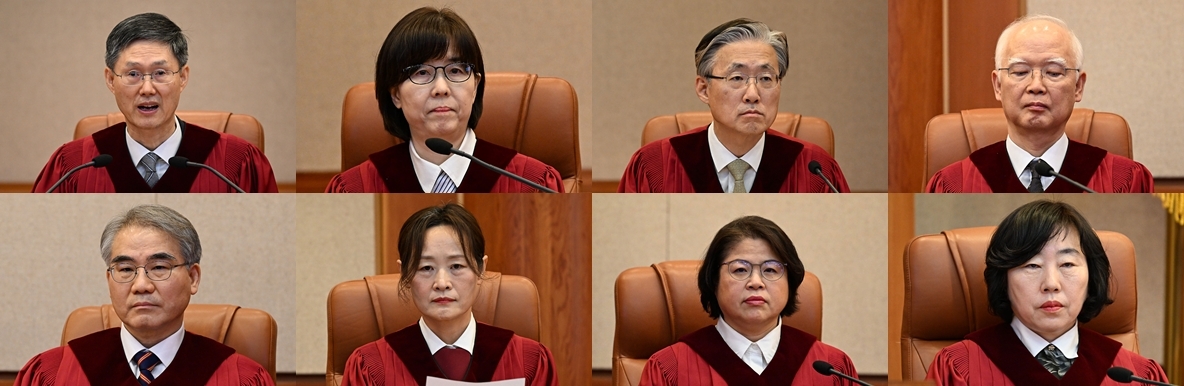
The Constitutional Court’s unanimous decision on Friday to remove former President Yoon Suk Yeol from office is drawing praise for more than its legal reasoning. In its ruling, the court delivered a powerful statement on the importance of democratic principles, calling for national unity and reaffirming core values vital to protecting a constitutional democracy.
The 114-page verdict was written in clear, accessible language — an aspect legal experts say reflects the court’s intention to speak directly to the public. Observers also suggest that the time taken to finalize the ruling may partly reflect the care taken to craft this message of integration and democratic responsibility.
"Justices have shown a willingness to rule unanimously that the outcome will not vary based on the ideological leanings -- whether progressive or conservative -- of each justice," said former constitutional researcher Roh Hee-beom.
Customarily, an impeachment verdict comprises a short conclusion with three to four sentences — this was true in the cases of former Presidents Roh Moo-hyun and Park Geun-hye and Prime Minister Han Duck-soo.
Instead, in Yoon’s verdict, the court detailed four different avenues Yoon should have pursued instead of using the armed forces, including seeking a political compromise within the institutional, political and judicial boundaries defined in the Constitution.
“It is difficult to see the conflict that arose between the defendant and the National Assembly as being the responsibility of one party, and this is a political issue that must be resolved in accordance with democratic principles. Expression of political views or public decision-making on this matter must be done within the scope that can be in harmony with democracy as guaranteed by the Constitution,” the verdict said.
In the verdict, the word “democracy” appears nine times, while “citizens” appears 13 times.
“Through a long period of deliberation and careful consideration, the decision was written in a logical and flexible manner that is easy for the public to understand, without being excessive. This respectful approach deserves praise,” the Korean Law Professors Society said in a statement.
Former Health Minister Ryu Si-min also commended the ruling for being written in “the language of everyday people,” which marked “a step forward” for the Constitutional Court.
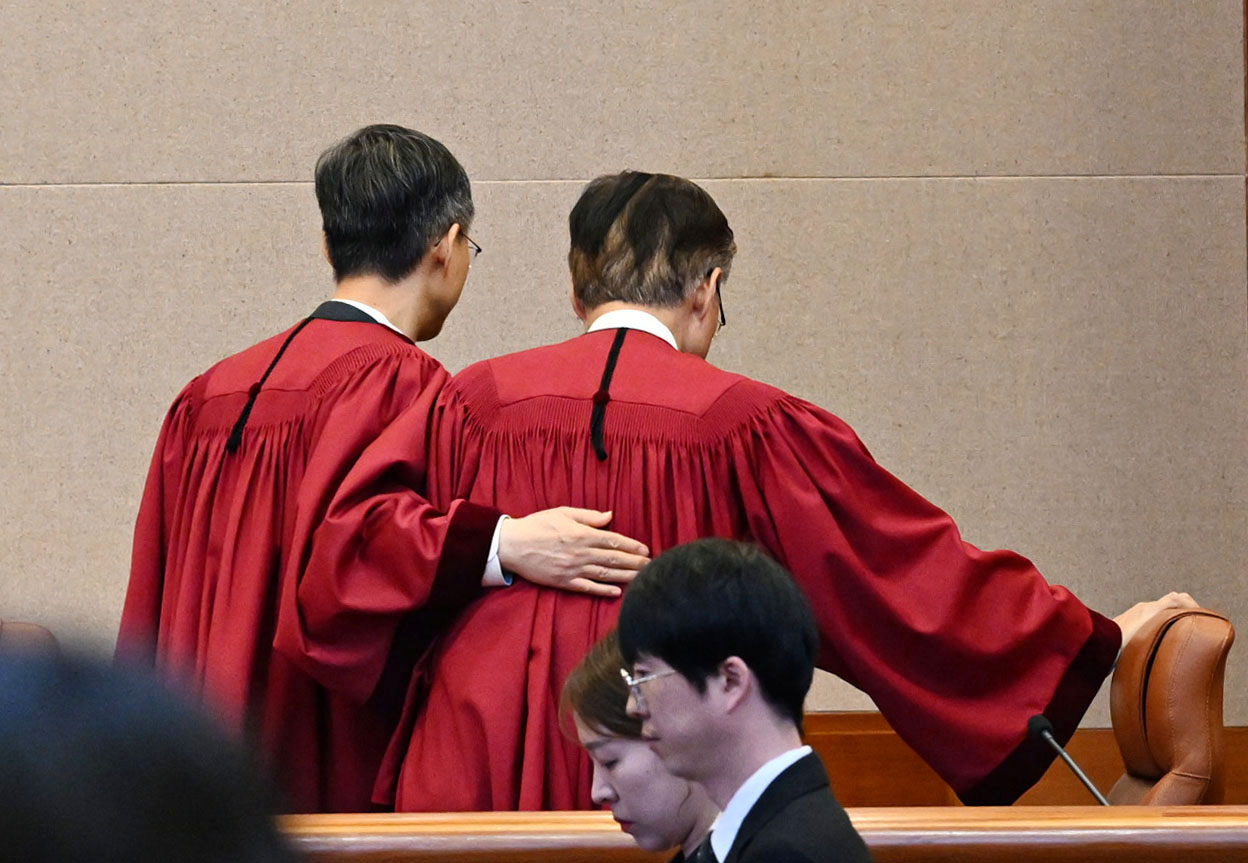
Likely to be remembered as one of the most challenging cases in South Korea’s constitutional history, Friday’s ruling came 122 days after Yoon declared martial law and ordered the armed forces to storm the National Assembly. It also marked the longest impeachment deliberation in the country’s history at 38 days.
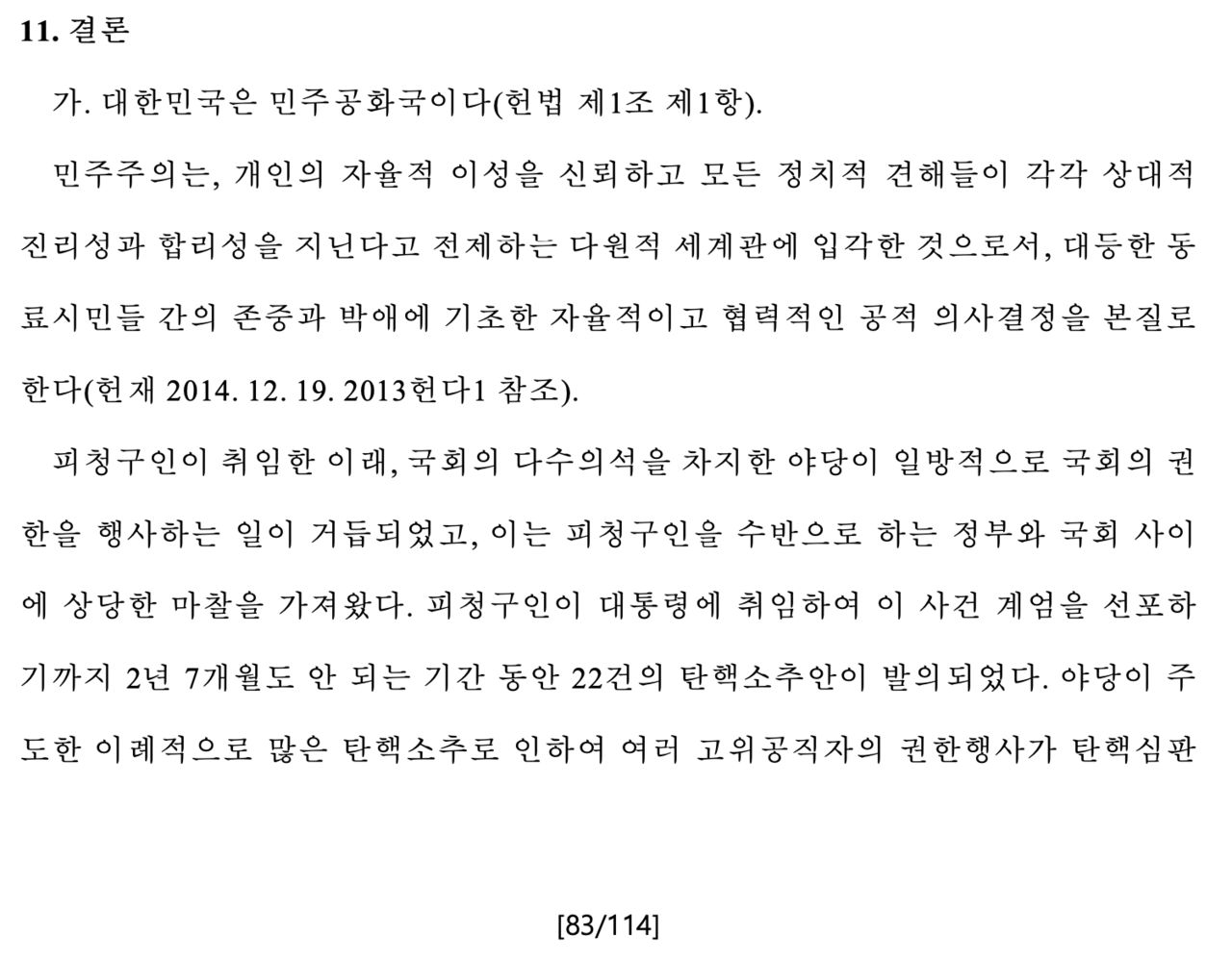
In the verdict's conclusion, the justices emphasized that the sovereign of a democratic republic is the Korean people.
Opening the conclusion, the justices cited Act 1, Clause 1 of the Constitution — “The Republic of Korea shall be a democratic republic” — with the following sentence defining the democratic system: “Democracy is based on a pluralistic worldview that trusts in the autonomous reason of individuals and assumes that all political views have relative truth and rationality, and is essentially based on cooperative public decision-making based on respect among equal fellow citizens.”
They concluded by stating how Yoon’s “unconstitutional and illegal acts are a betrayal of the people’s trust and constitute a serious violation of the law that cannot be tolerated from the perspective of protecting the Constitution.”
“As the president of all citizens, the defendant has a duty to unite society as a community beyond his support base. He failed to fulfill that duty,” the verdict read.
Following Friday's verdict, former President Yoon is set to leave the presidential residence in Hannam-dong, Yongsan-gu, Seoul, and return to his private residence in Seocho-gu where he lived before becoming president in 2022.
ddd@heraldcorp.com