

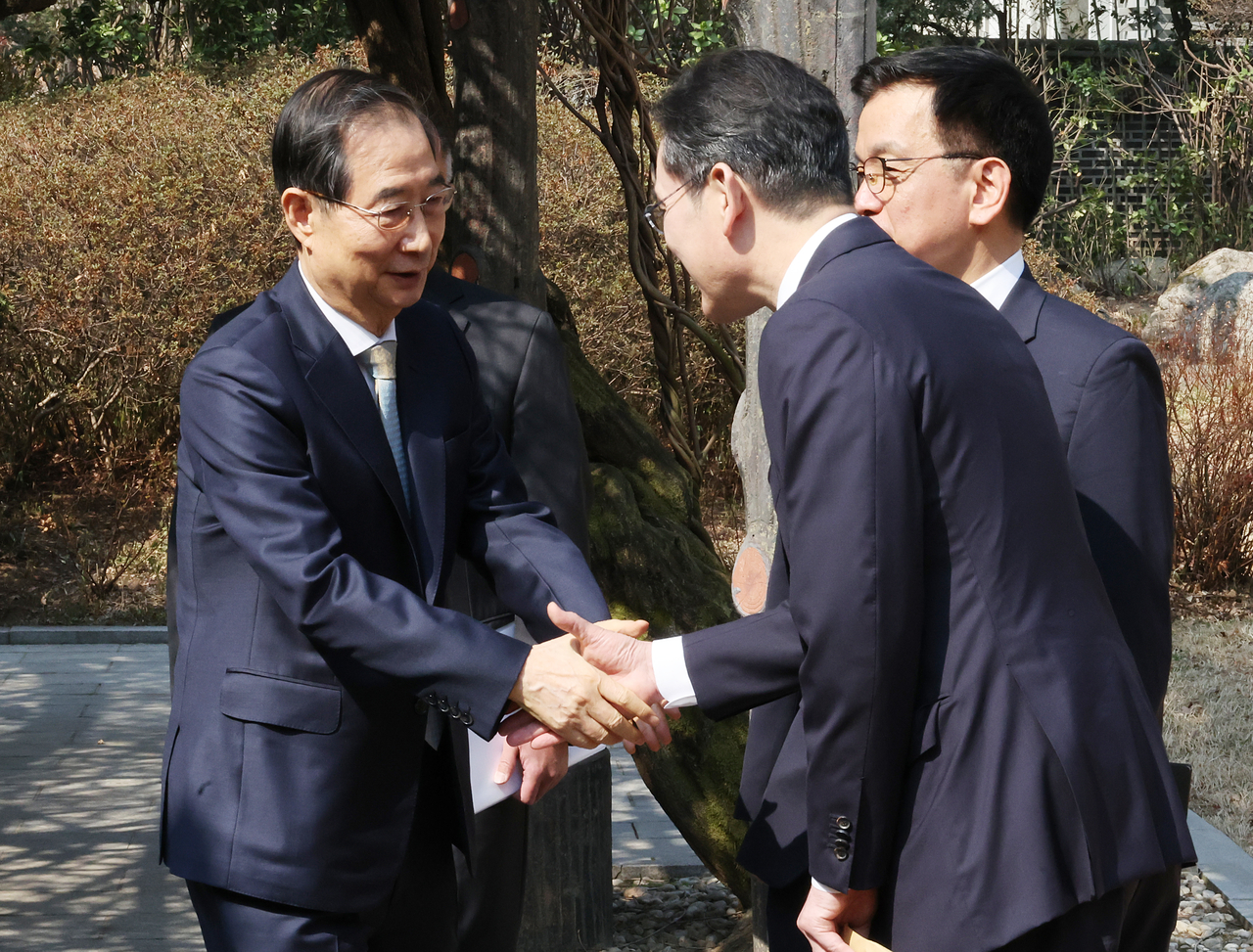
South Korea's acting President and Prime Minister Han Duck-soo on Tuesday vetoed an opposition-led revision of the Commercial Act that would have required corporate boards of directors to act in the interests of company shareholders.
It was the 41st veto exercised under the conservative Yoon Suk Yeol administration. Of those, Han vetoed seven bills as acting president.
At a Cabinet meeting in Seoul on Tuesday, Han expressed sympathy with the intent of the bill, which called for an expansion of corporate boards' fiduciary duty, but said the revision could have the side effect of undermining the competitive edge of most companies in South Korea, regardless of their size, in times of heightened uncertainty at home and abroad.
The bill "will have a negative impact on the national economy as a whole," Han said.
"Given that the bill could have a significant impact on the business environment and the competitiveness of most companies, we have determined that it is necessary to find an alternative that minimizes side effects through in-depth discussions," he also said.
Under the current Commercial Act, boards of directors are required to perform their duties in good faith and in the interest of the company, not necessarily that of its shareholders. This has drawn criticism that boardroom decisions have often disproportionately disadvantaged minority shareholders, if the interests of small shareholders contrast with those of controlling shareholders.
Those who fail to act in accordance with their fiduciary duties to the company by, for example, committing a breach of trust, face civil or criminal liabilities.
The liberal opposition parties have claimed that expanding the scope of fiduciary duties to shareholders would protect their rights.
Despite the good intentions of the revision, it failed to address certain ambiguities, which could hamper business activities of South Korean corporations, according to the acting president.
"Based only on the phrasing of the bill, it is difficult to tell which decisions fairly treat the interests of all shareholders," Han said. "Confusion may arise unexpectedly in corporate decision-making processes."
The revision passed the opposition-controlled parliament's plenary session on March 13 with a vote of 184-91.
Following Han's veto of the bill, Rep. Jo Seoung-lae, senior spokesperson of the main opposition Democratic Party of Korea said Han's veto is proof that Han is "a puppet of a group of people with vested interests."
"The revision is meant to protect the interests of minority shareholders and enhance corporate value. Only a handful of large conglomerates and the People Power Party are against it," Jo said.
The ruling People Power Party's Floor Leader Rep. Kweon Seong-dong said the party would work to prevent the bill from passing in a revote.
Kweon said the ruling bloc would come up with a separate bill to revise the Capital Markets Act so that the fiduciary duty expansion would apply only to thousands of listed companies, instead of a revision of the Commercial Act that would affect over 1 million companies. A revote of the vetoed bill requires at least 200 votes out of 300 lawmakers at the National Assembly. The ruling party has 108 lawmakers.
This was the latest development in the country struggling to cope with the long-standing phenomenon of South Korean stocks trading for relatively low prices compared to their valuations — the so-called "Korea Discount."
In a Facebook post on Monday, opposition leader Rep. Lee Jae-myung urged Han not to veto the Commercial Act revision. He added that behind the phenomenon was a lack of trust in South Korea's capital market, as observed in the gifting of Hanwha Group Chairman Kim Seoug-youn's shares to his three sons as part of the family succession plan, when the stock price was low Monday.
Meanwhile, at the Cabinet meeting, Han signed a pension reform bill into law, which will go into effect in January 2026.
The bill, which passed parliament on March 20 following a bipartisan compromise, stipulates that the mandatory pension scheme would see its pension contribution rate rise from 9 percent in 2025 to 13 percent in 2033. The income replacement rate -- which defines how much income would be paid out as a pension -- will rise to 43 percent of preretirement annual income starting in 2026. It marked the first pension reform in the country since 2007 to slow the pace of the pension fund's depletion.
Han, on the other hand, remained silent over the appointment of senior judge Ma Eun-hyuk as the Constitutional Court's ninth justice.
consnow@heraldcorp.com