
Verdict expected within 2 weeks
Suspended President Yoon Suk Yeol’s impeachment hearings was set to conclude on Tuesday, with Yoon arriving to deliver his final argument late into the evening to defend his Dec. 3 martial law declaration as legitimate and constitutional despite the accusations to the contrary.
He was the first president to defend himself in court in South Korea’s history.
Tuesday’s hearing was the 11th and final one after the Constitutional Court began with the first hearing on Jan. 14 amid heightened security measures. Concluding seven weeks of intense legal battles over whether to uphold the parliamentary vote impeaching him from office, the historic trial’s final hearing ended with both sides, Yoon and Rep. Jung Chung-rae, the Assembly’s Impeachment Committee chairperson, delivering closing arguments without time limits. Yoon's final arguments had not taken place as of press time.
The court is likely to deliver its ruling within two weeks, with the timing expected to be announced two or three days in advance. The verdict will be determined through a vote among its eight justices.
Since the court’s decision to uphold or overturn Yoon’s impeachment depends on the constitutionality and legality of his Dec. 3 martial law decree, the National Assembly’s legal team argued that Yoon’s decree failed to meet the legal requirements for declaring martial law.
One of the key issues in Yoon’s impeachment trial was his attempt to seize control of constitutional institutions, including the National Assembly and the National Election Commission, by mobilizing the military and police.
“If the state of emergency declared by Yoon were still in effect, what scenes would we be witnessing? Who can guarantee that a second or third state of emergency will not be declared?” Lee Gwang-beom, a lawyer from the National Assembly’s side asked during the hearing.
“On the night of Dec. 3, 2024, (Yoon) brutally trampled on the democratic constitutional order that the people of South Korea defended with their blood and lives.”
However, the president’s legal team argued that declaring martial law is the exclusive prerogative of a president. They claimed that South Korea was in a “national emergency” due to successive impeachment motions and budget cuts by the opposition parties, making the declaration lawful, according to them.
Yoon has argued that since the period of martial law ended peacefully with no one harmed, the impeachment motion should be dismissed.
The justices are expected to assess the credibility of key witness testimonies on major issues, including the procedural legitimacy of the Cabinet meeting on the day of the martial law declaration, alleged attempts to take over the National Assembly and the National Election Commission, and whether Yoon ordered the arrest of key political figures.
From the 4th to the 10th hearings, a total of 16 witnesses took the stand, many of them key military figures. In reviewing the facts, the justices are also expected to consider the testimonies of these current and former military officers to determine the constitutionality and legality of the martial law declaration.
The final ruling is expected around mid-March, approximately two weeks after the conclusion of Tuesday’s arguments, based on the previous impeachment cases of former Presidents Roh Moo-hyun and Park Geun-hye.
In ex-President Park’s impeachment trial, justices held deliberations on a daily basis, excluding holidays. The presiding justice drafted the verdict, summarized key issues and gathered the opinions of other justices, who expressed their individual views.
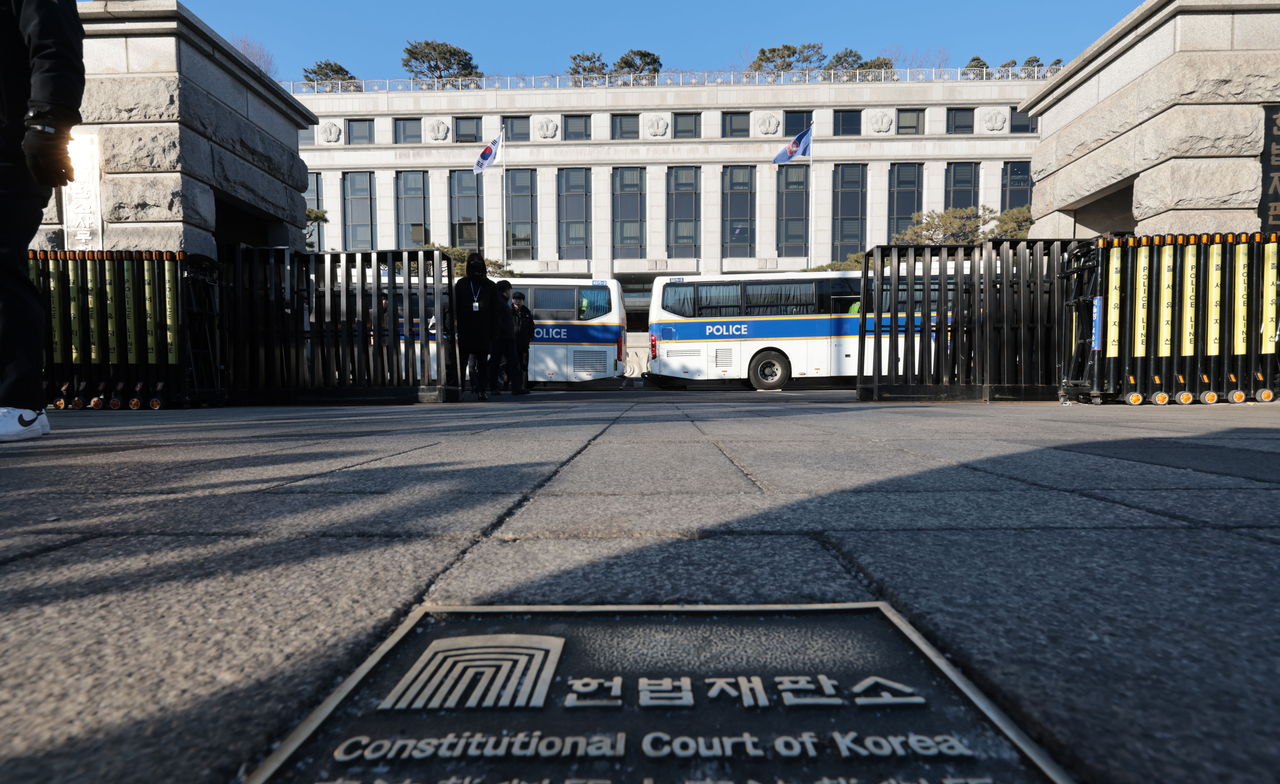
Meanwhile, police beefed up security in the court’s vicinity by dispatched more than 3,600 police officers from 60 units.
The roads and pedestrian streets were blocked with police buses that were used as barricades, as the area became extremely congested as both solo protests and anti-impeachment rallies by Yoon’s supporters were held simultaneously.
ddd@heraldcorp.com